Ueha Rumi, Ueha Satoshi, Kondo Kenji, Kikuta Shu, Yamasoba Tatsuya
Department of Otolaryngology and Head and Neck Surgery, Graduate School of Medicine, The University of Tokyo, Tokyo, Japan.
Division of Molecular Regulation of Inflammatory and Immune Diseases Research Institute for Biomedical Sciences, Tokyo University of Science, Chiba, Japan.
Front Aging Neurosci. 2018 Jun 13;10:183. doi: 10.3389/fnagi.2018.00183. eCollection 2018.
: Exposure to cigarette smoke is a cause of olfactory dysfunction. We previously reported that in young mice, cigarette smoke damaged olfactory progenitors and decreased mature olfactory receptor neurons (ORNs), then, mature ORNs gradually recovered after smoking cessation. However, in aged populations, the target cells in ORNs by cigarette smoke, the underlying molecular mechanisms by which cigarette smoke impairs the regenerative ORNs, and the degree of ORN regeneration after smoking cessation remain unclear. : To explore the effects of cigarette smoke on the ORN cell system using an aged mouse model of smoking, and to investigate the extent to which smoke-induced damage to ORNs recovers following cessation of exposure to cigarette smoke in aged mice. : We intranasally administered a cigarette smoke solution (CSS) to 16-month-old male mice over 24 days, then examined ORN existence, cell survival, changes of inflammatory cytokines in the olfactory epithelium (OE), and olfaction using histological analyses, gene analyses and olfactory habituation/dishabituation tests. : CSS administration reduced the number of mature ORNs in the OE and induced olfactory dysfunction. These changes coincided with an increase in the number of apoptotic cells and expression and a decrease in expression. Notably, the reduction in mature ORNs did not recover even on day 28 after cessation of treatment with CSS, resulting in persistent olfactory dysfunction. : In aged mice, by increasing ORN death, CSS exposure could eventually overwhelm the regenerative capacity of the OE, resulting in continued reduction in the number of mature ORNs and olfactory dysfunction.
接触香烟烟雾是嗅觉功能障碍的一个原因。我们之前报道过,在年轻小鼠中,香烟烟雾会损害嗅觉祖细胞并减少成熟嗅觉受体神经元(ORN),然后,成熟的ORN在戒烟后会逐渐恢复。然而,在老年人群中,香烟烟雾作用于ORN的靶细胞、香烟烟雾损害ORN再生的潜在分子机制以及戒烟后ORN再生的程度仍不清楚。
为了使用老年吸烟小鼠模型探索香烟烟雾对ORN细胞系统的影响,并研究老年小鼠在停止接触香烟烟雾后,烟雾诱导的ORN损伤恢复的程度。
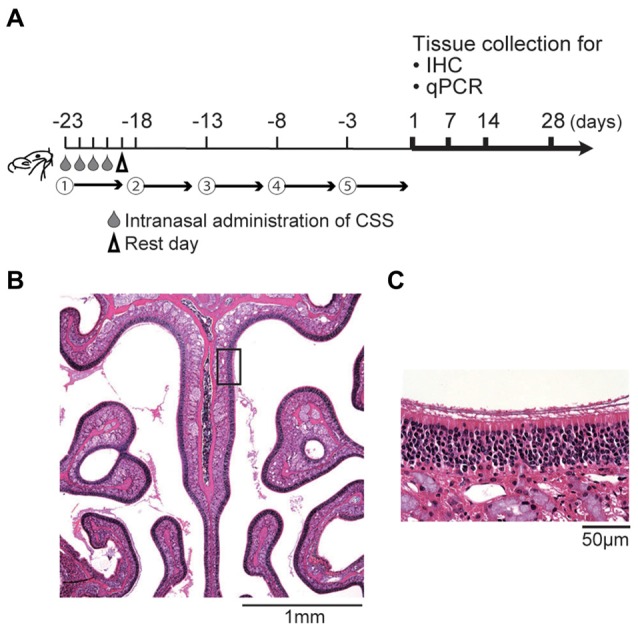
我们在24天内对16个月大的雄性小鼠鼻内给予香烟烟雾溶液(CSS),然后使用组织学分析、基因分析和嗅觉习惯化/去习惯化测试来检查ORN的存在、细胞存活、嗅觉上皮(OE)中炎性细胞因子的变化以及嗅觉。
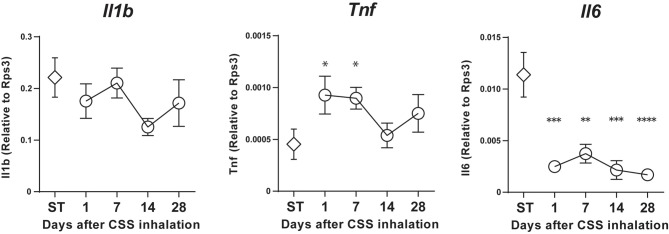
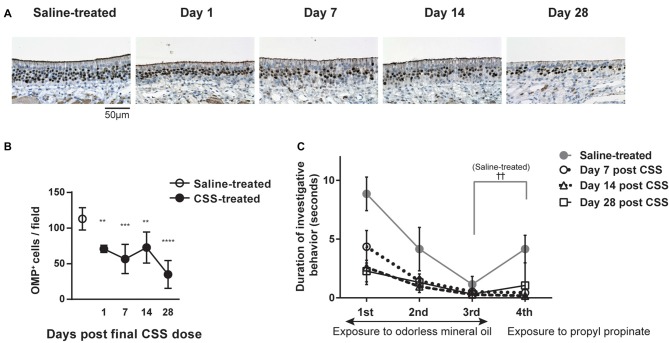
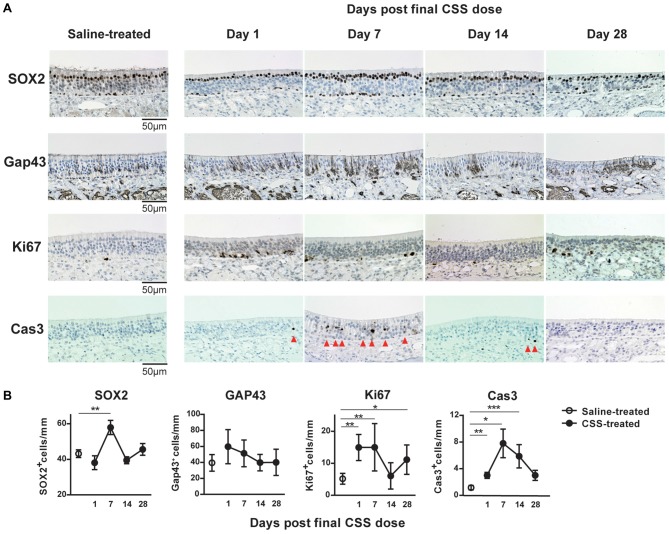
给予CSS会减少OE中成熟ORN的数量并导致嗅觉功能障碍。这些变化与凋亡细胞数量的增加以及[此处原文缺失两个基因相关内容]表达的增加和[此处原文缺失两个基因相关内容]表达的减少相一致。值得注意的是,即使在停止给予CSS后第28天,成熟ORN的减少仍未恢复,导致持续的嗅觉功能障碍。
在老年小鼠中,通过增加ORN死亡,接触CSS最终可能会超过OE的再生能力,导致成熟ORN数量持续减少和嗅觉功能障碍。