Nguyen Christopher M, Chen Kuan-Hua, Denburg Natalie L
Division of Cognitive Neuroscience, Department of Neurology, University of Iowa Carver College of Medicine, Iowa City, IA, United States.
Department of Psychiatry and Behavioral Sciences, University of Oklahoma Health Sciences Center, Oklahoma City, OK, United States.
Front Psychol. 2018 Jun 13;9:870. doi: 10.3389/fpsyg.2018.00870. eCollection 2018.
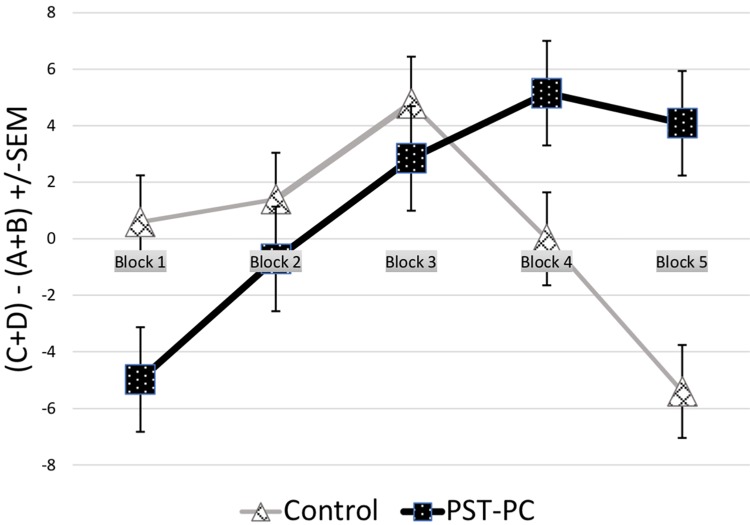
Some older adults who are cognitively healthy have been found to make poor decisions. The vulnerability of such older adults has been postulated to be the result of disproportionate aging of the frontal lobes that contributes to a decline in executive functioning abilities among some older adults. The purpose of this study was to investigate whether decision-making performance in older adults can be enhanced by a psychoeducational intervention. Twenty cognitively and emotionally intact persons aged 65 years and older were recruited and randomized into two conditions: psychoeducational condition [Problem-Solving Therapy for Primary Care (PST-PC)] and no-treatment Control group. Participants in the psychoeducational condition each received four 45-min sessions of PST-PC across a 2-week period. The Iowa Gambling Task (IGT) was administered as the outcome measure to the treatment group, while participants in the Control group completed the IGT without intervention. A significant interaction effect was observed between group status and the trajectory of score differences across trials on the IGT. Particularly, as the task progressed to the last 20% of trials, participants in the PST-PC group significantly outperformed participants in the Control group in terms of making more advantageous decisions. These findings demonstrated that a four-session problem-solving therapy can reinforce aspects of executive functioning (that may have declined as a part of healthy aging), thereby enhancing complex decision-making in healthy older adults.
一些认知健康的老年人被发现会做出糟糕的决策。据推测,这类老年人的易感性是额叶不成比例衰老的结果,这导致一些老年人的执行功能能力下降。本研究的目的是调查心理教育干预是否能提高老年人的决策表现。招募了20名65岁及以上认知和情绪健全的人,并将他们随机分为两组:心理教育组[初级保健问题解决疗法(PST-PC)]和无治疗对照组。心理教育组的参与者在两周内各接受了四次45分钟的PST-PC治疗。爱荷华赌博任务(IGT)作为治疗组的结果测量指标,而对照组的参与者在无干预的情况下完成IGT。在IGT上,观察到组状态与各试验得分差异轨迹之间存在显著的交互作用。特别是,随着任务进展到最后20%的试验,PST-PC组的参与者在做出更有利决策方面明显优于对照组的参与者。这些发现表明,为期四次的问题解决疗法可以强化执行功能的各个方面(这些方面可能作为健康衰老的一部分而下降),从而提高健康老年人的复杂决策能力。