Department of Psychology, University of Florida, Gainesville, FL, USA.
Pain Research and Intervention Center of Excellence, University of Florida, Gainesville, FL, USA.
Sci Rep. 2024 Jan 2;14(1):68. doi: 10.1038/s41598-023-50500-x.
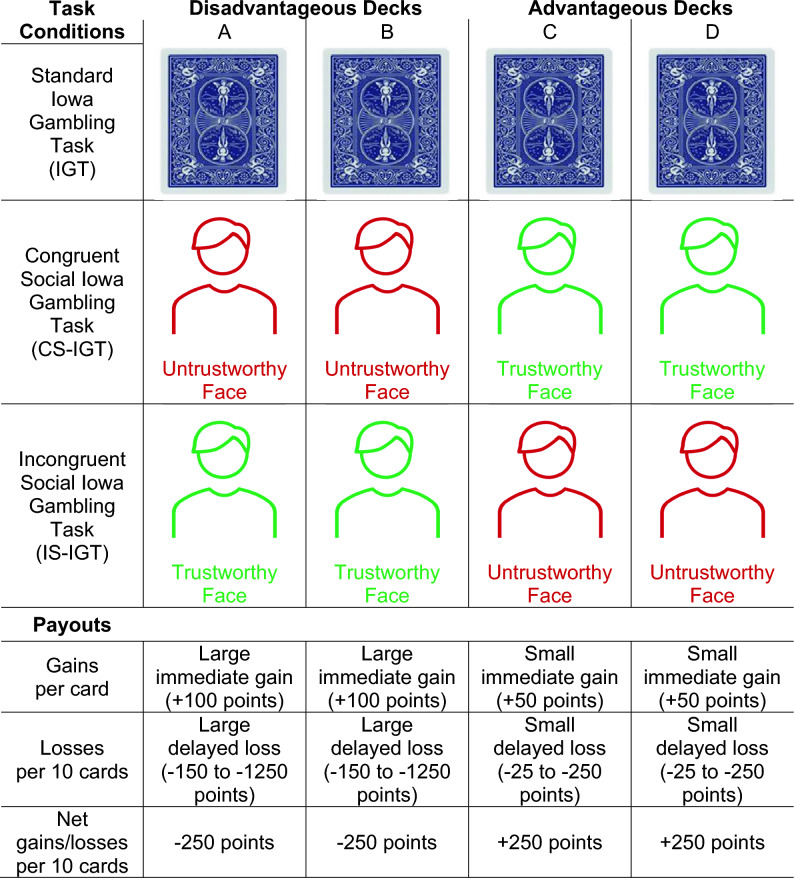
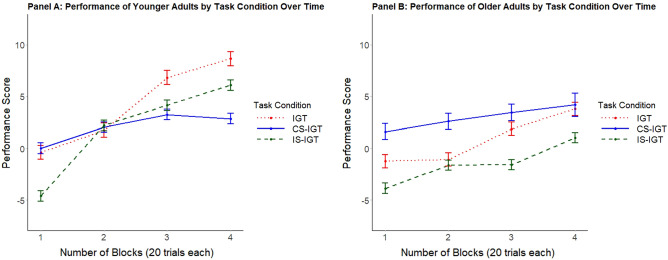
Facial impressions contribute to evaluations of trustworthiness. Older adults are especially vulnerable to trust violations, incurring risks for deception and exploitation. Using the newly developed social Iowa Gambling Task (S-IGT), we examined age-group differences in the impact of facial trustworthiness on decision-making and learning. In the congruent condition (CS-IGT), advantageous decks were paired with trustworthy faces and disadvantageous decks with untrustworthy faces. In the incongruent condition (IS-IGT), this pairing was reversed. Younger (n = 143) and older (n = 129) participants completed either the standard Iowa Gambling Task (IGT), CS-IGT, or IS-IGT. Both age groups preferred trustworthy faces in their initial choices. Older adults performed worse than younger adults across all tasks over time. Further, compared to younger adults, older adults performed worse on the IS-IGT, suggesting that incongruent facial cues interfered with older adults' performance, which aligns with reduced sensitivity to negative social reputations in aging. Multilevel modeling also indicated that age-group differences were most pronounced across all tasks in the last 40 trials. Together these findings suggest that differences between younger and older adults in experience-dependent decision-making are magnified in social contexts that involve a "wolf in sheep's clothing," which may reflect age-related difficulties in integrating incongruent information.
面部印象会影响人们对可信度的评价。老年人尤其容易受到信任的侵犯,从而面临欺骗和剥削的风险。我们使用新开发的社会 Iowa 赌博任务 (S-IGT) 研究了面部可信度对决策和学习的影响在不同年龄组之间的差异。在一致条件 (CS-IGT) 下,有利的牌组与可信的面孔配对,不利的牌组与不可信的面孔配对。在不一致条件 (IS-IGT) 下,这种配对被颠倒了。年轻组 (n=143) 和老年组 (n=129) 参与者分别完成了标准 Iowa 赌博任务 (IGT)、CS-IGT 或 IS-IGT。两个年龄组在最初的选择中都更喜欢可信的面孔。与年轻人相比,老年人在所有任务中随着时间的推移表现都更差。此外,与年轻人相比,老年人在 IS-IGT 上的表现更差,这表明不一致的面部线索干扰了老年人的表现,这与衰老过程中对负面社会声誉的敏感性降低一致。多层次模型还表明,在所有任务中,年龄组之间的差异在最后 40 次试验中最为明显。这些发现表明,在涉及“披着羊皮的狼”的社交情境中,年轻人和老年人在经验依赖型决策方面的差异会被放大,这可能反映了与年龄相关的整合不一致信息的困难。