Schott Nadja, Klotzbier Thomas J
Department of Sport and Exercise Science, University of Stuttgart, Stuttgart, Germany.
Front Psychol. 2018 Jun 13;9:947. doi: 10.3389/fpsyg.2018.00947. eCollection 2018.
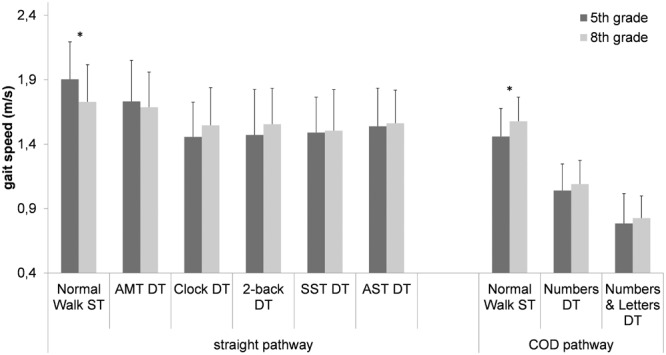
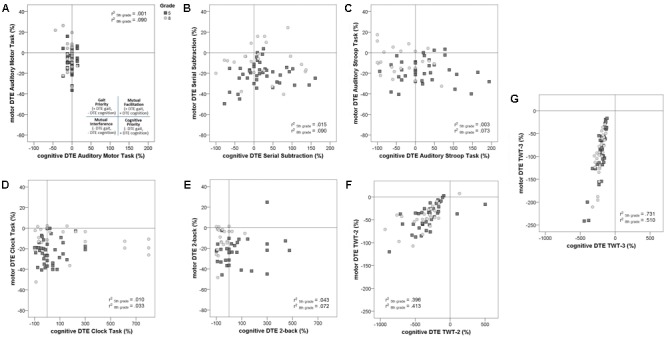
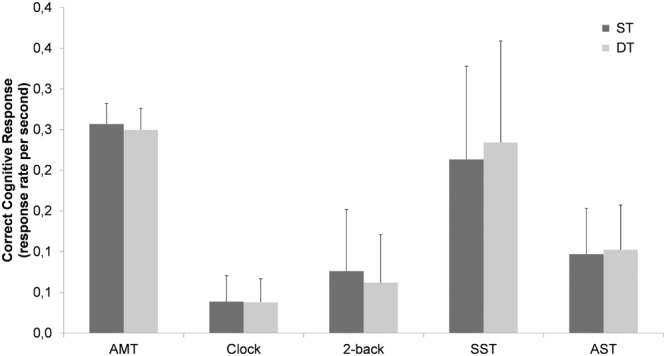
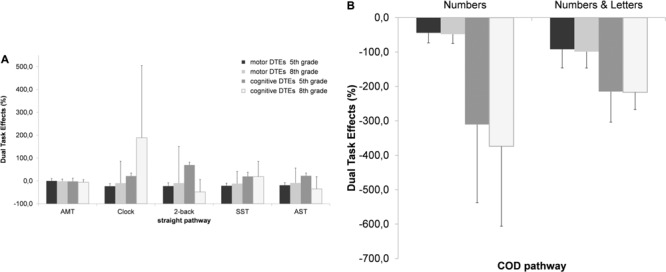
The evidence supporting the effects of age on the ability to coordinate a motor and a cognitive task show inconsistent results in children and adolescents, where the Dual-Task Effects (DTE) - if computed at all - range from either being lower or comparable or higher in younger children than in older children, adolescents and adults. A feasible reason for the variability in such findings is the wide range of cognitive tasks (and to some extend of motor tasks) used to study Cognitive-Motor Interference (CMI). Our study aims at determining the differences in CMI when performing cognitive tasks targeting different cognitive functions at varying walking pathways. 69 children and adolescents (boys, = 45; girls, = 24; mean age, 11.5 ± 1.50 years) completed higher-level executive function tasks (2-Back, Serial Subtraction, Auditory Stroop, Clock Task, TMT-B) in comparison to non-executive distracter tasks [Motor Response Task (MRT), TMT-A] to assess relative effects on gait during straight vs. repeated Change of Direction (COD) walking. DT during COD walking was assessed using the Trail-Walking-Test (TWT). The motor and cognitive DTE were calculated for each task. There were significant differences between 5th and 8th graders on single gait speed on the straight ( = 0.016) and the COD pathway ( = 0.023), but not on any of the DT conditions. The calculation of DTEs revealed that motor DTEs were lowest for the MRT and highest for the TWT in the numbers/letters condition ( < 0.05 for all comparisons). In contrast, there were cognitive benefits for the higher-order cognitive tasks on the straight pathways, but cognitive costs for both DT conditions on the COD pathway ( < 0.01 for all comparisons). Our findings demonstrate that DT changes in walking when completing a secondary task that involve higher-level cognition are attributable to more than low-level divided attention or motor response processes. These results specifically show the direct competition for higher-level executive function resources important for walking, and are in agreement with previous studies supporting the cognitive-motor link in relation to gait in children. This might be in line with the idea that younger children may not have adequate cognitive resources.
支持年龄对协调运动和认知任务能力产生影响的证据,在儿童和青少年中显示出不一致的结果,其中双任务效应(DTE)——如果进行计算的话——在年幼儿童中与年龄较大的儿童、青少年和成年人相比,范围从更低、相当到更高。这些研究结果存在差异的一个可行原因是,用于研究认知 - 运动干扰(CMI)的认知任务(以及在某种程度上的运动任务)范围广泛。我们的研究旨在确定在不同步行路径上执行针对不同认知功能的认知任务时,CMI的差异。69名儿童和青少年(男孩45名;女孩24名;平均年龄11.5±1.50岁)完成了高级执行功能任务(2 - 回溯、连续减法、听觉斯特鲁普、时钟任务、TMT - B),并与非执行干扰任务[运动反应任务(MRT)、TMT - A]进行比较,以评估在直线行走与重复变向(COD)行走过程中对步态的相对影响。使用轨迹行走测试(TWT)评估COD行走过程中的双任务。计算每个任务的运动和认知DTE。五年级和八年级学生在直线(p = 0.016)和COD路径(p = 0.023)上的单一步态速度存在显著差异,但在任何双任务条件下均无差异。DTE的计算表明,在数字/字母条件下,运动DTE在MRT时最低,在TWT时最高(所有比较p < 0.05)。相比之下,在直线路径上,高阶认知任务有认知益处,但在COD路径上的两种双任务条件下均有认知成本(所有比较p < = 0.01)。我们的研究结果表明,在完成涉及高级认知的次要任务时,行走中的双任务变化不仅仅归因于低水平的注意力分散或运动反应过程。这些结果具体显示了对行走重要的高级执行功能资源的直接竞争,并且与之前支持儿童步态中认知 - 运动联系的研究一致。这可能符合年幼儿童可能没有足够认知资源的观点。