Russell Hannah G, Tsao Jack W
Department of Neurology, University of Tennessee Health Science Center, Memphis, TN, United States.
Children's Foundation Research Institute, Le Bonheur Children's Hospital, Memphis, TN, United States.
Front Neurol. 2018 Jun 8;9:436. doi: 10.3389/fneur.2018.00436. eCollection 2018.
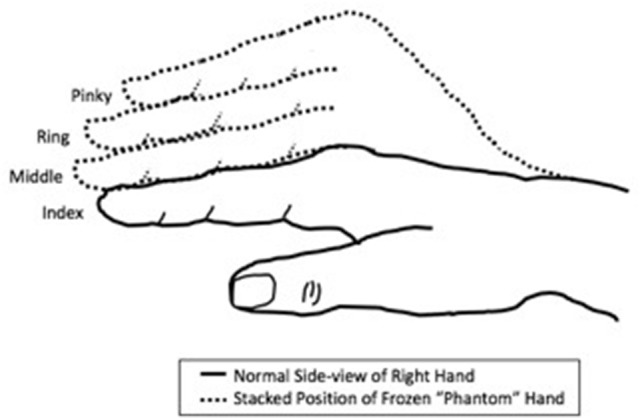
Following the administration of brachial plexus anesthesia for right thumb carpometacarpal arthroplasty with ligament reconstruction, a 54-year-old woman with all limbs intact developed phantom limb sensations, including the misperception of the placement of her right arm and frozen limb sensations in her fingers. Immobility of her fingers in a stacked position was experienced for ~3.5 days after surgery, and she described her phantom sensations as the hand experiencing "tingling" and feeling "heavy." While the onset of these phantom sensations occurred almost immediately after administration of brachial plexus anesthesia, they lasted for ~69 h after anesthesia wear off, suggesting that cortical effects from denervation resolves much more slowly than initial remapping, giving insight into the mechanisms behind phantom limb sensations that are often experienced by amputees.
在为一名54岁四肢健全的女性进行右侧拇指腕掌关节置换并韧带重建的臂丛神经麻醉后,她出现了幻肢感觉,包括对右臂位置的错误感知以及手指的肢体冻结感。术后约3.5天,她的手指呈堆叠状无法活动,她将幻肢感觉描述为手部有“刺痛感”且感觉“沉重”。虽然这些幻肢感觉几乎在臂丛神经麻醉后立即出现,但在麻醉消退后仍持续了约69小时,这表明去神经支配的皮质效应比最初的重新映射消退得要慢得多,这为截肢者经常经历的幻肢感觉背后的机制提供了见解。