Ebadi Fardaza Farbod, Heidari Hassan, Solhi Mahnaz
Health Promotion Research Center, Iran University of Medical Sciences, Tehran, Iran.
Department of Health Services and Health Education, School of Health, Iran University of Medical Sciences, Tehran, Iran.
Med J Islam Repub Iran. 2017 Dec 21;31:116. doi: 10.14196/mjiri.31.116. eCollection 2017.
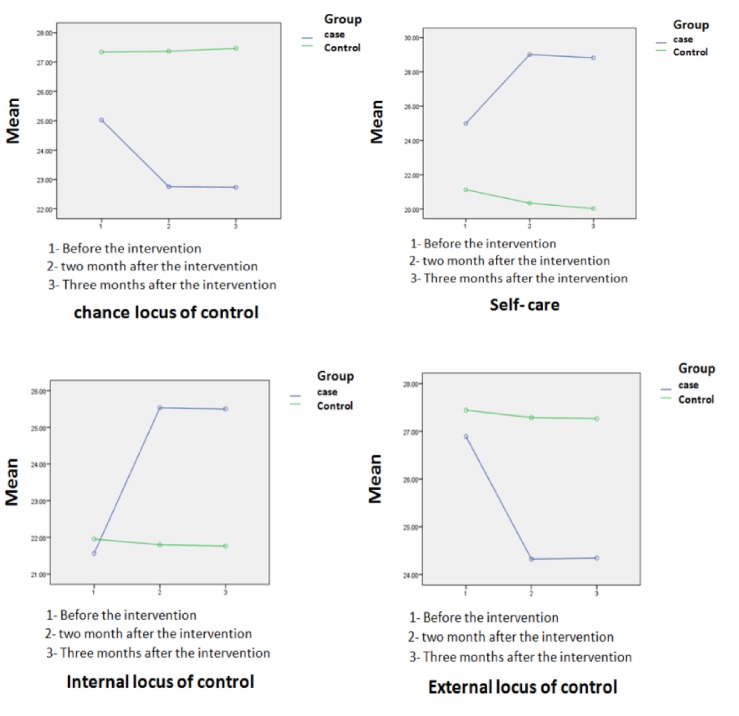
Different factors, such as personality and psychological characteristics, are effective in the self-care and control of diabetes. This study aimed at determining the effect of educational intervention based on locus of control structure of attribution theory on the self-care behavior of patients with type II diabetes. This was a quasi-experimental controlled study performed on 180 patients in Babol Diabetes Association. The sampling method was simple random sampling. Data collection tool was form C of standard questionnaire in multidimensional health locus of control (MHLC) and summary of diabetes self-care activities (SDSCA). Based on the results obtained from the initial completion of the questionnaires, educational intervention was designed as three 60-minute educational sessions using short lectures, question and answer, group discussions, and consultation methods, as well as educational materials, such as films, posters, and pamphlets. Intervention was only performed for the test group. The questionnaires were filled out again 2 and 3 months after the intervention. Before the intervention, there was no significant difference in the mean scores of self-care, internal, chance, and external locus of control between the 2 groups. However, 2 to 3 months after the intervention, the mean scores of self-care (p<0.001) and locus of control (p<0.001) increased in the test group. Moreover, the mean score of chance (p<0.001) and external (p<0.001) locus of control decreased significantly. Educational intervention decreases the mean scores of chance and external locus of control and increases the mean score of internal locus of control; as a result, it improves self-care in patients with diabetes.
不同因素,如个性和心理特征,在糖尿病的自我护理和控制中发挥着作用。本研究旨在确定基于归因理论控制点结构的教育干预对II型糖尿病患者自我护理行为的影响。这是一项在巴博尔糖尿病协会对180名患者进行的准实验对照研究。抽样方法为简单随机抽样。数据收集工具为多维健康控制点(MHLC)标准问卷的C表和糖尿病自我护理活动总结(SDSCA)。根据问卷初次填写获得的结果,教育干预设计为使用简短讲座、问答、小组讨论和咨询方法以及电影、海报和宣传册等教育材料进行的三次60分钟教育课程。干预仅在试验组进行。干预后2个月和3个月再次填写问卷。干预前,两组在自我护理、内控、机遇和外控的平均得分上无显著差异。然而,干预后2至3个月,试验组的自我护理平均得分(p<0.001)和控制点平均得分(p<0.001)有所提高。此外,机遇(p<0.001)和外控(p<0.001)的平均得分显著降低。教育干预降低了机遇和外控的平均得分,提高了内控的平均得分;因此,它改善了糖尿病患者的自我护理。