Department of Anesthesiology, Shenzhen Maternity and Child Healthcare Hospital, Southern Medical University, Shenzhen, Guangdong 518028, China.
Biomed Res Int. 2018 May 23;2018:2708175. doi: 10.1155/2018/2708175. eCollection 2018.
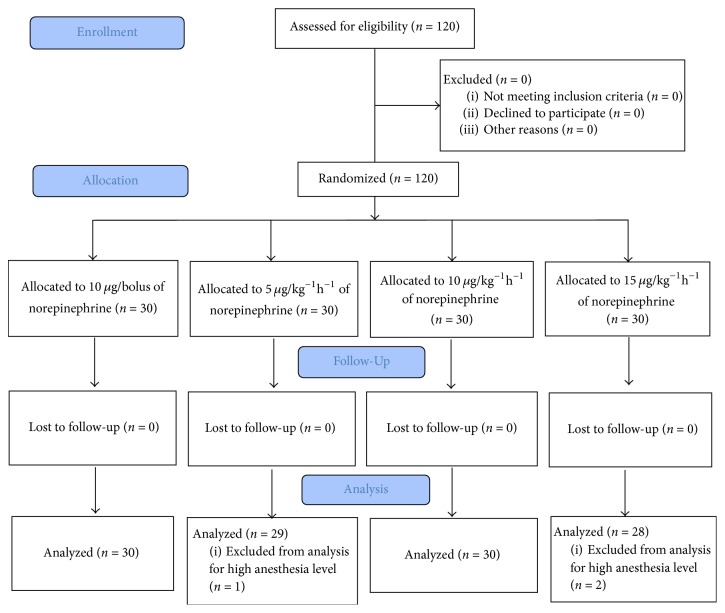
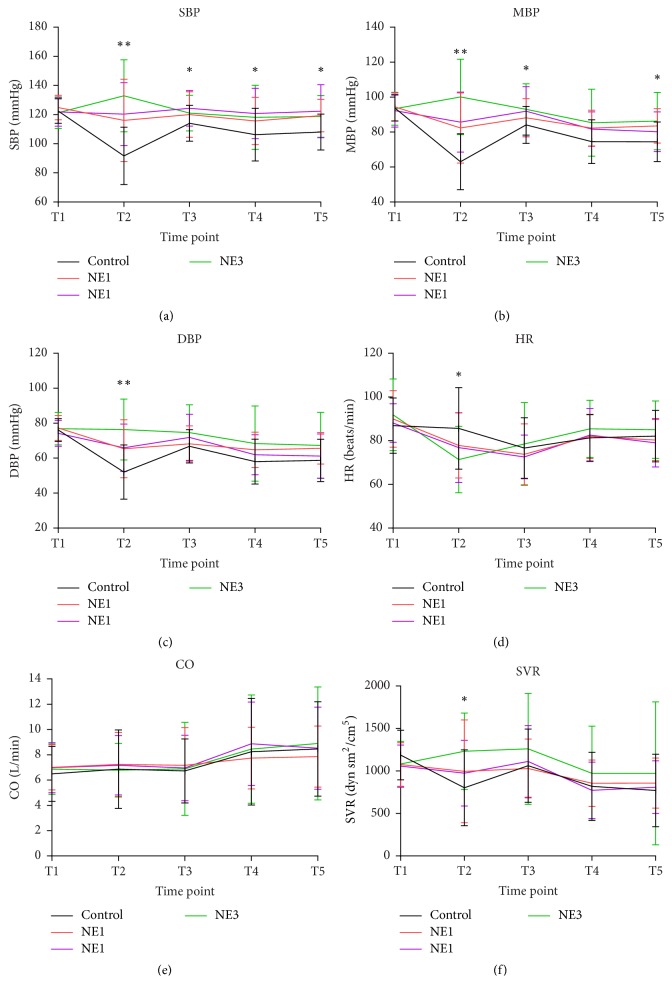
The aim of this paper is to evaluate the efficacy and safety of three different norepinephrine dosing regimens for preventing spinal hypotension in cesarean section. In this randomized double-blinded controlled study, 120 parturients scheduled for elective section delivery under spinal anesthesia were assigned to 1 of 4 groups. In the control group, patients received saline infusion. In three norepinephrine groups, the infusion dosage regimens were 5, 10, and 15 g/kg/h, respectively. Hypotension was treated with a rescue bolus of 10 g norepinephrine. The study protocol was continued until the end of surgery. The primary outcome was the proportion of participants that underwent hypotension. The proportion of hypotension participants was significantly reduced in the norepinephrine groups (37.9%, 20%, and 25%, respectively) compared to that in the control group (86.7%). However, the highest dose of norepinephrine (15 g/kg/h) resulted in more hypertension episodes. In addition, blood pressure was better maintained in the norepinephrine 5 g/kg/h and 10 g/kg/h groups than in the control group and 15 g/kg/h group. No significant differences in other hemodynamic variables, adverse effects, maternal and neonatal blood gases, or Apgar scores were observed among the groups. In summary, for patients who undergo cesarean delivery under spinal anesthesia, infusion of 5-10 g/kg/h norepinephrine was effective to reduce hypotension incidence without significant adverse effects on maternal and neonatal outcomes. Clinical Trial Registration Number is ChiCTR-INR-16009452.
本文旨在评估三种不同去甲肾上腺素剂量方案预防剖宫产术中脊髓低血压的疗效和安全性。在这项随机双盲对照研究中,将 120 例行脊髓麻醉下择期剖宫产的产妇分为 4 组。在对照组中,患者给予生理盐水输注。在三个去甲肾上腺素组中,输注剂量方案分别为 5、10 和 15μg/kg/h。低血压用 10μg去甲肾上腺素抢救性推注治疗。研究方案持续到手术结束。主要结局是接受低血压治疗的参与者比例。与对照组(86.7%)相比,去甲肾上腺素组(分别为 37.9%、20%和 25%)的低血压参与者比例显著降低。然而,去甲肾上腺素的最高剂量(15μg/kg/h)导致更多的高血压发作。此外,与对照组和 15μg/kg/h 组相比,去甲肾上腺素 5μg/kg/h 和 10μg/kg/h 组的血压更好地维持。各组间其他血流动力学变量、不良反应、母儿血气和 Apgar 评分无显著差异。总之,对于接受脊髓麻醉下剖宫产的患者,输注 5-10μg/kg/h 的去甲肾上腺素可有效降低低血压发生率,且对母婴结局无显著不良影响。临床试验注册号为 ChiCTR-INR-16009452。