Department of Psychology, Cognitive Neuroscience Research Unit, City, University of London, London EC1V 0HB, United Kingdom.
Sobell Department of Motor Neuroscience and Movement Disorders, UCL Institute of Neurology, University College London, London WC1N 3BG, United Kingdom.
eNeuro. 2018 Jun 26;5(3). doi: 10.1523/ENEURO.0159-18.2018. eCollection 2018 May-Jun.
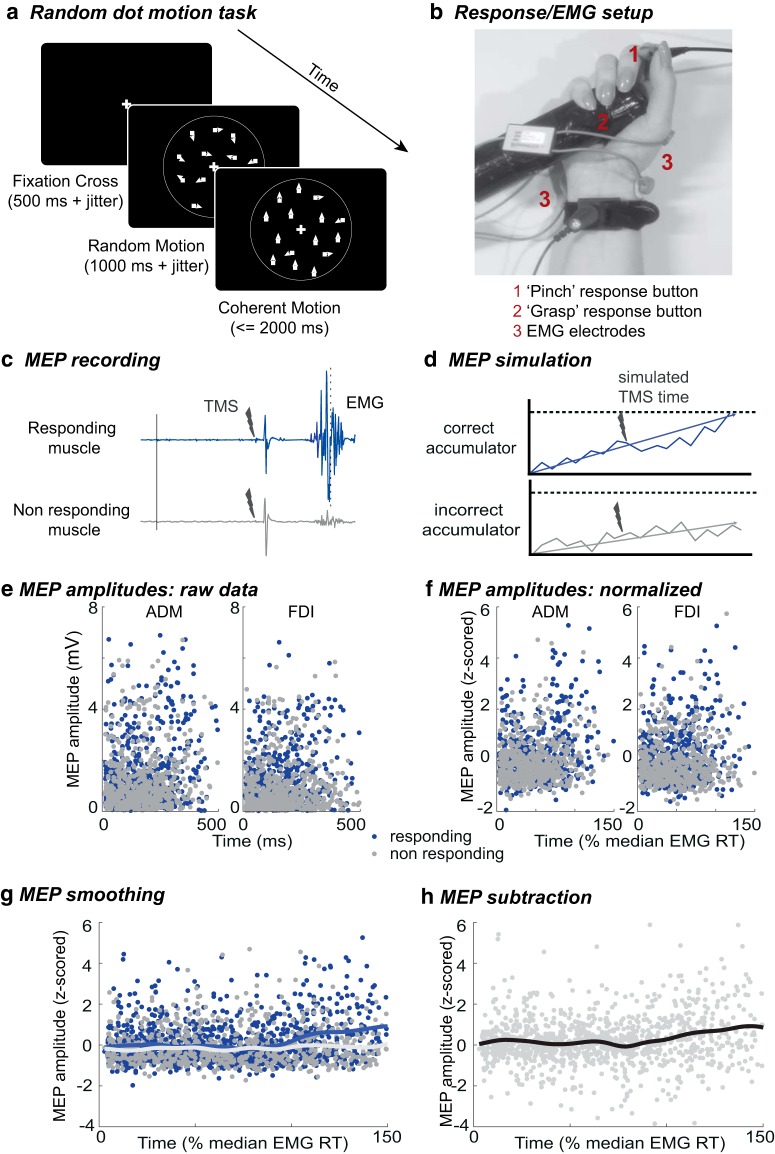
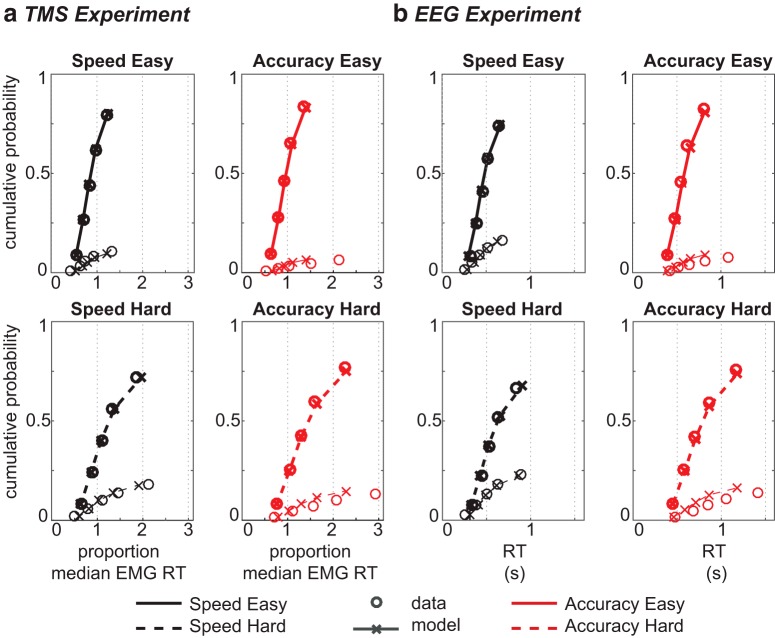
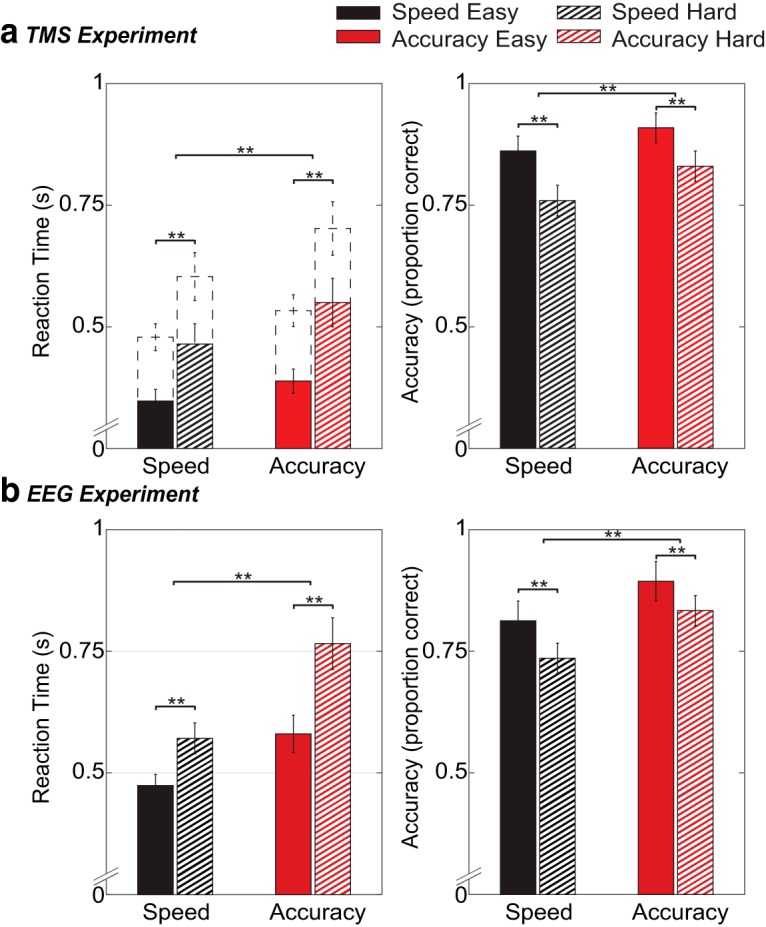
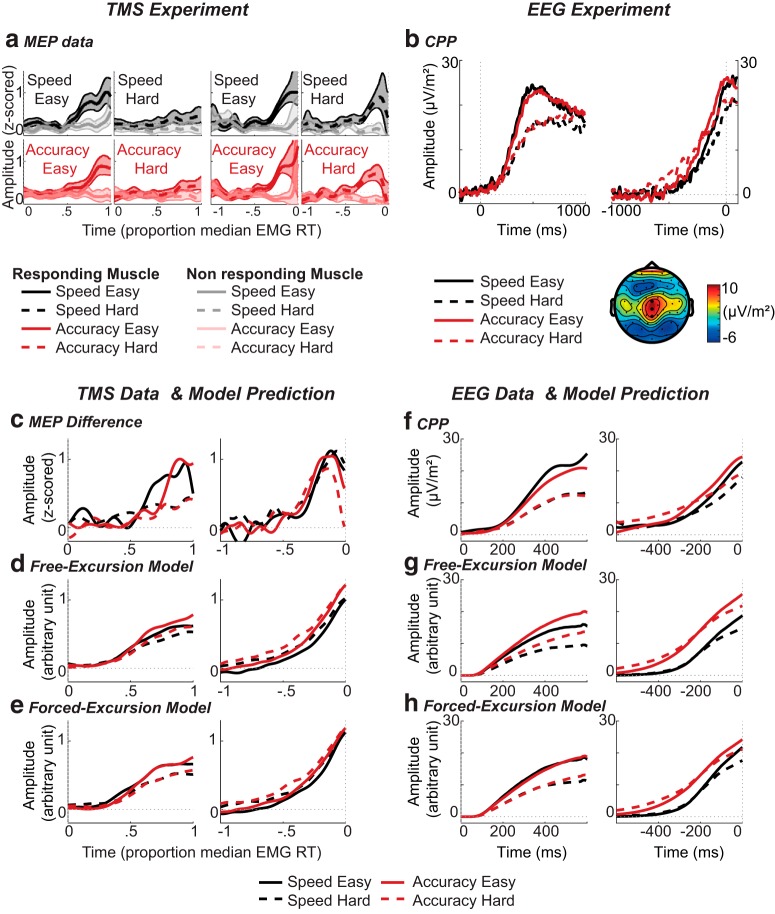
Evolutionary pressures suggest that choices should be optimized to maximize rewards, by appropriately trading speed for accuracy. This speed-accuracy tradeoff (SAT) is commonly explained by variation in just the baseline-to-boundary distance, i.e., the excursion, of accumulation-to-bound models of perceptual decision-making. However, neural evidence is not consistent with this explanation. A compelling account of speeded choice should explain both overt behavior and the full range of associated brain signatures. Here, we reconcile seemingly contradictory behavioral and neural findings. In two variants of the same experiment, we triangulated upon the neural underpinnings of the SAT in the human brain using both EEG and transcranial magnetic stimulation (TMS). We found that distinct neural signals, namely the event-related potential (ERP) centroparietal positivity (CPP) and a smoothed motor-evoked potential (MEP) signal, which have both previously been shown to relate to decision-related accumulation, revealed qualitatively similar average neurodynamic profiles with only subtle differences between SAT conditions. These signals were then modelled from behavior by either incorporating traditional boundary variation or utilizing a forced excursion. These model variants are mathematically equivalent, in terms of their behavioral predictions, hence providing identical fits to correct and erroneous reaction time distributions. However, the forced-excursion version instantiates SAT via a more global change in parameters and implied neural activity, a process conceptually akin to, but mathematically distinct from, urgency. This variant better captured both ERP and MEP neural profiles, suggesting that the SAT may be implemented via neural gain modulation, and reconciling standard modelling approaches with human neural data.
进化压力表明,选择应该优化,以通过适当权衡速度和准确性来最大化回报。这种速度-准确性权衡(SAT)通常可以通过积累到边界模型的基线到边界距离的变化来解释,即漂移。然而,神经证据并不支持这种解释。一个令人信服的加速选择解释应该既能解释明显的行为,又能解释与之相关的全脑特征。在这里,我们调和了看似矛盾的行为和神经发现。在同一个实验的两个变体中,我们使用 EEG 和经颅磁刺激(TMS)来探究人类大脑中 SAT 的神经基础。我们发现,不同的神经信号,即事件相关电位(ERP)中央顶区正波(CPP)和平滑的运动诱发电位(MEP)信号,这两种信号之前都被证明与决策相关的积累有关,它们的平均神经动力学特征相似,只有 SAT 条件之间存在细微差异。然后,我们通过行为模型将这些信号建模,要么纳入传统的边界变化,要么利用强制漂移。这些模型变体在行为预测方面是数学等效的,因此可以对正确和错误反应时间分布进行相同的拟合。然而,强制漂移版本通过参数和隐含神经活动的更全局变化来实现 SAT,这一过程在概念上类似于但在数学上不同于紧迫感。这个变体更好地捕捉了 ERP 和 MEP 神经特征,表明 SAT 可能通过神经增益调制来实现,从而调和了标准建模方法与人类神经数据。