Department of Biology and Biotechnology, Ruhr University Bochum, Bochum, Germany.
Department of Biochemistry, Weill Cornell Medicine, New York, NY, USA.
Neuron. 2018 Jun 27;98(6):1080-1098. doi: 10.1016/j.neuron.2018.05.018.
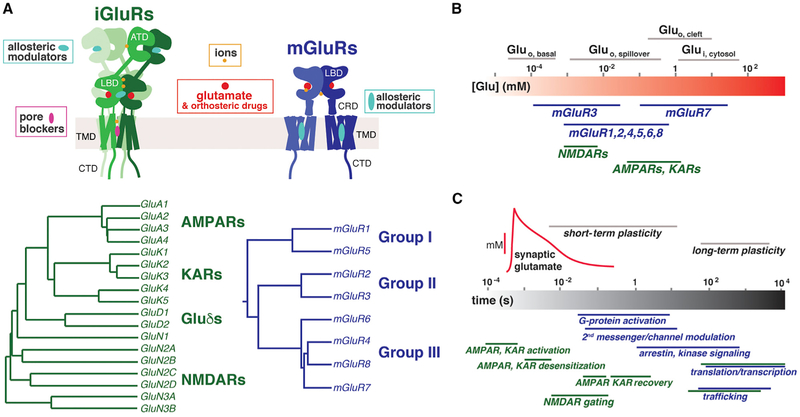
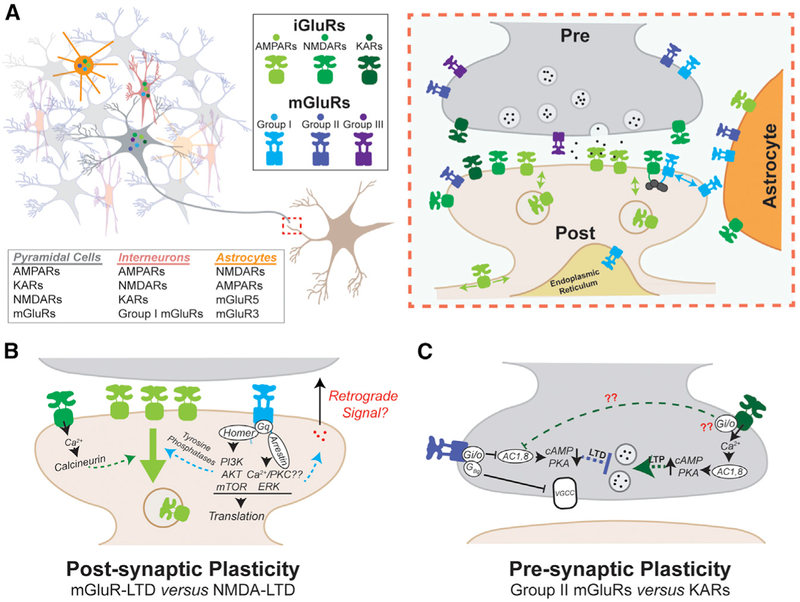
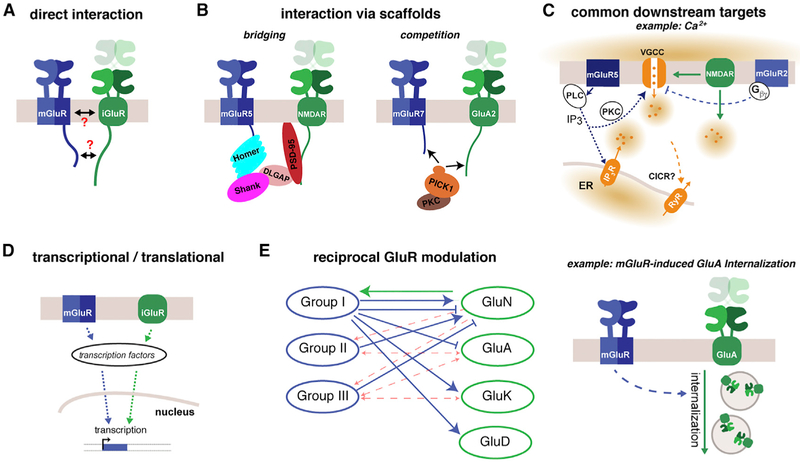
Glutamate serves as both the mammalian brain's primary excitatory neurotransmitter and as a key neuromodulator to control synapse and circuit function over a wide range of spatial and temporal scales. This functional diversity is decoded by two receptor families: ionotropic glutamate receptors (iGluRs) and metabotropic glutamate receptors (mGluRs). The challenges posed by the complexity and physiological importance of each of these subtypes has limited our appreciation and understanding of how these receptors work in concert. In this review, by comparing both receptor families with a focus on their crosstalk, we argue for a more holistic understanding of neural glutamate signaling.
谷氨酸既是哺乳动物大脑的主要兴奋性神经递质,也是一种关键的神经调质,可在广泛的时空尺度上控制突触和回路功能。这种功能多样性由两种受体家族解码:离子型谷氨酸受体(iGluRs)和代谢型谷氨酸受体(mGluRs)。这些亚型的复杂性和生理重要性带来的挑战限制了我们对这些受体协同作用方式的理解和认识。在这篇综述中,我们通过比较这两种受体家族,重点关注它们的串扰,主张更全面地理解神经谷氨酸信号。