World Health Organization, Geneva, Switzerland.
Independent expert, Ahmedabad, India.
Reprod Health. 2018 Jun 28;15(1):118. doi: 10.1186/s12978-018-0552-1.
Although the need for multi-faceted and multi-sectoral approaches to address the multidimensional issue of child marriage is well-acknowledged, there is a dearth of documented experience on the process of implementing and managing such programmes.
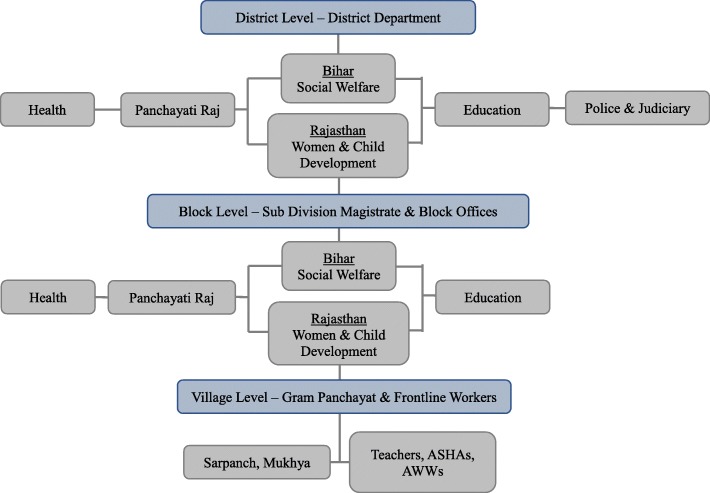
WHO evaluated a district-level, government-led multi-sectoral intervention to address child marriage in Jamui, Bihar and Sawai Madhopur, Rajasthan, implemented by MAMTA Health Institute for Mother and Child (MAMTA). We evaluated the intervention's design, implementation, monitoring, and outputs and identified key challenges and successes.
Through actions at the state and district levels, the intervention succeeded in creating a cascade effect to stimulate more concerted action at block and village levels, with tangible intersectoral convergence occurring at the village level. The success factors we identified included an experienced partner NGO that was committed to supporting this effort, context-specific design and implementation, and a flexible and responsive approach. However, despite contributing to informal coordination between various stakeholders, the intervention did not succeed in developing a sustained joint-working mechanism at the district level. Shared ownership for prioritization of child marriage across national- and state-level sectors was not established, due in part to lack of directives transcending ministerial/departmental boundaries. Nevertheless, due to its efforts at the district-level, the intervention was able to enlist leadership from the District Magistrates and Child Marriage Prohibition Officers, in line with their duties outlined in the 2006 Prohibition of Child Marriage Act. The challenges we identified included lack of clear directives and institutional support for collaboration, obstacles to monitoring, administrative challenges, differing perspectives on strategy among district leaders, community resistance, and intervention over-commitment.
The findings of this evaluation reveal the potential of multi-sectoral approaches to prevent and respond to child marriage and provide insight into obstacles that affect multi-sectoral coordination. We point to actions that MAMTA could take to strengthen collaboration on this and other initiatives. We also recommend further documentation and evaluation of projects and programmes in this area.
尽管人们已经认识到需要采取多方面和多部门的方法来解决儿童婚姻的多维度问题,但在实施和管理此类方案的过程方面,经验却乏善可陈。
世界卫生组织(WHO)评估了由 MAMTA 健康研究所(MAMTA)为比哈尔邦的贾穆伊(Jamui)和拉贾斯坦邦的绍艾·马多普尔(Sawai Madhopur)实施的一个以政府为主导的多部门干预措施,以解决儿童婚姻问题。我们评估了干预措施的设计、实施、监测和产出,并确定了关键的挑战和成功因素。
通过在州和地区层面采取行动,该干预措施成功地产生了级联效应,刺激了在街区和村庄层面采取更协调的行动,并且在村庄层面出现了实质性的跨部门趋同。我们确定的成功因素包括一个有经验的非政府组织合作伙伴,该组织致力于支持这一努力,具有针对性的设计和实施,以及灵活和响应式的方法。然而,尽管该干预措施为各利益相关者之间的非正式协调做出了贡献,但它并没有成功地在地区层面建立一个持续的联合工作机制。由于缺乏超越部级/部门界限的指令,国家和州级部门之间没有建立对儿童婚姻问题的共同优先排序。尽管如此,由于该干预措施在地区层面所做的努力,它成功地争取到了地区治安官和儿童婚姻禁止官员的领导,这符合 2006 年《禁止儿童婚姻法》规定的他们的职责。我们确定的挑战包括缺乏明确的合作指令和机构支持、监测障碍、行政挑战、地区领导人之间对战略的不同看法、社区抵制以及干预措施过度投入。
这项评估的结果表明了多部门方法在预防和应对儿童婚姻方面的潜力,并深入了解了影响多部门协调的障碍。我们指出了 MAMTA 可以采取的行动,以加强在这方面和其他倡议上的合作。我们还建议进一步记录和评估这一领域的项目和方案。