Institute of Psychology, Health & Society, University of Liverpool, Liverpool, UK.
Obesity (Silver Spring). 2018 Aug;26(8):1365-1371. doi: 10.1002/oby.22224. Epub 2018 Jun 28.
Perceiving one's own weight status as being overweight is a likely motivation for weight loss. However, self-perceived overweight status has also been found to be associated with overeating and weight gain. This study examined whether weight stigma concerns explain why individuals who perceive their weight status as overweight are at increased risk of overeating.
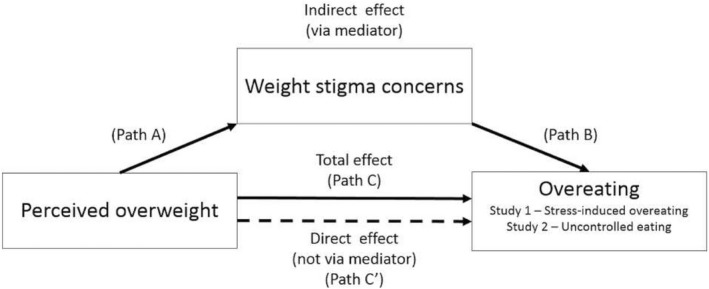
We conducted two survey studies of United States adults (N = 1,236) in which we assessed whether weight stigma concerns explain the cross-sectional relationship between perceived overweight and overeating tendencies.
Across two studies, the cross-sectional relationship between perceived overweight and overeating tendencies was in part explained by weight stigma concerns. Participants who perceived their weight as "overweight" reported greater weight stigma concerns than participants who perceived their weight as "about right," and this explained 23.3% (Study 1) to 58.6% (Study 2) of the variance in the relationship between perceived overweight and overeating tendencies.
Weight stigma concerns may explain why perceiving one's own weight status as overweight is associated with an increased tendency to overeat.
认为自己超重是减肥的一个可能动机。然而,自我感知的超重状态也与暴饮暴食和体重增加有关。本研究旨在探讨体重耻辱感是否可以解释为什么认为自己超重的人更容易暴饮暴食。
我们对美国成年人进行了两项调查研究(N=1236),评估了体重耻辱感是否可以解释自我感知超重与暴饮暴食倾向之间的横断面关系。
在两项研究中,自我感知超重与暴饮暴食倾向之间的横断面关系部分可以用体重耻辱感来解释。与自我感知体重“正常”的参与者相比,认为自己体重“超重”的参与者报告的体重耻辱感更强烈,这解释了自我感知超重与暴饮暴食倾向之间关系的 23.3%(研究 1)到 58.6%(研究 2)的变异。
体重耻辱感可能可以解释为什么自我感知体重超重与增加暴饮暴食的倾向有关。