Vidanapathirana Dinesha Maduri, Jayasena Subashinie, Jasinge Eresha, Stiburkova Blanka
Department of Chemical Pathology, Lady Ridgeway Hospital, Colombo, Sri Lanka.
Institute of Rheumatology, Prague, Czech Republic.
BMC Pediatr. 2018 Jun 29;18(1):210. doi: 10.1186/s12887-018-1185-9.
Renal hypouricemia is a rare heterogeneous inherited disorder characterized by impaired tubular uric acid transport, reabsorption insufficiency and /or acceleration of secretion. The affected individuals are predisposed to nephrolithiasis and recurrent episodes of exercise-induced acute kidney injury. Type 1 is caused by dysfunctional variants in the SLC22A12 gene (URAT1), while type 2 is caused by defects in the SLC2A9 gene (GLUT9). To date, more than 150 patients with the loss-of-function mutations for the SLC22A12 gene have been found (compound heterozygotes and/or homozygotes), most of whom are Japanese and Koreans.
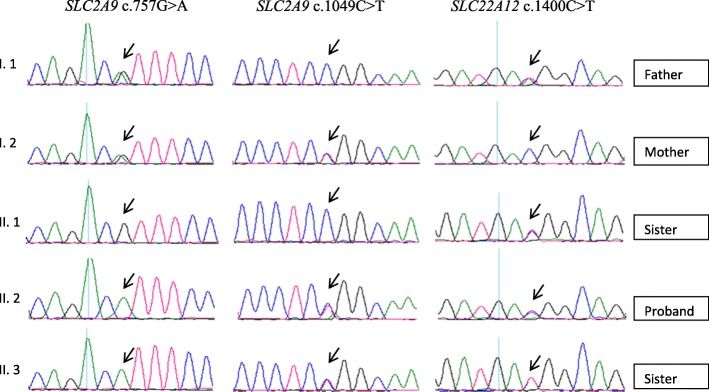
Herein, we report a nine year old Sri Lankan boy with renal hypouricemia (serum uric acid 97 μmol/L, fractional excretion of uric acid 33%).The sequencing analysis of SLC22A12 revealed a potentially deleterious missense variant c.1400C > T (p.T467 M, rs200104135) in heterozygous state. This variant has been previously identified in homozygous and/or compound heterozygous state with other causative SLC22A12 variant c.1245_1253del (p.L415_G417del) in Roma population.
This is the first identification of a family with mild renal hypouricemia1 associated to the p.T467 M variant. Detailed investigations of urate blood and urine concentrations in patients with unexplained hypouricemia are needed and renal hypouricemia should also be considered in patients other than those from Japan and/or Korea. Our finding confirms an uneven geographical and ethnic distribution of Romany prevalent SLC22A12 variant that need to be considered in Asian patients (population data Genome Aggregation Database: allele frequency in South Asia 0.007055, in East Asia 0.001330).
肾性低尿酸血症是一种罕见的异质性遗传性疾病,其特征为肾小管尿酸转运受损、重吸收不足和/或分泌加速。患病个体易患肾结石和运动诱发的急性肾损伤反复发作。1型由SLC22A12基因(URAT1)功能异常变异引起,而2型由SLC2A9基因(GLUT9)缺陷引起。迄今为止,已发现150多名SLC22A12基因功能丧失突变患者(复合杂合子和/或纯合子),其中大多数是日本人和韩国人。
在此,我们报告一名9岁的斯里兰卡男孩患有肾性低尿酸血症(血清尿酸97μmol/L,尿酸排泄分数33%)。SLC22A12基因的测序分析显示杂合状态下存在一个潜在有害的错义变异c.1400C>T(p.T467M,rs200104135)。该变异先前已在罗姆人群中与其他致病性SLC从22A12变异c.1245_1253del(p.L415_G417del)以纯合和/或复合杂合状态被鉴定出来。
这是首次鉴定出与p.T467M变异相关的轻度肾性低尿酸血症1型家族。对于不明原因低尿酸血症患者,需要详细调查血尿酸和尿尿酸浓度,除日本和/或韩国患者外,其他患者也应考虑肾性低尿酸血症。我们的发现证实了罗姆人普遍存在的SLC22A12变异在地理和种族分布上的不均衡,这在亚洲患者中需要考虑(群体数据基因组聚合数据库:南亚等位基因频率为0.007055,东亚为0.001330)。