Department of Nephrology, Nagasaki University Graduate School of Biomedical Sciences, Nagasaki, Japan.
Department of Urology, Nagasaki University Graduate School of Biomedical Sciences, Nagasaki, Japan.
BMC Nephrol. 2020 Jul 16;21(1):282. doi: 10.1186/s12882-020-01940-4.
Renal hypouricemia (RHUC) is a genetic disorder caused by mutations in the SLC22A12 gene, which encodes the major uric acid (UA) transporter, URAT1. The clinical course of related, living donor-derived RHUC in patients undergoing kidney transplantation is poorly understood. Here, we report a case of kidney transplantation from a living relative who had an SLC22A12 mutation. After the transplantation, the recipient's fractional excretion of UA (FEUA) decreased, and chimeric tubular epithelium was observed.
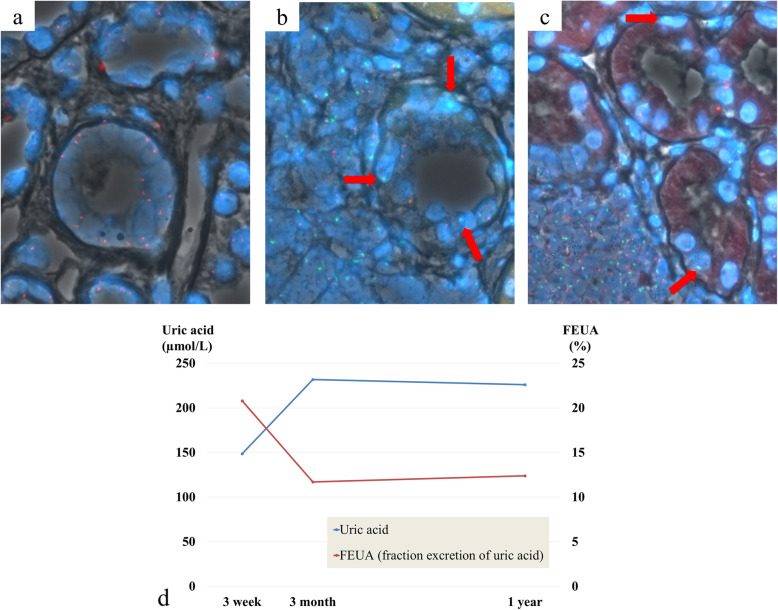
A 40-year-old man underwent kidney transplantation. His sister was the kidney donor. Three weeks after the transplantation, he had low serum-UA, 148.7 μmol/L, and elevated FEUA, 20.8% (normal: < 10%). The patient's sister had low serum-UA (101.1 μmol/L) and high FEUA (15.8%) before transplant. Suspecting RHUC, we performed next-generation sequencing on a gene panel containing RHUC-associated genes. A heterozygous missense mutation in the SLC22A12 gene was detected in the donor, but not in the recipient. The recipient's serum-UA level increased from 148.7 μmol/L to 231.9 μmol/L 3 months after transplantation and was 226.0 μmol/L 1 year after transplantation. His FEUA decreased from 20.8 to 11.7% 3 months after transplantation and was 12.4% 1 year after transplantation. Fluorescence in situ hybridization of allograft biopsies performed 3 months and 1 year after transplantation showed the presence of Y chromosomes in the tubular epithelial cells, suggesting the recipient's elevated serum-UA levels were owing to a chimeric tubular epithelium.
We reported on a kidney transplant recipient that developed RHUC owing to his donor possessing a heterozygous mutation in the SLC22A12 (URAT1) gene. Despite this mutation, the clinical course was not problematic. Thus, the presence of donor-recipient chimerism in the tubular epithelium might positively affect the clinical course, at least in the short-term.
肾性低尿酸血症(RHUC)是一种由 SLC22A12 基因突变引起的遗传疾病,该基因编码主要的尿酸(UA)转运体 URAT1。在接受肾移植的患者中,与活体供体来源的 RHUC 相关的临床病程尚不清楚。在这里,我们报告了一例由携带 SLC22A12 突变的活体亲属进行的肾移植病例。移植后,受者的 UA 分数排泄(FEUA)下降,并观察到嵌合管状上皮。
一名 40 岁男性接受了肾移植。他的妹妹是肾脏供体。移植后 3 周,他的血清-UA 水平较低,为 148.7μmol/L,FEUA 升高,为 20.8%(正常:<10%)。供者在移植前血清-UA 水平较低(101.1μmol/L),FEUA 水平较高(15.8%)。怀疑为 RHUC,我们对包含 RHUC 相关基因的基因panel 进行了下一代测序。在供体中发现 SLC22A12 基因的杂合错义突变,但在受者中未发现。受者的血清-UA 水平从 148.7μmol/L 增加到移植后 3 个月的 231.9μmol/L,1 年后增加到 226.0μmol/L。他的 FEUA 从移植后 3 个月的 20.8%下降到 11.7%,1 年后下降到 12.4%。移植后 3 个月和 1 年后的移植肾活检的荧光原位杂交显示肾小管上皮细胞中存在 Y 染色体,提示受者血清-UA 水平升高是由于嵌合管状上皮所致。
我们报告了一例肾移植受者,由于其供体携带 SLC22A12(URAT1)基因的杂合突变而发生 RHUC。尽管存在这种突变,但临床病程并无问题。因此,管状上皮中供体-受者嵌合体的存在可能会对至少短期的临床病程产生积极影响。