Dahlberg Anton, Ghaderi Ata, Sarkadi Anna, Salari Raziye
Child Health and Parenting (CHAP), Department of Public Health and Caring Sciences, Uppsala University, Box 564, Uppsala, 751 22, Sweden.
Department of Clinical Neuroscience, Division of Psychology, Karolinska Institutet, Stockholm, Sweden.
Child Psychiatry Hum Dev. 2019 Feb;50(1):132-141. doi: 10.1007/s10578-018-0826-4.
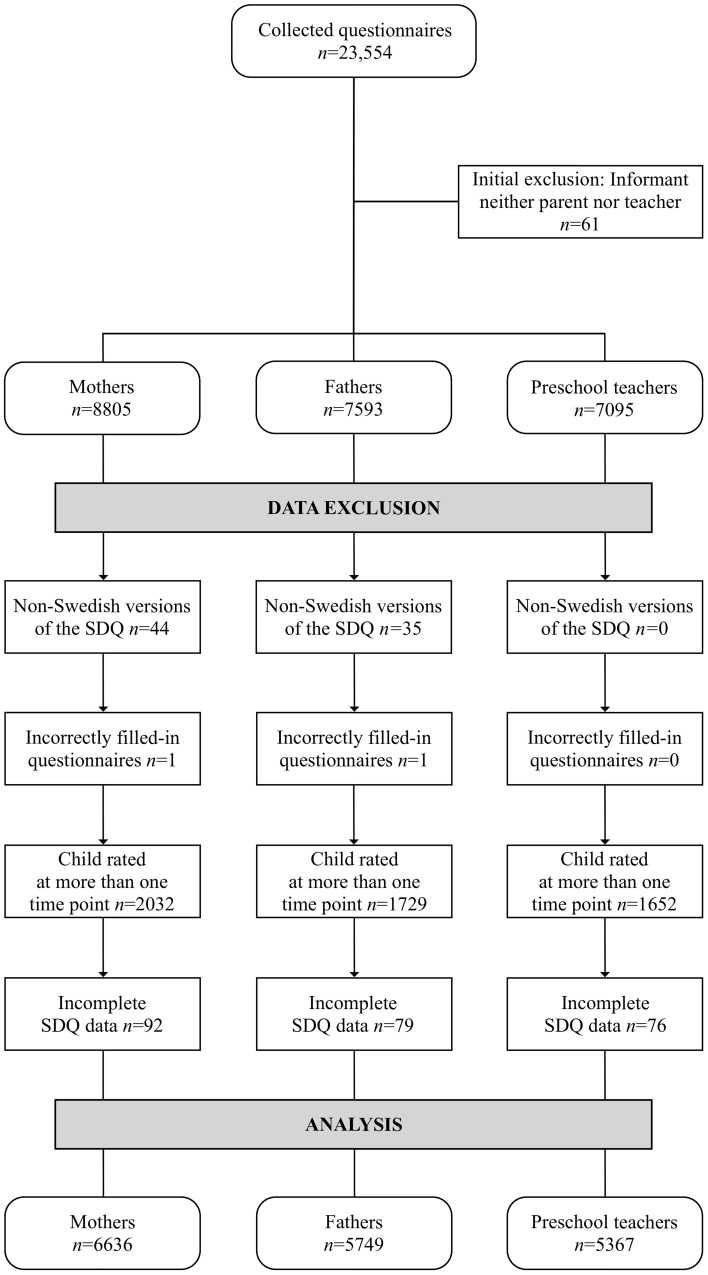
The Strengths and Difficulties Questionnaire (SDQ) is a well-established instrument for measuring social and behavioural problems among children, with good psychometric properties for older children, but less validity reports on pre-schoolers. In addition, there is a knowledge gap concerning fathers as informants. The present work is one of the few validity studies to include preschool teachers and the first on preschool children where fathers are included as separate informants. In this study, SDQs were collected from a large community sample (n = 17,752) of children aged 3-5, rated by mothers, fathers, and preschool teachers and analysed using confirmatory factor analysis. Our results revealed acceptable fit for all informant groups and measurement invariance across child gender, child age, and parental education level. Our findings suggest good construct validity of the SDQ for a non-clinical preschool population and imply that it may be used for assessing child behaviour problems from different informant perspectives.
优势与困难问卷(SDQ)是一种成熟的用于测量儿童社会和行为问题的工具,对大龄儿童具有良好的心理测量特性,但针对学龄前儿童的效度报告较少。此外,关于父亲作为信息提供者方面存在知识空白。本研究是少数纳入学前教师的效度研究之一,也是首个将父亲作为单独信息提供者纳入的针对学龄前儿童的研究。在本研究中,从一个由3至5岁儿童组成的大型社区样本(n = 17752)中收集了SDQ问卷,由母亲、父亲和学前教师进行评分,并使用验证性因素分析进行分析。我们的结果显示,所有信息提供者群体的拟合度均可接受,且在儿童性别、儿童年龄和父母教育水平方面具有测量不变性。我们的研究结果表明,SDQ对于非临床学龄前人群具有良好的结构效度,这意味着它可用于从不同信息提供者的角度评估儿童行为问题。