Hunter Julia Alexandra, Lee Taehoon, Persaud Navindra
Faculty of Medicine, Royal College of Surgeons in Ireland, Dublin, Ireland, and Li Ka Shing Knowledge Institute of St. Michael's Hospital, Toronto, ON, Canada.
Center for Urban Health Solution, Li Ka Shing Knowledge Institute of St. Michael's Hospital, Toronto, ON, Canada.
J Med Libr Assoc. 2018 Jul;106(3):352-360. doi: 10.5195/jmla.2018.256. Epub 2018 Jul 1.
The research compared the comprehensiveness and accuracy of two online resources that provide drug information: Lexicomp and Wikipedia.
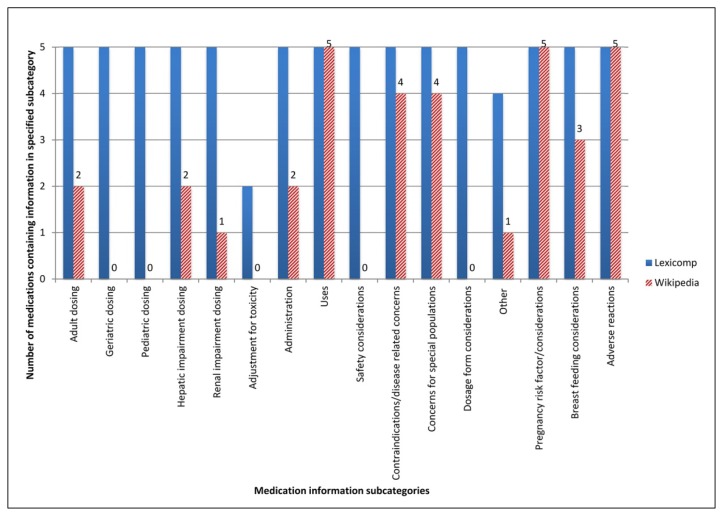
Medication information on five commonly prescribed medications was identified and comparisons were made between resources and the relevant literature. An initial content comparison of the following three categories of medication information was performed: dose and instructions, uses, and adverse effects or warnings. The content comparison included sixteen points of comparison for each of the five investigated medications, totaling eighty content comparisons. For each of the medications, adverse reactions that appeared in only one of the resources were identified. When primary, peer-reviewed literature was not referenced supporting the discrepant adverse reactions, a literature search was performed to determine whether or not evidence existed to support the listed claims.
Lexicomp consistently provided more medication information, with information provided in 95.0% (76/80) of the content, compared to Wikipedia's 42.5% (34/80). Lexicomp and Wikipedia had information present in 91.4% (32/35) and 20.0% (7/35) of dosing and instructions content, respectively. Adverse effects or warning content was provided in 97.5% (39/40) of Lexicomp content and 55.0% (22/40) of Wikipedia content. The "uses" category was present in both Lexicomp and Wikipedia for the 5 medications considered. Of adverse reactions listed solely in Lexicomp, 191/302 (63.2%) were supported by primary, peer-reviewed literature in contrast to 7/7 (100.0%) of adverse reactions listed only in Wikipedia. A review of US Food and Drug Administration Prescribing Information and the Adverse Event Reporting System dashboard found support for a respective 17/102 (16.7%) and 92/102 (90.2%) of Lexicomp's adverse reactions that were not supported in the literature.
Lexicomp is a comprehensive medication information tool that contains lists of adverse reactions that are not entirely supported by primary-peer reviewed literature.
本研究比较了两种提供药物信息的在线资源Lexicomp和维基百科的全面性和准确性。
确定了五种常用处方药的用药信息,并对这些资源与相关文献进行了比较。对以下三类用药信息进行了初步内容比较:剂量与用法说明、用途以及不良反应或警示。内容比较包括对五种被调查药物中的每一种进行16个比较点,总共80个内容比较。对于每种药物,确定仅在其中一种资源中出现的不良反应。当没有引用一级同行评审文献来支持存在差异的不良反应时,进行文献检索以确定是否有证据支持列出的说法。
Lexicomp始终提供更多的用药信息,其在95.0%(76/80)的内容中提供了信息,而维基百科为42.5%(34/80)。Lexicomp和维基百科分别在91.4%(32/35)和20.0%(7/35)的剂量与用法说明内容中提供了信息。Lexicomp内容的97.5%(39/40)和维基百科内容的55.0%(22/40)提供了不良反应或警示内容。在所考虑的5种药物中,Lexicomp和维基百科都有“用途”类别。仅在Lexicomp中列出的不良反应中,191/302(63.2%)得到一级同行评审文献的支持,而仅在维基百科中列出的不良反应为7/7(100.0%)。对美国食品药品监督管理局的处方信息和不良事件报告系统仪表板的审查发现,分别有17/102(16.7%)和92/102(90.2%)的Lexicomp不良反应在文献中未得到支持。
Lexicomp是一个全面的用药信息工具,其中包含的不良反应列表并未完全得到一级同行评审文献的支持。