Ma Xiuying, Sun Jia, Ye Weijian, Huang Yewei, Sun Congcong, Tao Youli, Wang Tao, Cong Weitao, Geng Funeng
Sichuan Key Laboratory of Medical American Cockroach, Chengdu, Sichuan 610000, P.R. China.
College of Pharmacy, Wenzhou Medical University, Wenzhou, Zhejiang 325000, P.R. China.
Oncol Lett. 2018 Jul;16(1):931-939. doi: 10.3892/ol.2018.8713. Epub 2018 May 16.
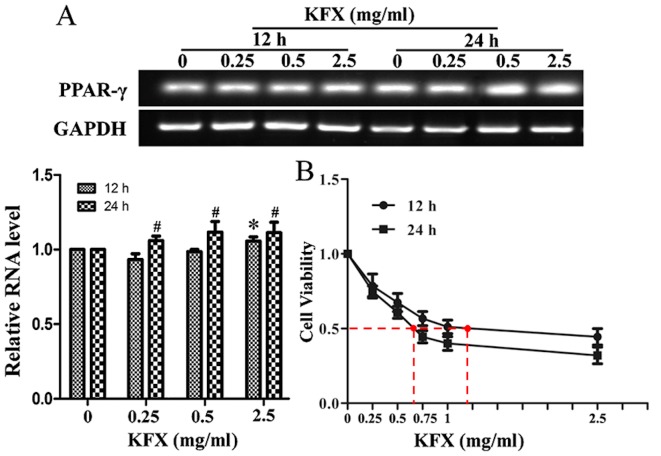
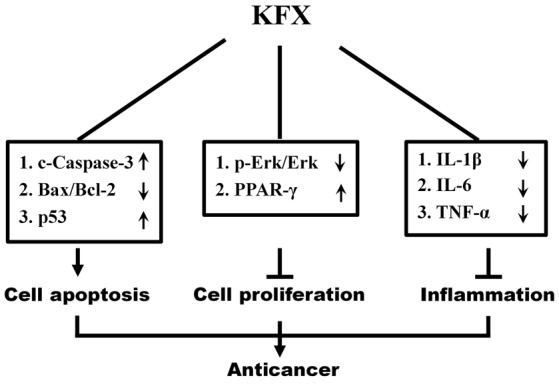
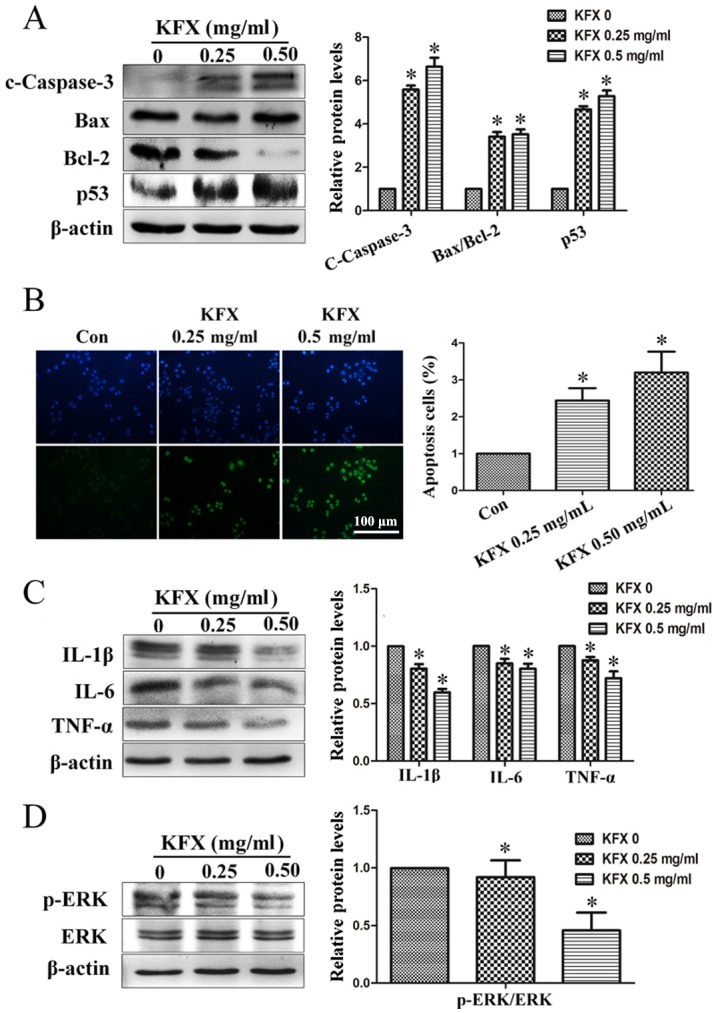
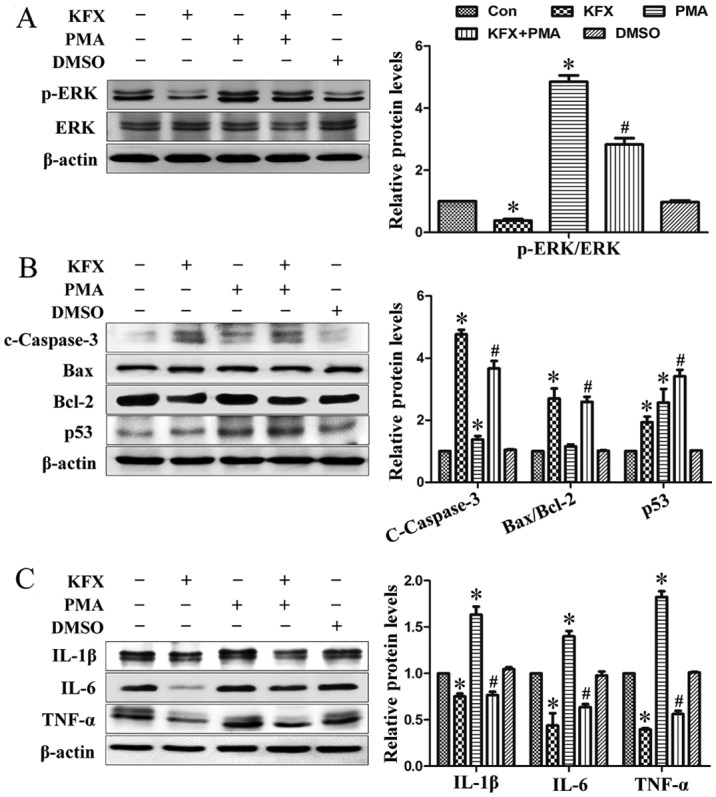
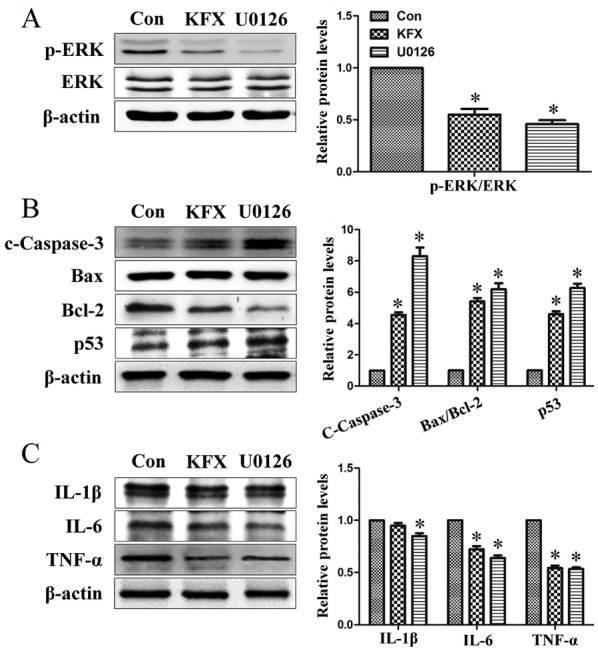
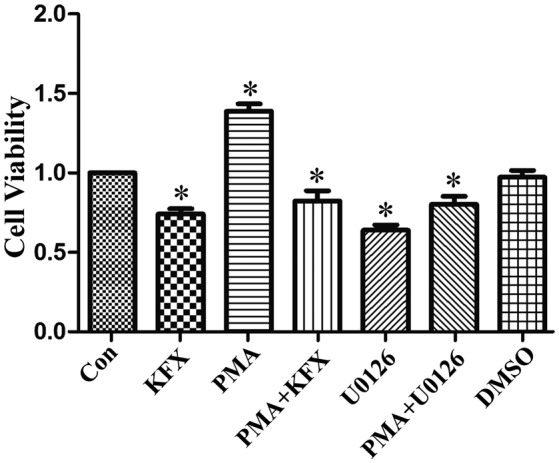
Kangfuxin (KFX) is an oral liquid derived from , with complex components. KFX has been demonstrated to exhibit anticancer activity in a variety of different types of tumor, including gastric cancer; however, its underlying molecular mechanism remains unclear. The present study was designed to investigate the pro-apoptotic effects of KFX on SGC-7901 cells, in order to provide a theoretical basis for clinical application. In order to clarify the pro-apoptotic effects of KFX on SGC-7901 cells, MTT analysis was conducted. To evaluate the anticancer effect of KFX, peroxisome proliferator-activated receptor (PPAR)-γ was analyzed by reverse transcription-polymerase chain reaction. Western blot analysis was used to determine the effects of KFX on the expression of cleaved caspase-3, phosphorylated extracellular signal-regulated kinase (p-ERK), ERK, tumor protein p53 (p53), B-cell lymphoma 2 (Bcl-2), Bcl-2 associated X, interleukin (IL)-6 and IL-1β. In addition, terminal deoxynucleotidyl-transferase-mediated dUTP nick-end labeling (TUNEL) analysis was used to detect apoptosis in SGC-7901 cells. It was revealed that PPAR-γ was increased in SGC-7901 cells following treatment with KFX, shown by an increase in mRNA expression. Furthermore, western blot analysis identified that KFX treatment groups exhibited markedly inhibited levels of Bcl-2, IL-6, IL-1β and p-ERK, and induced p53 protein expression. Additionally, TUNEL and MTT assays demonstrated that treatment with KFX may induce SGC-7901 cell apoptosis and inhibit proliferation. In conclusion, to the best of our knowledge, the results of the present study demonstrated for the first time that KFX may induce SGC-7901 cell apoptosis and inhibit its proliferation, and this may be primarily attributed to its role in mitogen-activated protein kinase/extracellular-signal-regulated kinase kinase/ERK signaling pathway inhibition.
康复新(KFX)是一种源自[具体来源未给出]的口服液,成分复杂。KFX已被证明在多种不同类型的肿瘤中具有抗癌活性,包括胃癌;然而,其潜在的分子机制仍不清楚。本研究旨在探讨KFX对SGC-7901细胞的促凋亡作用,为临床应用提供理论依据。为了阐明KFX对SGC-7901细胞的促凋亡作用,进行了MTT分析。为了评估KFX的抗癌作用,通过逆转录-聚合酶链反应分析过氧化物酶体增殖物激活受体(PPAR)-γ。蛋白质免疫印迹分析用于确定KFX对裂解的半胱天冬酶-3、磷酸化细胞外信号调节激酶(p-ERK)、ERK、肿瘤蛋白p53(p53)、B细胞淋巴瘤2(Bcl-2)、Bcl-2相关X蛋白、白细胞介素(IL)-6和IL-1β表达的影响。此外,末端脱氧核苷酸转移酶介导的dUTP缺口末端标记(TUNEL)分析用于检测SGC-7901细胞中的凋亡。结果显示,用KFX处理后,SGC-7901细胞中的PPAR-γ mRNA表达增加。此外,蛋白质免疫印迹分析表明,KFX处理组的Bcl-2、IL-6、IL-1β和p-ERK水平明显受到抑制,并诱导p53蛋白表达。此外,TUNEL和MTT分析表明,用KFX处理可诱导SGC-7901细胞凋亡并抑制其增殖。总之,据我们所知,本研究结果首次表明KFX可能诱导SGC-7901细胞凋亡并抑制其增殖,这可能主要归因于其在丝裂原活化蛋白激酶/细胞外信号调节激酶激酶/ERK信号通路抑制中的作用。