Guha Tanaya, Yang Zhaojun, Grossman Ruth B, Narayanan Shrikanth S
Department of Electrical Engineering, Indian Institute of Technology Kanpur, India.
Signal Analysis and Interpretation Lab (SAIL), University of Southern California, Los Angeles.
IEEE Trans Affect Comput. 2018 Jan-Mar;9(1):14-20. doi: 10.1109/TAFFC.2016.2578316. Epub 2016 Jun 8.
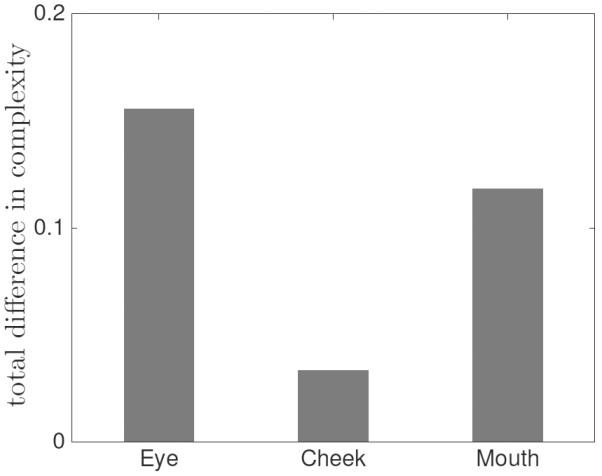
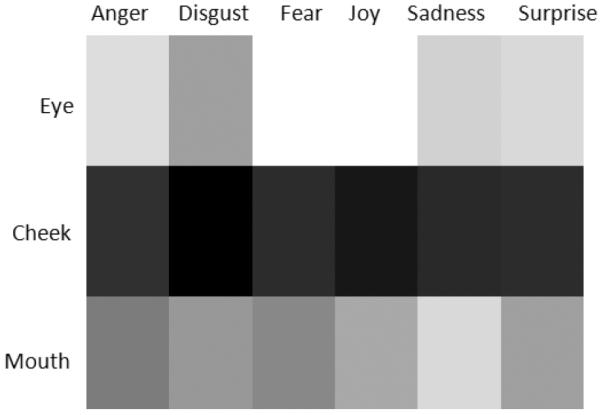
Several studies have established that facial expressions of children with autism are often perceived as atypical, awkward or less engaging by typical adult observers. Despite this clear deficit in the quality of facial expression production, very little is understood about its underlying mechanisms and characteristics. This paper takes a computational approach to studying details of facial expressions of children with high functioning autism (HFA). The objective is to uncover those characteristics of facial expressions, notably distinct from those in typically developing children, and which are otherwise difficult to detect by visual inspection. We use motion capture data obtained from subjects with HFA and typically developing subjects while they produced various facial expressions. This data is analyzed to investigate how the overall and local facial dynamics of children with HFA differ from their typically developing peers. Our major observations include reduced complexity in the dynamic facial behavior of the HFA group arising primarily from the eye region.
多项研究表明,典型的成年观察者常常认为自闭症儿童的面部表情是非典型的、不自然的或缺乏吸引力的。尽管面部表情产生的质量存在明显缺陷,但对于其潜在机制和特征却知之甚少。本文采用计算方法来研究高功能自闭症(HFA)儿童面部表情的细节。目的是揭示面部表情的那些特征,这些特征明显不同于典型发育儿童的特征,并且通过视觉检查很难检测到。我们使用从患有HFA的受试者和典型发育受试者产生各种面部表情时获得的动作捕捉数据。对这些数据进行分析,以研究患有HFA的儿童的整体和局部面部动态与他们典型发育的同龄人有何不同。我们的主要观察结果包括,HFA组动态面部行为的复杂性降低,这主要源于眼部区域。