MRC Centre for Reproductive Health, Queen's Medical Research Institute, The University of Edinburgh, Edinburgh, UK.
Royal (Dick) School of Veterinary Studies and the Roslin Institute, The University of Edinburgh, Edinburgh, UK.
Immunology. 2018 Nov;155(3):285-293. doi: 10.1111/imm.12976. Epub 2018 Jul 31.
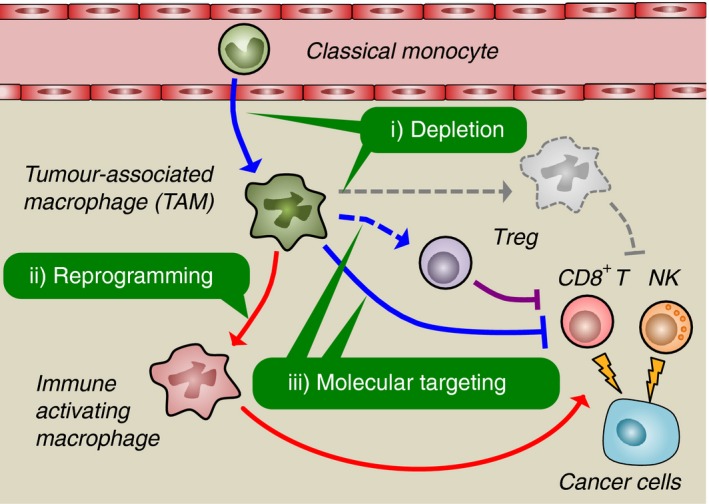
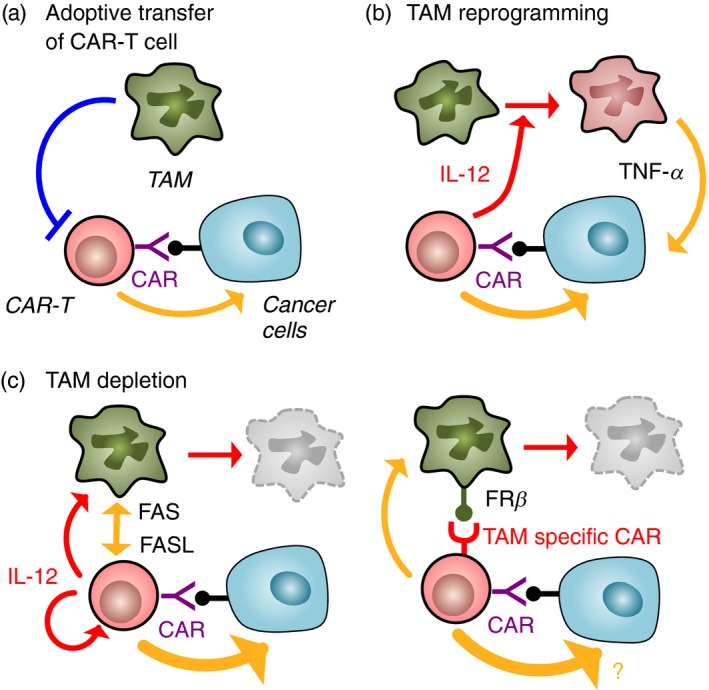
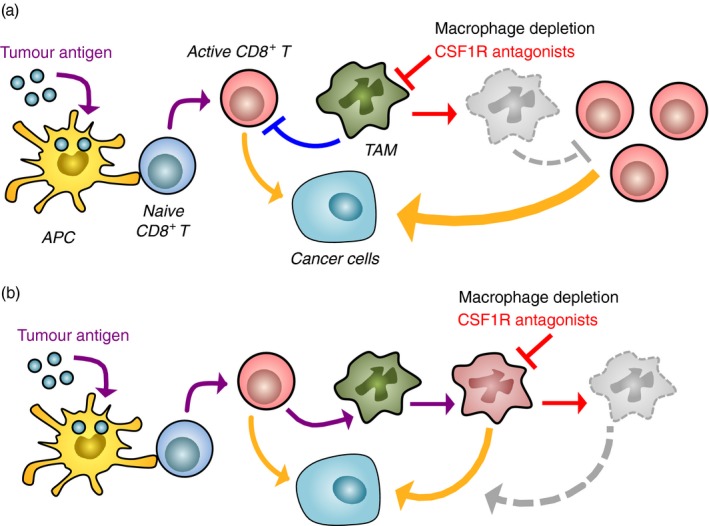
Tumour-infiltrating immune cells regulate tumour development and progression either negatively or positively. For example, cytotoxic lymphocytes (CTL) such as CD8 T and natural killer (NK) cells can recognize and eliminate cancer cells, and thereby restrict the tumour growth and metastasis, if they exert full cytotoxicity. In contrast, tumour-infiltrating myeloid cells such as tumour-associated macrophages (TAM) promote the expansion and dissemination of cancer cells depending on their functional states. Given the tumour-killing ability of CTL, the augmentation of CTL-induced antitumour immune reactions has been considered as an attractive therapeutic modality for lethal solid tumours and several promising strategies have emerged, which include immune checkpoint inhibitors, cancer vaccines and adoptive CTL transfer. These immunotherapies are now tested in clinical trials and have shown significant antitumour effects in patients with lymphoma and some solid tumours such as melanoma and lung cancer. Despite these encouraging results, these therapies are not efficient in a certain fraction of patients and tumour types with tumour cell-intrinsic mechanisms such as impaired antigen presentation and/or tumour cell-extrinsic mechanisms including the accumulation of immunosuppressive cells. Several animal studies suggest that tumour-infiltrating myeloid cells, especially TAM, are one of the key targets to improve the efficacy of immunotherapies as these cells can suppress the functions of CD8 T and NK cells. In this review, we will summarize recent animal studies regarding the involvement of TAM in the immune checkpoint, cancer vaccination and adoptive CTL transfer therapies, and discuss the therapeutic potential of TAM targeting to improve the immunotherapies.
肿瘤浸润免疫细胞通过正调控或负调控影响肿瘤的发生发展。例如,细胞毒性 T 淋巴细胞(CTL)如 CD8 T 细胞和自然杀伤(NK)细胞可以识别和消除癌细胞,从而限制肿瘤的生长和转移,如果它们发挥完全的细胞毒性。相反,肿瘤浸润髓系细胞,如肿瘤相关巨噬细胞(TAM),根据其功能状态促进癌细胞的扩增和扩散。鉴于 CTL 的肿瘤杀伤能力,增强 CTL 诱导的抗肿瘤免疫反应已被认为是治疗致命实体瘤的一种有吸引力的治疗方式,已经出现了几种有前途的策略,包括免疫检查点抑制剂、癌症疫苗和过继性 CTL 转移。这些免疫疗法目前正在临床试验中进行测试,并已在淋巴瘤和一些实体瘤患者中显示出显著的抗肿瘤效果,如黑色素瘤和肺癌。尽管取得了这些令人鼓舞的结果,但这些疗法在某些肿瘤类型和肿瘤细胞内在机制(如抗原呈递受损)或肿瘤细胞外在机制(如免疫抑制细胞的积累)的患者中并不有效。一些动物研究表明,肿瘤浸润髓系细胞,尤其是 TAM,是提高免疫疗法疗效的关键靶点之一,因为这些细胞可以抑制 CD8 T 和 NK 细胞的功能。在这篇综述中,我们将总结最近关于 TAM 参与免疫检查点、癌症疫苗和过继性 CTL 转移治疗的动物研究,并讨论 TAM 靶向治疗以改善免疫疗法的治疗潜力。