Department of Neurology, University of Arkansas for Medical Sciences, Little Rock, AR 72205, USA.
Department of Neurobiology, Duke University School of Medicine, Durham, NC 27710, USA.
Neuropharmacology. 2018 Sep 1;139:150-162. doi: 10.1016/j.neuropharm.2018.06.035. Epub 2018 Jun 28.
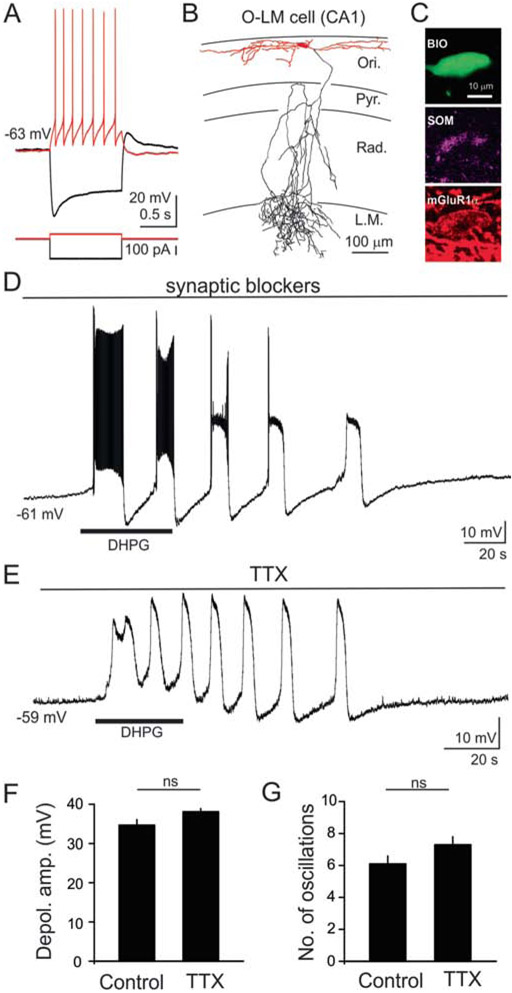
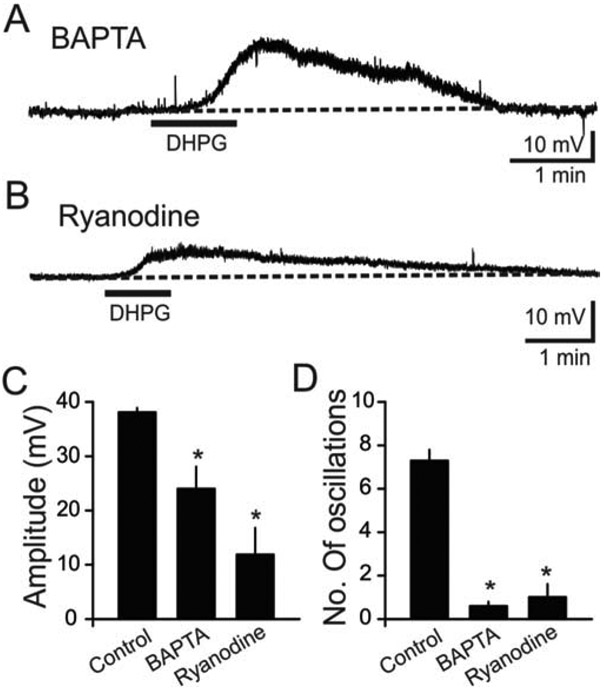
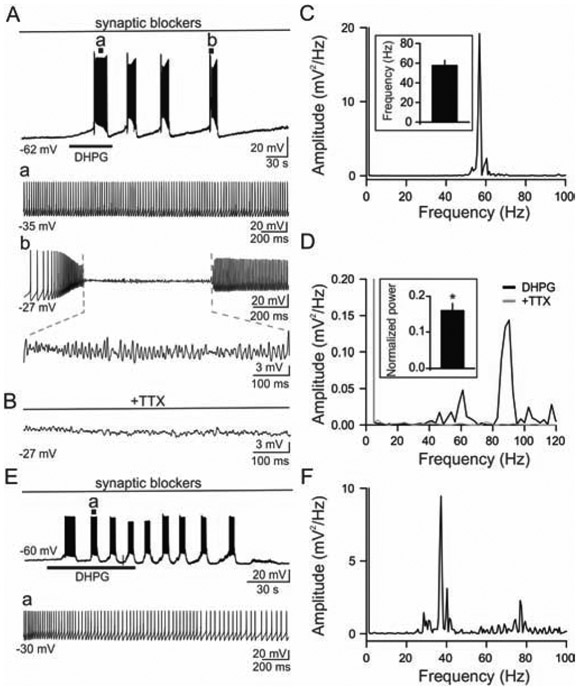
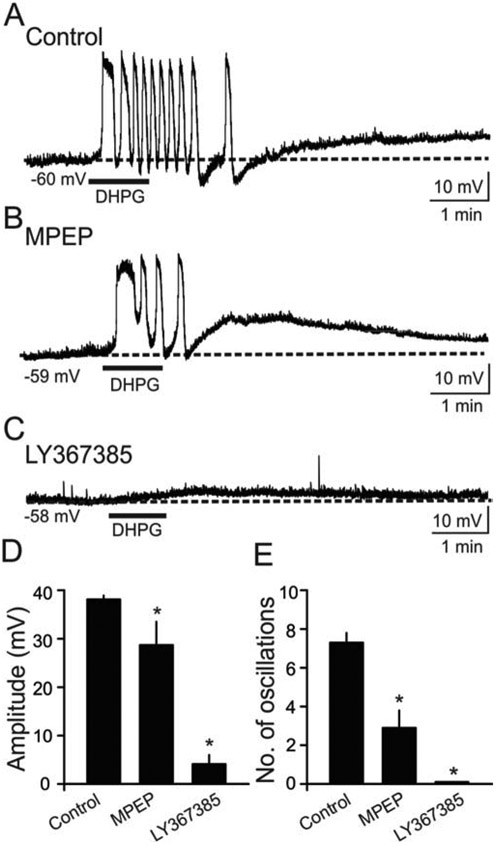
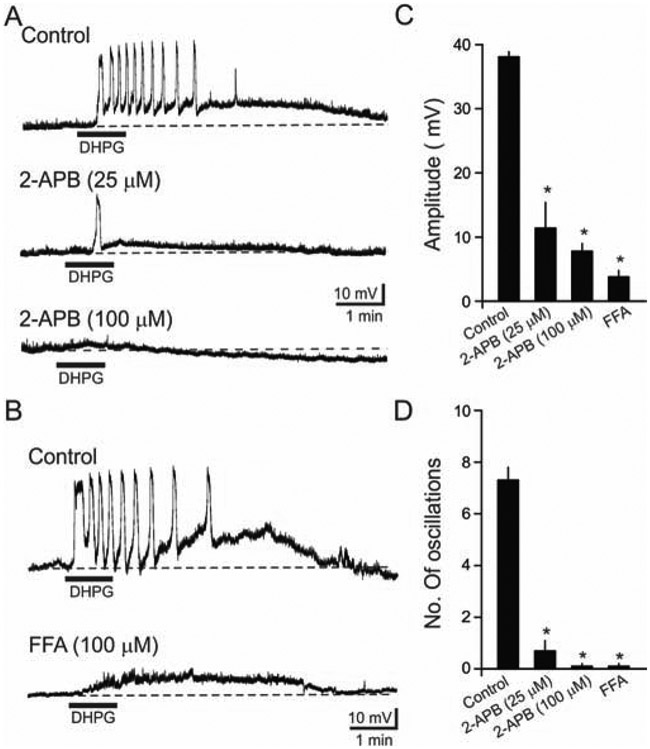
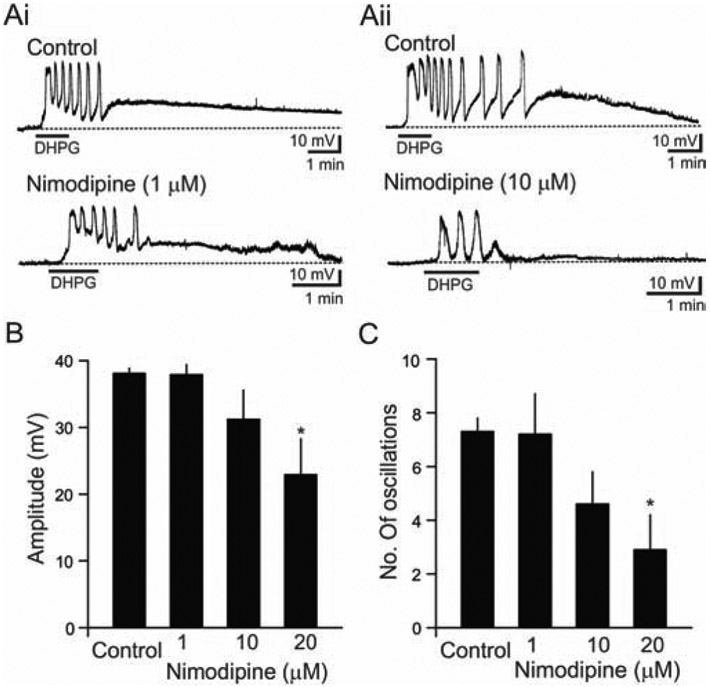
GABAergic interneurons in the hippocampus are critically involved in almost all hippocampal circuit functions including coordinated network activity. Somatostatin-expressing oriens-lacunosum moleculare (O-LM) interneurons are a major subtype of dendritically projecting interneurons in hippocampal subregions (e.g., CA1), and express group I metabotropic glutamate receptors (mGluRs), specifically mGluR and mGluR. Group I mGluRs are thought to regulate hippocampal circuit functions partially through GABAergic interneurons. Previous studies suggest that a group I/II mGluR agonist produces slow supra-threshold membrane oscillations (<0.1 Hz), which are associated with high-frequency action potential (AP) discharges in O-LM interneurons. However, the properties and underlying mechanisms of these slow oscillations remain largely unknown. We performed whole-cell patch-clamp recordings from mouse interneurons in the stratum oriens/alveus (O/A interneurons) including CA1 O-LM interneurons. Our study revealed that the selective mGluR agonist (S)-3,5-dihydroxyphenylglycine (DHPG) induced slow membrane oscillations (<0.1 Hz), which were associated with gamma frequency APs followed by AP-free perithreshold gamma oscillations. The selective mGluR antagonist (S)-(+)-α-Amino-4-carboxy-2-methylbenzeneacetic acid (LY367385) reduced the slow oscillations, and the selective mGluR antagonist 2-methyl-6-(phenylethynyl)pyridine hydrochloride (MPEP) partially blocked them. Blockade of nonselective cation-conducting transient receptor potential channels, L-type Ca channels, or ryanodine receptors all abolished the slow oscillations, suggesting the involvement of multiple mechanisms. Our findings suggest that group I mGluR activation in O/A interneurons may play an important role in coordinated network activity, and O/A interneuron vulnerability to excitotoxicity, in disease states like seizures, is at least in part due to an excessive rise in intracellular Ca.
海马中的 GABA 能中间神经元对于几乎所有海马回路功能都至关重要,包括协调的网络活动。表达生长抑素的或层-腔隙分子(O-LM)中间神经元是海马亚区(例如 CA1)中主要的树突投射中间神经元亚型之一,并且表达 I 组代谢型谷氨酸受体(mGluR),特别是 mGluR 和 mGluR。I 组 mGluR 被认为部分通过 GABA 能中间神经元来调节海马回路功能。先前的研究表明,I/II 组 mGluR 激动剂产生慢阈下膜振荡(<0.1 Hz),这与 O-LM 中间神经元中的高频动作电位(AP)放电有关。然而,这些慢振荡的特性和潜在机制在很大程度上仍然未知。我们从包括 CA1 O-LM 中间神经元在内的海马区的层/腔隙(O/A 中间神经元)中的小鼠中间神经元中进行全细胞膜片钳记录。我们的研究表明,选择性 mGluR 激动剂(S)-3,5-二羟基苯甘氨酸(DHPG)诱导慢膜振荡(<0.1 Hz),与伽马频率 AP 相关,随后是 AP 无阈下伽马振荡。选择性 mGluR 拮抗剂(S)-(+)-α-氨基-4-羧基-2-甲基苯乙酸(LY367385)减少慢振荡,而选择性 mGluR 拮抗剂 2-甲基-6-(苯乙炔基)吡啶盐酸盐(MPEP)部分阻断它们。非选择性阳离子传导瞬时受体电位通道、L 型钙通道或兰尼碱受体的阻断均消除了慢振荡,表明涉及多种机制。我们的发现表明,O/A 中间神经元中 I 组 mGluR 的激活可能在协调的网络活动中发挥重要作用,并且在癫痫等疾病状态下,O/A 中间神经元对兴奋性毒性的易感性至少部分是由于细胞内 Ca 过度升高所致。