Xie Hui, Zhang Qiang, Huo Kang, Liu Rui, Jian Zhi-Jie, Bian Yi-Tong, Li Guo-Liang, Zhu Dan, Zhang Li-Hui, Yang Jian, Luo Guo-Gang
Department of Neurology, The First Affiliated Hospital of Xi'an Jiaotong University, No. 277 Yanta West Road, Xi'an, 710061, Shaanxi, China.
Department of Neurology, Shaanxi Provincial People's Hospital, Xi'an, 710068, China.
BMC Neurol. 2018 Jul 2;18(1):93. doi: 10.1186/s12883-018-1096-2.
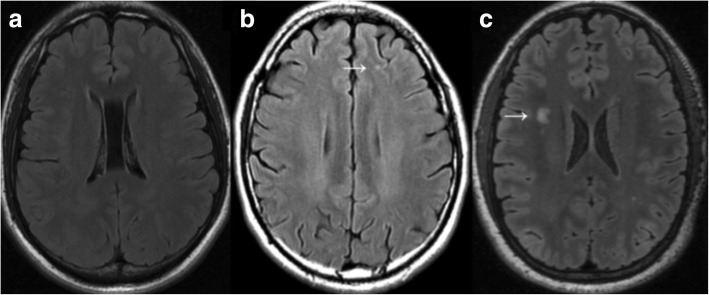
White matter hyperintensities (WMHs) are frequently detected in migraine patients. However, their significance and correlation to migraine disease burden remain unclear. This study aims to examine the correlation of WMHs with migraine features and explore the relationship between WMHs and migraine prognosis.
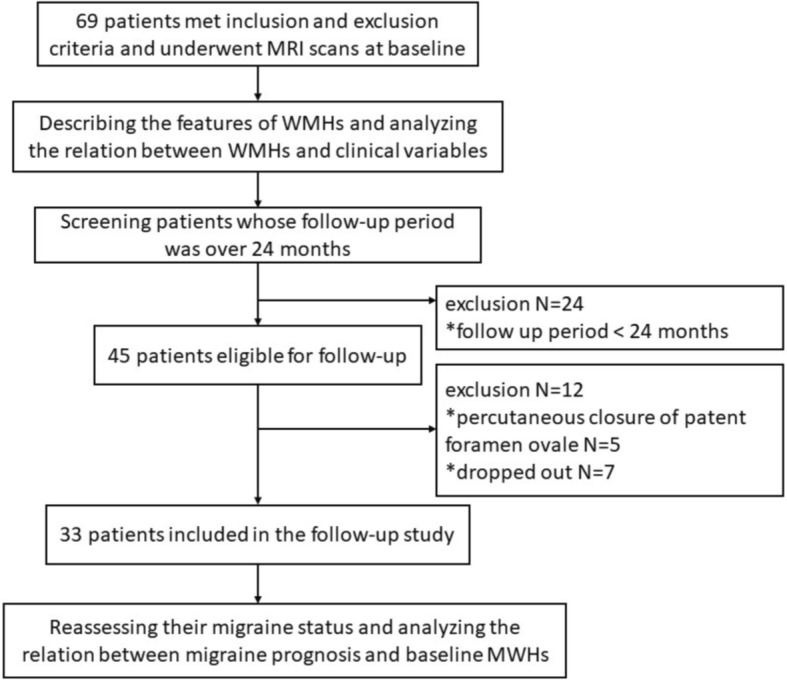
A total of 69 migraineurs underwent MRI scans to evaluate WMHs. Migraine features were compared between patients with and without WMHs. After an average follow-up period of 3 years, these patients were divided into two groups, according to the reduction of headache frequency: improved and non-improved groups. The percentage and degree of WMHs were compared between these two groups.
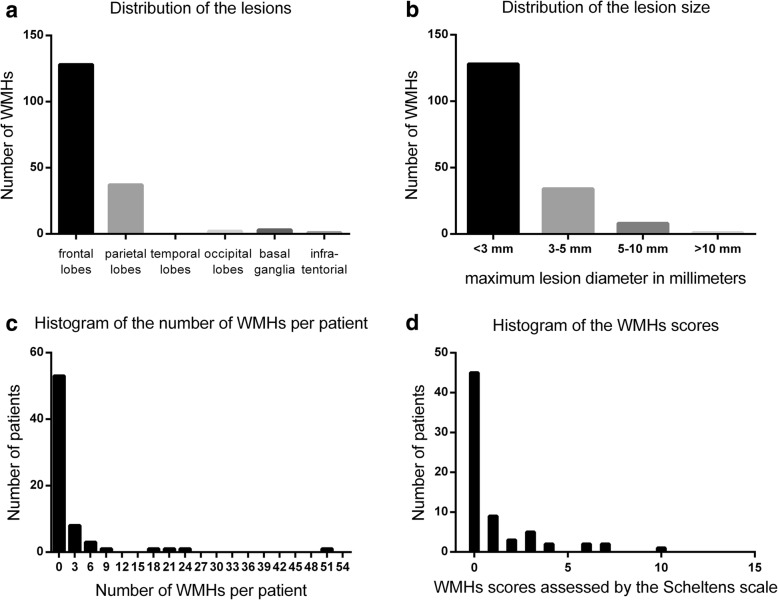
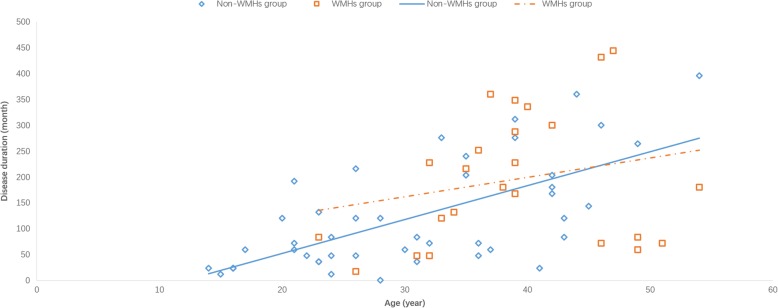
A total of 24 patients (34.8%) had WMHs. Patients with WMHs were significantly older (39.0 ± 7.9 vs. 30.6 ± 10.4 years, P < 0.001) and had a longer disease duration (median: 180.0 vs. 84.0 months, P = 0.013). Furthermore, 33 patients completed the follow up period (15 patients improved and 18 patients did not improve). Patients in the non-improved group had a higher frequency of WMHs (55.6% vs. 13.3%, P = 0.027) and median WMHs score (1.0 vs. 0.0, P = 0.030).
WMHs can predict unfavorable migraine prognosis. Furthermore, WMHs may have a closer association with age than migraine features.
偏头痛患者中经常检测到白质高信号(WMHs)。然而,它们的意义以及与偏头痛疾病负担的相关性仍不清楚。本研究旨在探讨WMHs与偏头痛特征的相关性,并探索WMHs与偏头痛预后之间的关系。
共有69名偏头痛患者接受了MRI扫描以评估WMHs。比较有和没有WMHs的患者的偏头痛特征。在平均3年的随访期后,根据头痛频率的降低情况将这些患者分为两组:改善组和未改善组。比较这两组之间WMHs的百分比和程度。
共有24名患者(34.8%)有WMHs。有WMHs的患者年龄显著更大(39.0±7.9岁 vs. 30.6±10.4岁,P<0.001),病程更长(中位数:180.0个月 vs. 84.0个月,P=0.013)。此外,33名患者完成了随访期(15名患者改善,18名患者未改善)。未改善组患者的WMHs频率更高(55.6% vs. 13.3%,P=0.027),WMHs中位数评分更高(1.0 vs. 0.0,P=0.030)。
WMHs可预测偏头痛的不良预后。此外,与偏头痛特征相比,WMHs可能与年龄有更密切的关联。