The Skaggs Institute for Chemical Biology, The Scripps Research Institute, La Jolla, CA 92037.
Department of Molecular Medicine, The Scripps Research Institute, La Jolla, CA 92037.
Proc Natl Acad Sci U S A. 2018 Jul 17;115(29):7527-7532. doi: 10.1073/pnas.1807109115. Epub 2018 Jul 2.
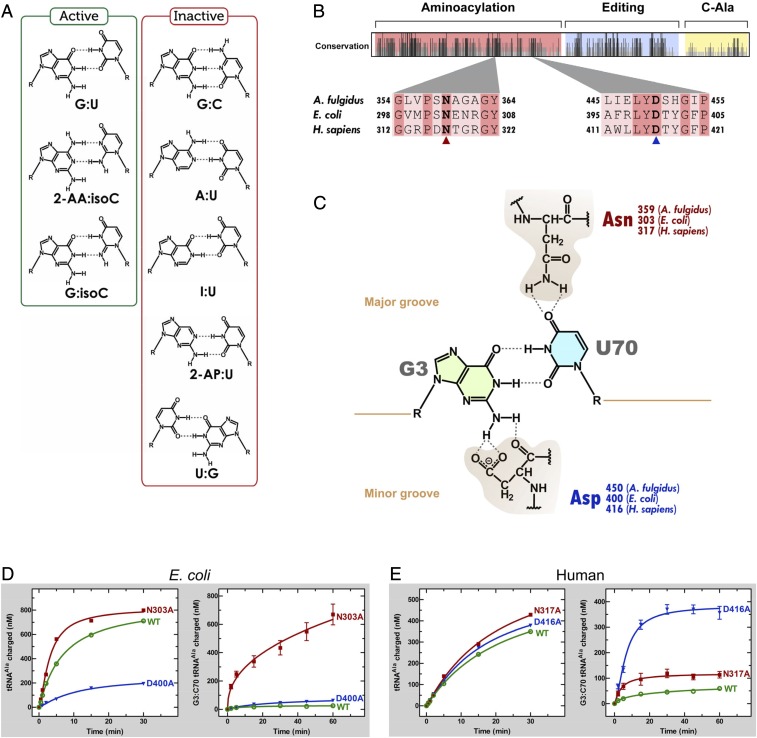
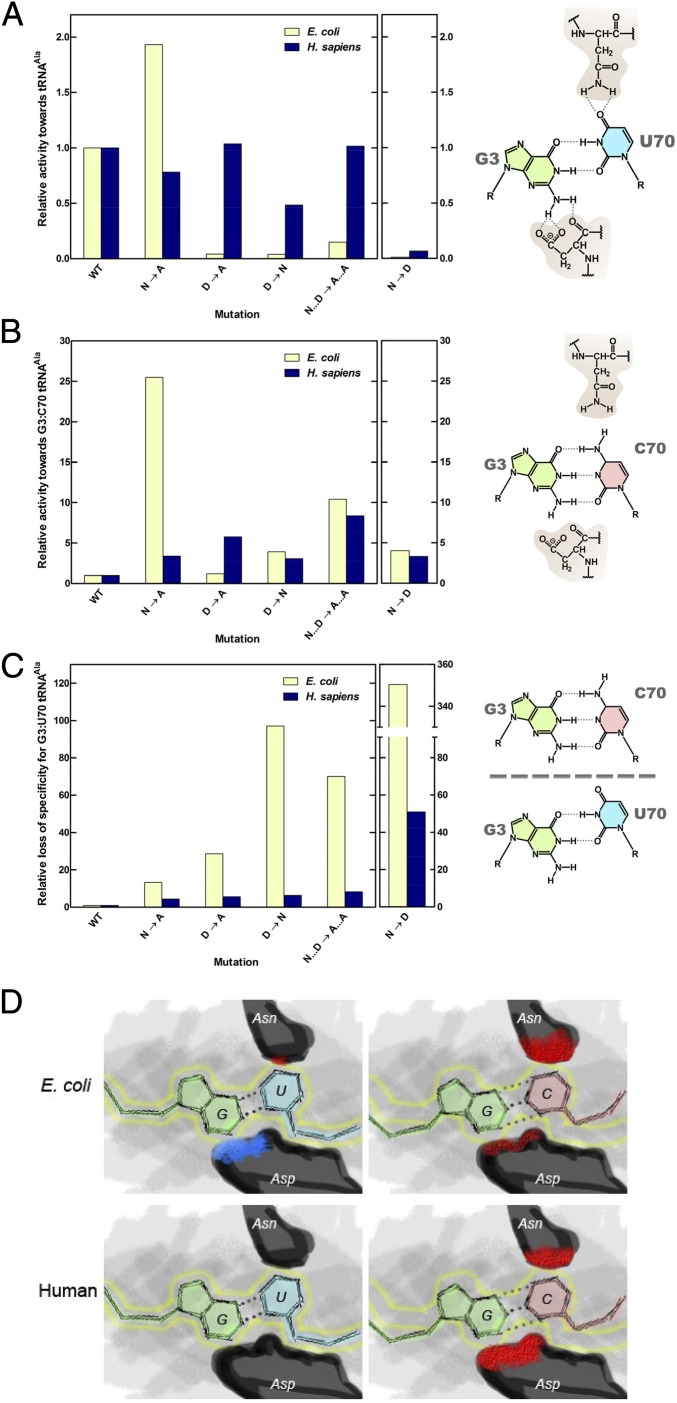
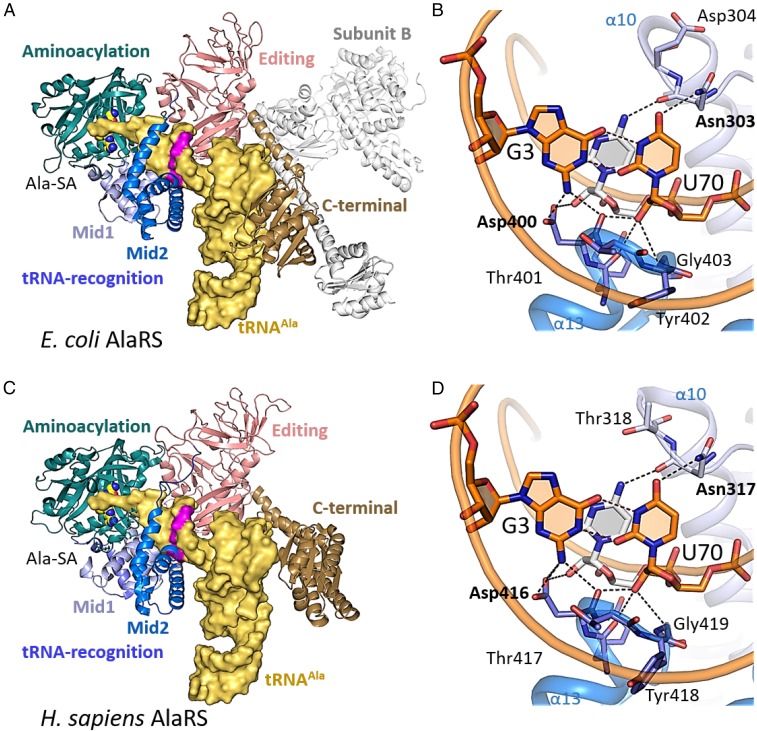
Throughout three domains of life, alanyl-tRNA synthetases (AlaRSs) recognize a G3:U70 base pair in the acceptor stem of tRNA as the major identity determinant of tRNA The crystal structure of the archaeon AlaRS in complex with tRNA provided the basis for G3:U70 recognition with residues (Asp and Asn) that are conserved in the three domains [Naganuma M, et al. (2014) 510:507-511]. The recognition mode is unprecedented, with specific accommodation of the dyad asymmetry of the G:U wobble pair and exclusion of the dyad symmetry of a Watson-Crick pair. With this conserved mode, specificity is based more on "fit" than on direct recognition of specific atomic groups. Here, we show that, in contrast to the archaeal complex, the enzyme uses direct positive (energetically favorable) minor groove recognition of the unpaired 2-amino of G3 by Asp and repulsion of a competing base pair by Asn. Strikingly, mutations that disrupted positive recognition by the enzyme had little or no effect on G:U recognition by the human enzyme. Alternatively, AlaRS selects G:U without positive recognition and uses Asp instead to repel a competitor. Thus, the widely conserved Asp-plus-Asn architecture of AlaRSs can select G:U in a straightforward (bacteria) or two different unconventional (eukarya/archaea) ways. The adoption of different modes for recognition of a widely conserved G:U pair in alanine tRNAs suggests an early and insistent role for G:U in the development of the genetic code.
在生命的三个领域中,丙氨酰-tRNA 合成酶(AlaRSs)识别 tRNA 接受茎中的 G3:U70 碱基对作为 tRNA 的主要身份决定因素。古菌 AlaRS 与 tRNA 复合物的晶体结构为 G3:U70 识别提供了基础,其中有保守残基(天冬氨酸和天冬酰胺)参与识别 [Naganuma M, 等. (2014) 510:507-511]。这种识别模式是前所未有的,对 G:U 摆动对的二联体不对称具有特异性容纳,排除了 Watson-Crick 对的二联体对称。通过这种保守模式,特异性更多地基于“适配”而不是直接识别特定的原子基团。在这里,我们表明,与古菌复合物相反,该酶利用天冬氨酸直接(能量有利)识别未配对的 G3 的 2-氨基,同时排斥竞争碱基对。引人注目的是,破坏该酶的直接正识别的突变对人酶的 G:U 识别几乎没有影响。相反,AlaRS 在没有正识别的情况下选择 G:U,并利用天冬氨酸来排斥竞争碱基。因此,AlaRSs 中广泛保守的天冬氨酸加天冬酰胺结构可以以直接的(细菌)或两种不同的非常规(真核生物/古菌)方式选择 G:U。在丙氨酸 tRNA 中广泛保守的 G:U 对的不同识别模式的采用表明 G:U 在遗传密码发展中的早期和强烈作用。