MRC Centre for Neuropsychiatric Genetics and Genomics, Division of Psychological Medicine and Clinical Neurosciences, School of Medicine, Cardiff University, Cardiff, CF24 4HQ, UK.
Cardiff University Brain Research Imaging Centre, School of Psychology, Cardiff University, Cardiff, CF24 4HQ, UK.
Neuropsychopharmacology. 2018 Dec;43(13):2578-2585. doi: 10.1038/s41386-018-0126-5. Epub 2018 Jun 23.
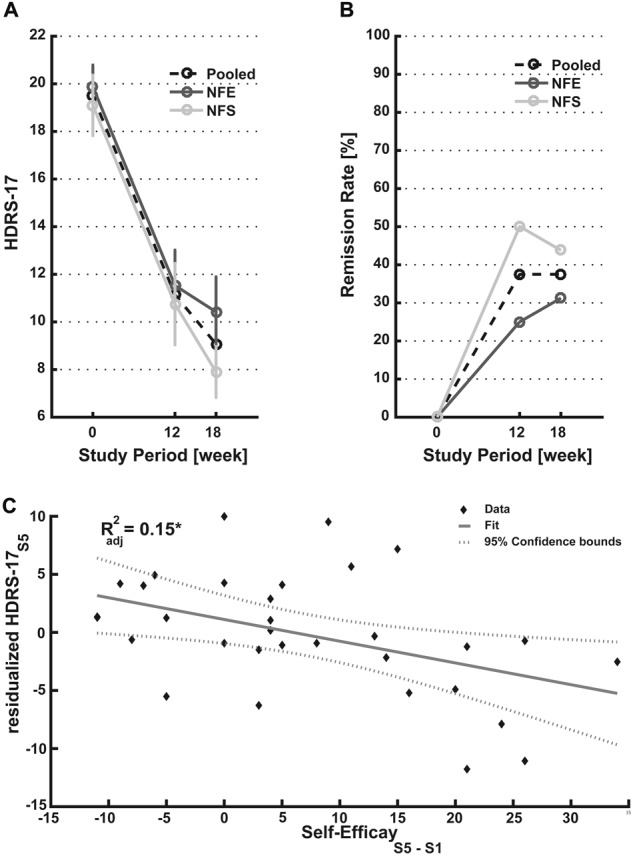
Functional magnetic resonance imaging neurofeedback (fMRI-NF) training of areas involved in emotion processing can reduce depressive symptoms by over 40% on the Hamilton Depression Rating Scale (HDRS). However, it remains unclear if this efficacy is specific to feedback from emotion-regulating regions. We tested in a single-blind, randomized, controlled trial if upregulation of emotion areas (NFE) yields superior efficacy compared to upregulation of a control region activated by visual scenes (NFS). Forty-three moderately to severely depressed medicated patients were randomly assigned to five sessions augmentation treatment of either NFE or NFS training. At primary outcome (week 12) no significant group mean HDRS difference was found (B = -0.415 [95% CI -4.847 to 4.016], p = 0.848) for the 32 completers (16 per group). However, across groups depressive symptoms decreased by 43%, and 38% of patients remitted. These improvements lasted until follow-up (week 18). Both groups upregulated target regions to a similar extent. Further, clinical improvement was correlated with an increase in self-efficacy scores. However, the interpretation of clinical improvements remains limited due to lack of a sham-control group. We thus surveyed effects reported for accepted augmentation therapies in depression. Data indicated that our findings exceed expected regression to the mean and placebo effects that have been reported for drug trials and other sham-controlled high-technology interventions. Taken together, we suggest that the experience of successful self-regulation during fMRI-NF training may be therapeutic. We conclude that if fMRI-NF is effective for depression, self-regulation training of higher visual areas may provide an effective alternative.
功能磁共振成像神经反馈 (fMRI-NF) 训练涉及情绪处理的区域可以使汉密尔顿抑郁评定量表 (HDRS) 的抑郁症状降低 40%以上。然而,目前尚不清楚这种疗效是否特定于情绪调节区域的反馈。我们在一项单盲、随机、对照试验中测试了,与视觉场景激活的控制区域 (NFS) 相比,情绪区域的上调 (NFE) 是否能产生更好的疗效。43 名中重度抑郁的药物治疗患者被随机分配到五个疗程的 NFE 或 NFS 训练增强治疗中。在主要结局(第 12 周),32 名完成者(每组 16 名)没有发现组间 HDRS 评分有显著差异(B = -0.415 [95% CI -4.847 至 4.016],p = 0.848)。然而,两组的抑郁症状都减轻了 43%,38%的患者缓解。这些改善持续到随访(第 18 周)。两组都以相似的程度上调了目标区域。此外,临床改善与自我效能评分的增加相关。然而,由于缺乏假对照组,临床改善的解释仍然有限。因此,我们调查了抑郁症中接受的增强治疗的报告效果。数据表明,我们的发现超过了药物试验和其他假对照高科技干预报告的预期回归均值和安慰剂效应。总的来说,我们认为在 fMRI-NF 训练中成功进行自我调节的体验可能具有治疗作用。我们得出结论,如果 fMRI-NF 对抑郁症有效,那么更高视觉区域的自我调节训练可能是一种有效的替代方法。