Department of Laboratory Medicine and Pathobiology, MaRS Centre, University of Toronto, West Tower, 661 University Avenue, Toronto, ON, M5G 1M1, Canada.
Department of Molecular Genetics, MaRS Centre, University of Toronto, West Tower, 661 University Avenue, Toronto, ON, M5G 1M1, Canada.
Nat Commun. 2018 Jul 2;9(1):2567. doi: 10.1038/s41467-018-05009-7.
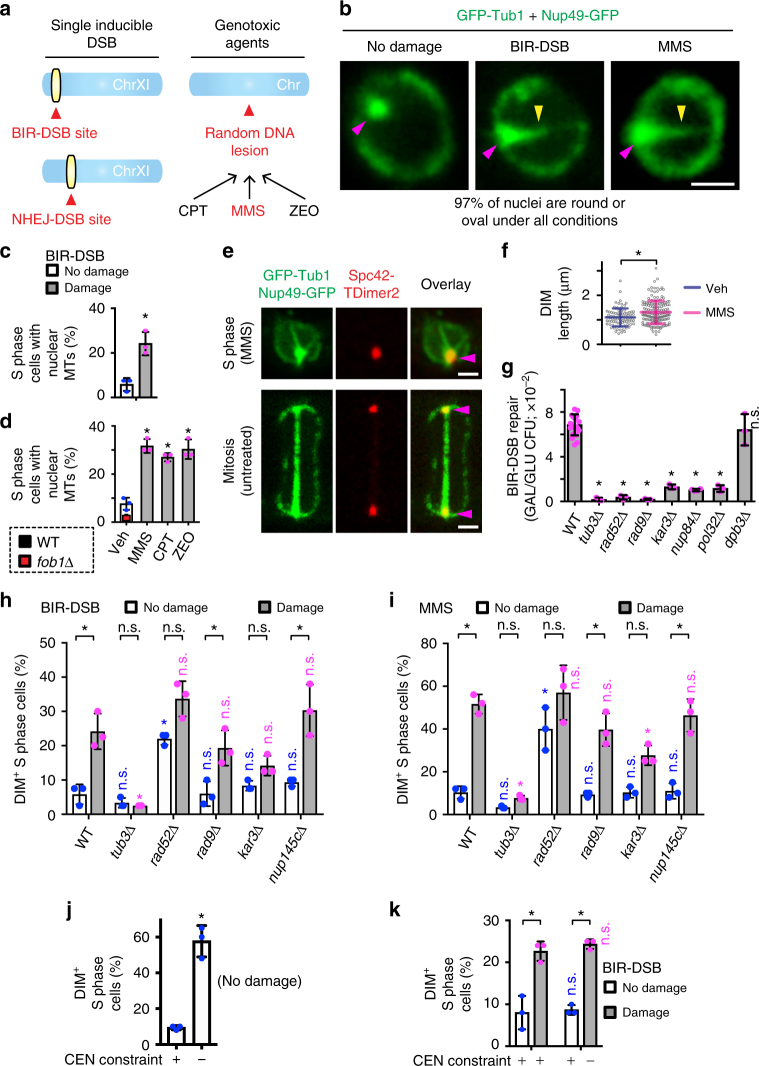
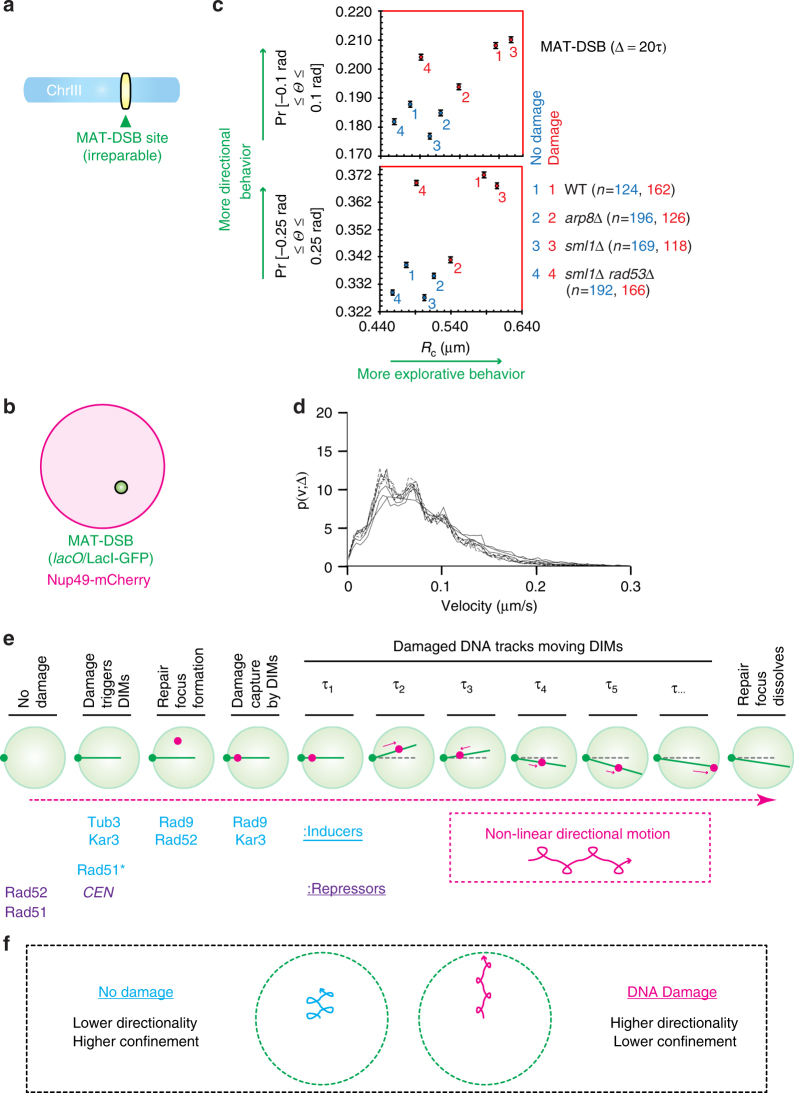
Damaged DNA shows increased mobility, which can promote interactions with repair-conducive nuclear pore complexes (NPCs). This apparently random mobility is paradoxically abrogated upon disruption of microtubules or kinesins, factors that typically cooperate to mediate the directional movement of macromolecules. Here, we resolve this paradox by uncovering DNA damage-inducible intranuclear microtubule filaments (DIMs) that mobilize damaged DNA and promote repair. Upon DNA damage, relief of centromeric constraint induces DIMs that cooperate with the Rad9 DNA damage response mediator and Kar3 kinesin motor to capture DNA lesions, which then linearly move along dynamic DIMs. Decreasing and hyper-inducing DIMs respectively abrogates and hyper-activates repair. Accounting for DIM dynamics across cell populations by measuring directional changes of damaged DNA reveals that it exhibits increased non-linear directional behavior in nuclear space. Abrogation of DIM-dependent processes or repair-promoting factors decreases directional behavior. Thus, inducible and dynamic nuclear microtubule filaments directionally mobilize damaged DNA and promote repair.
受损的 DNA 表现出增加的移动性,这可以促进与修复促进性核孔复合物(NPC)的相互作用。这种明显的随机移动性在微管或驱动蛋白被破坏时被取消,而这些因素通常合作介导大分子的定向运动。在这里,我们通过揭示可诱导核内微管丝(DIM)来解决这个悖论,这些微管丝可移动受损的 DNA 并促进修复。在 DNA 损伤时,着丝粒约束的缓解诱导 DIM,与 Rad9 DNA 损伤反应介质和 Kar3 驱动蛋白合作,捕获 DNA 损伤,然后沿着动态 DIM 线性移动。减少和过度诱导 DIM 分别取消和过度激活修复。通过测量受损 DNA 的方向变化来衡量整个细胞群体中的 DIM 动力学,揭示了它在核空间中表现出增加的非线性定向行为。取消 DIM 依赖性过程或促进修复的因素会降低定向行为。因此,可诱导和动态的核微管丝定向移动受损的 DNA 并促进修复。