Breast Service, Department of Surgery, Memorial Sloan Kettering Cancer Center, New York, NY, USA.
Biostatistics Service, Department of Epidemiology and Biostatistics, Memorial Sloan Kettering Cancer Center, New York, NY, USA.
Ann Surg Oncol. 2018 Oct;25(10):2909-2916. doi: 10.1245/s10434-018-6585-4. Epub 2018 Jul 2.
Nipple-sparing mastectomy (NSM) is increasingly used for breast cancer risk reduction and treatment. Prior small studies with variable control for baseline characteristics suggest superior satisfaction with NSM. The purpose of this study was to compare patient satisfaction following NSM and total mastectomy (TM) utilizing the BREAST-Q patient-reported outcome measure in a well-characterized patient population.
Patients at a single institution undergoing NSM or TM with immediate tissue expander/implant reconstruction who completed a follow-up BREAST-Q from 2007 to 2017 were identified by retrospective review of a prospective database. Baseline characteristics were compared, and linear mixed models were used to analyze associations with BREAST-Q scores over time.
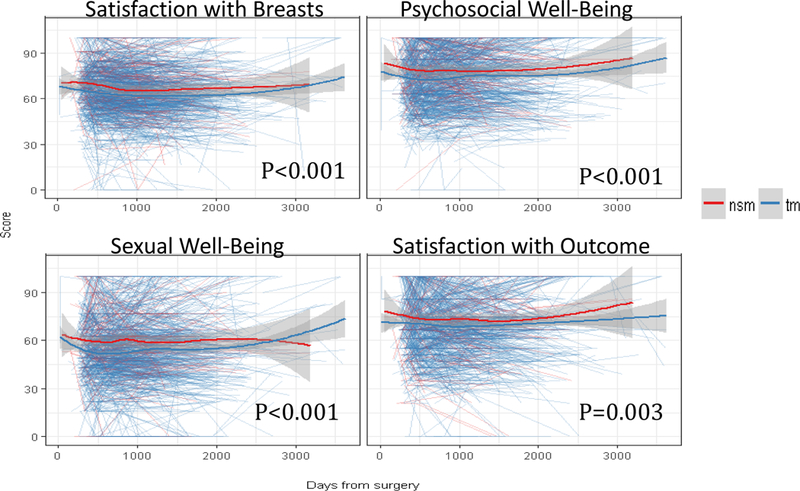
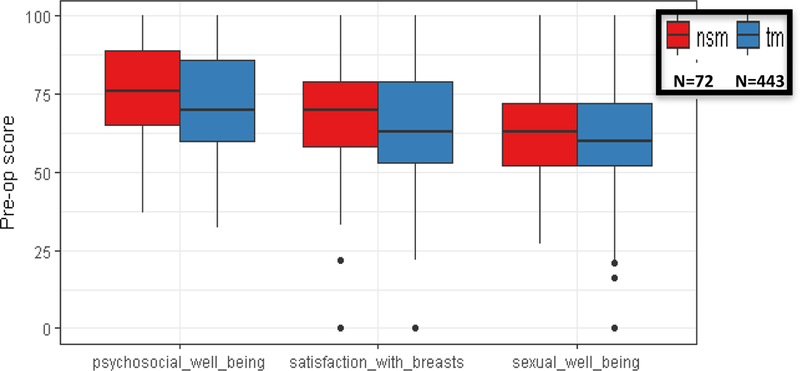
Of 1866 eligible patients, 219 (12%) underwent NSM, and 1647 (88%) underwent TM. Median time from baseline to BREAST-Q was 658 days. Patients with NSM were younger, more likely to be white, and had lower BMI. They more often had prophylactic surgery, bilateral mastectomies, lower-stage disease, and less often received chemotherapy/radiation than patients with TM. On multivariable analysis, after controlling for relevant clinical variables, there was no difference in satisfaction with breasts or satisfaction with outcome overall between NSM and TM patients. Psychosocial well-being and sexual well-being were significantly higher in the NSM group. After additionally controlling for preoperative BREAST-Q score in a subset of patients (72 NSM; 443 TM), only psychosocial well-being remained significantly higher in NSM patients.
Patient-reported outcomes should be discussed with women weighing the risks and benefits of NSM to provide a better understanding of expected quality of life.
保留乳头的乳房切除术(NSM)越来越多地用于降低乳腺癌风险和治疗。先前的小型研究显示,在控制基线特征方面存在差异,表明 NSM 的满意度更高。本研究旨在利用 BREAST-Q 患者报告结局测量工具,在特征良好的患者人群中比较 NSM 和全乳切除术(TM)的患者满意度。
通过回顾性分析前瞻性数据库,确定了 2007 年至 2017 年期间在单家机构接受 NSM 或 TM 且完成 BREAST-Q 随访的患者。比较了基线特征,并使用线性混合模型分析了与 BREAST-Q 评分随时间的关联。
在 1866 名合格患者中,219 名(12%)接受了 NSM,1647 名(88%)接受了 TM。从基线到 BREAST-Q 的中位数时间为 658 天。NSM 患者年龄较小,更可能是白人,BMI 较低。与 TM 患者相比,他们更常接受预防性手术、双侧乳房切除术、较低分期的疾病,且较少接受化疗/放疗。在多变量分析中,控制了相关临床变量后,NSM 和 TM 患者的乳房满意度和总体结局满意度无差异。NSM 组的心理社会健康和性健康显著更高。在亚组患者(72 例 NSM;443 例 TM)中进一步控制术前 BREAST-Q 评分后,仅心理社会健康状况仍在 NSM 患者中显著更高。
应与权衡 NSM 风险和获益的女性讨论患者报告的结果,以更好地了解预期的生活质量。