Lehrstuhl für Technische Mikrobiologie, Technische Universität München, Freising, Germany.
PLoS One. 2018 Jul 3;13(7):e0200102. doi: 10.1371/journal.pone.0200102. eCollection 2018.
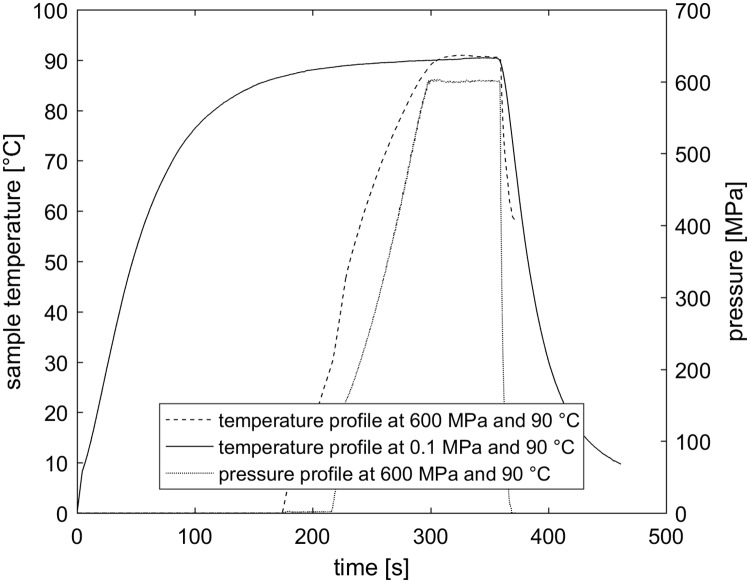
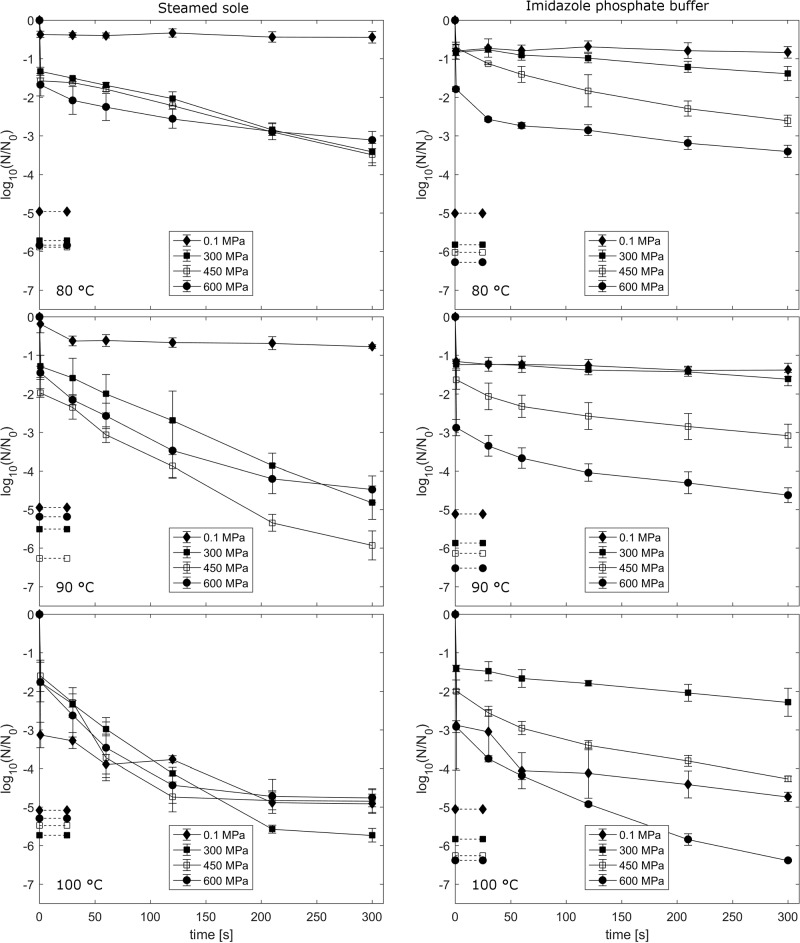
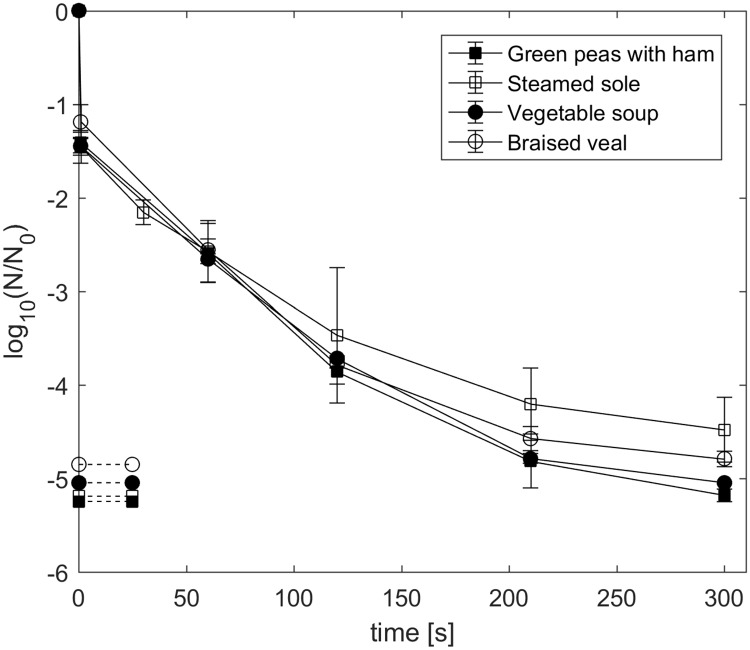
The effect of high pressure thermal (HPT) treatments on the inactivation of spores of non-proteolytic type E Clostridium botulinum TMW 2.990 was investigated at high pressures (300 to 600 MPa) and elevated temperatures (80 to 100 °C) in four low-acid foods (steamed sole, green peas with ham, vegetable soup, braised veal) and imidazole phosphate buffer (IPB). In addition, corresponding conventional thermal treatments at ambient pressure were performed to expose possible synergisms of pressure and temperature on spore inactivation. In general, spore count reduction was more efficient by combining pressure and temperatures < 100 °C and the overall process duration could be shortened due to accelerated heating rates (adiabatic effect). Processing at 90 °C and 600 MPa resulted in inactivation below the detection limit after 5 min in all foods except steamed sole. Traditional thermal processing of spores at 90 °C for 10 min, on the other hand, did not result in an estimated 6-log reduction. Additional HPT treatments in steamed sole and IPB did not reveal pronounced food matrix dependent protective effects. Here, varying pressure levels did not appear to be the driving force for spore count reduction in steamed sole at any temperature. By applying a Weibull distribution on destruction kinetics of isobaric/isothermal holding times, 6D-values were calculated. Compression and decompression phase (1 s pressure holding time) had a considerable impact on spore count reduction (max. -2.9 log units) in both, foods and buffer. Hence, compression and decompression phases should directly be included into the total lethal effect of HPT treatments to avoid prolonged holding times and overprocessing.
高压热(HPT)处理对非蛋白酶型 E 型肉毒梭状芽孢杆菌 TMW 2.990 孢子的灭活效果进行了研究,处理条件为在四种低酸食品(蒸比目鱼、火腿豌豆、蔬菜汤、炖小牛肉)和咪唑磷酸盐缓冲液(IPB)中,在 300 至 600 MPa 的高压和 80 至 100°C 的高温下进行处理。此外,还进行了相应的常压常规热处理,以暴露压力和温度对孢子灭活的协同作用。一般来说,在 100°C 以下的温度下结合压力处理时,孢子计数减少的效率更高,并且由于加热速率加快(绝热效应),整个过程的持续时间可以缩短。在所有食品中,除了蒸比目鱼外,在 90°C 和 600 MPa 下处理 5 分钟后,孢子的失活程度低于检测限。另一方面,传统的 90°C 热处理 10 分钟,孢子的失活程度未达到估计的 6 个对数减少。在蒸比目鱼和 IPB 中进行额外的 HPT 处理并未显示出明显的食品基质依赖性保护作用。在此,在任何温度下,不同的压力水平似乎都不是蒸比目鱼中孢子计数减少的驱动力。通过在等压/等温保持时间的破坏动力学上应用 Weibull 分布,计算出 6D 值。在食品和缓冲液中,压缩和减压阶段(1 秒压力保持时间)对孢子计数减少有很大的影响(最大减少 2.9 个对数单位)。因此,压缩和减压阶段应直接包含在 HPT 处理的总致死效应中,以避免延长保持时间和过度处理。