Beth Israel Deaconess Medical Center, Department of Pathology, Boston, MA, United States of America.
PLoS One. 2018 Jul 3;13(7):e0199688. doi: 10.1371/journal.pone.0199688. eCollection 2018.
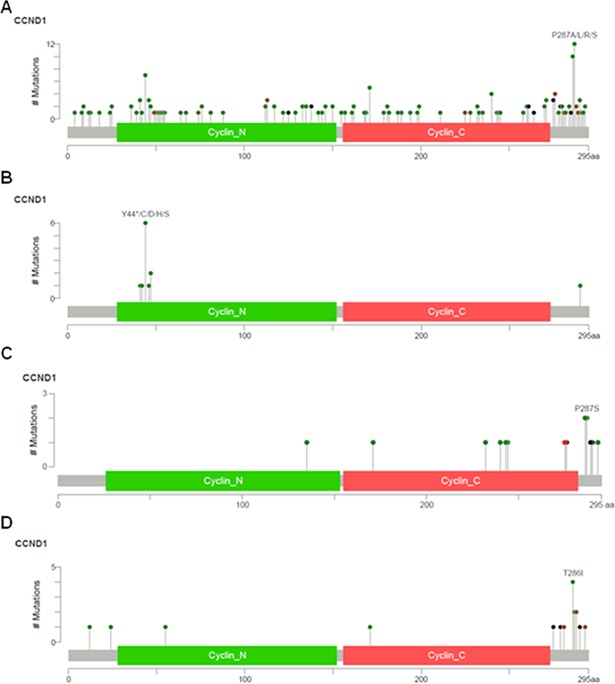
Cyclin D1 (CCND1) is a core cell cycle regulator and is frequently overexpressed in human cancers, often via amplification, translocation or post-transcription regulation. Accumulating evidence suggests that mutations of the CCND1 gene that result in nuclear retention and constitutive activation of CDK4/6 kinases are oncogenic drivers in cancer. However, the spectrum of CCND1 mutations across human cancers has not been systematically investigated. Here, we retrospectively mined whole-exome sequencing data from 124 published studies representing up to 29,432 cases from diverse cancer types and sites of origin, including carcinoma, melanoma, sarcoma and lymphoma/leukemia, via online tools to determine the frequency and spectrum of CCND1 mutations in human cancers and their associated clinico-pathological characteristics. Overall, in contrast to gene amplification, which occurred at a frequency of 4.8% (1,419 of 28,769 cases), CCND1 mutations were of very low frequency (0.5%, 151 of 29,432 cases) across all cancers, but were predominantly enriched in uterine endometrioid-type adenocarcinoma (6.5%, 30 of 458 cases) in both primary tumors and in advanced, metastatic endometrial cancer samples. CCND1 mutations in endometrial endometrioid adenocarcinoma occurred most commonly in the c-terminus of cyclin D1, as putative driver mutations, in a region thought to result in oncogenic activation of cyclin D1 via inhibition of Thr-286 phosphorylation and nuclear export, thereby resulting in nuclear retention and protein overexpression. Our findings implicate oncogenic c-terminal mutations of CCND1 in the pathogenesis of a subset of human cancers and provide a key resource to guide future preclinical and clinical investigations.
细胞周期蛋白 D1(CCND1)是核心细胞周期调节剂,在人类癌症中经常过度表达,通常通过扩增、易位或转录后调节。越来越多的证据表明,导致核保留和 CDK4/6 激酶组成性激活的 CCND1 基因突变是癌症中的致癌驱动因素。然而,CCND1 基因突变在人类癌症中的谱尚未被系统研究。在这里,我们通过在线工具回顾性地挖掘了来自 124 项已发表研究的全外显子组测序数据,这些研究代表了来自不同癌症类型和起源部位的多达 29432 例病例,包括癌、黑色素瘤、肉瘤和淋巴瘤/白血病,以确定 CCND1 基因突变在人类癌症中的频率和谱及其与临床病理特征的关联。总体而言,与基因扩增(发生频率为 4.8%,即 28769 例中的 1419 例)相比,CCND1 基因突变在所有癌症中的频率非常低(0.5%,即 29432 例中的 151 例),但在原发性肿瘤和晚期转移性子宫内膜癌样本中,主要富集于子宫子宫内膜样型腺癌(6.5%,458 例中的 30 例)。子宫内膜样腺癌中的 CCND1 基因突变最常见于细胞周期蛋白 D1 的 C 端,作为假定的驱动突变,发生在一个被认为通过抑制 Thr-286 磷酸化和核输出从而导致核保留和蛋白过表达而导致细胞周期蛋白 D1 致癌激活的区域。我们的研究结果表明,CCND1 的致癌 C 端突变参与了人类癌症的一部分发病机制,并为指导未来的临床前和临床研究提供了关键资源。