School of Earth, Environmental and Biological Sciences, Queensland University of Technology, Brisbane, Australia.
BMC Evol Biol. 2018 Jul 3;18(1):104. doi: 10.1186/s12862-018-1218-x.
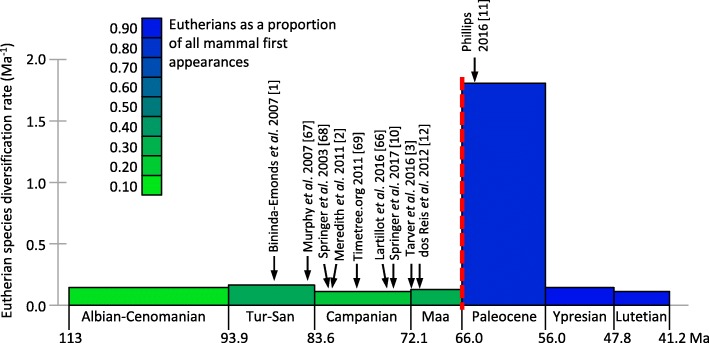
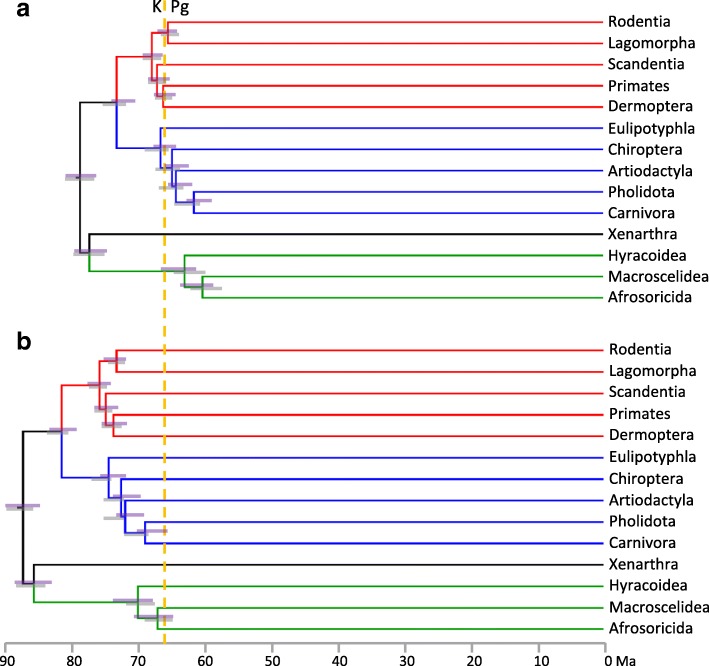
Recent molecular dating estimates for placental mammals echo fossil inferences for an explosive interordinal diversification, but typically place this event some 10-20 million years earlier than the Paleocene fossils, among apparently more "primitive" mammal faunas.
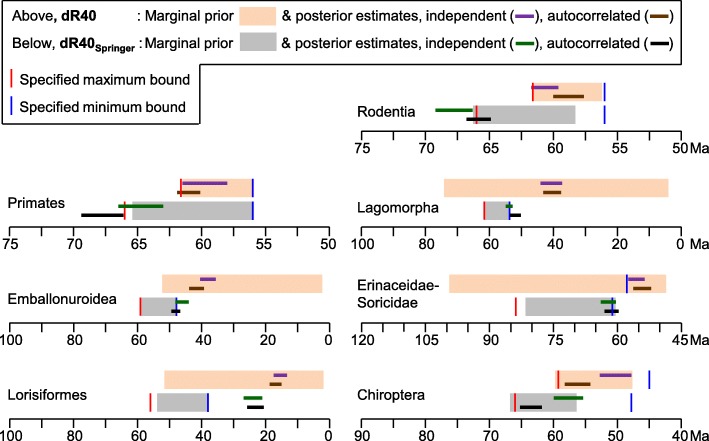
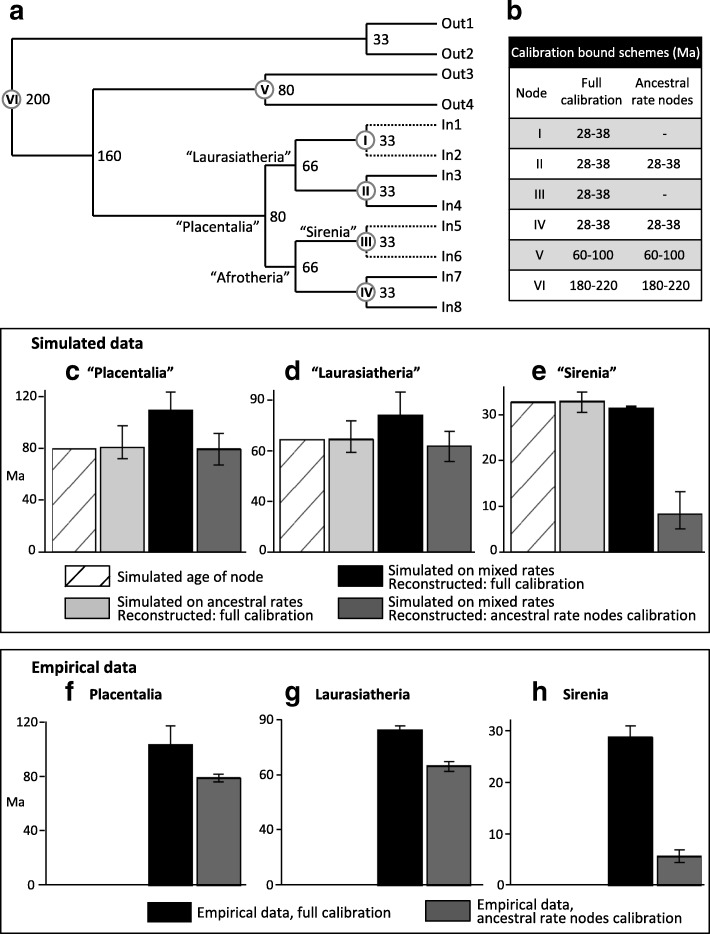
However, current models of molecular evolution do not adequately account for parallel rate changes, and result in dramatic divergence underestimates for large, long-lived mammals such as whales and hominids. Calibrating among these taxa shifts the rate model errors deeper in the tree, inflating interordinal divergence estimates. We employ simulations based on empirical rate variation, which show that this "error-shift inflation" can explain previous molecular dating overestimates relative to fossil inferences. Molecular dating accuracy is substantially improved in the simulations by focusing on calibrations for taxa that retain plesiomorphic life-history characteristics. Applying this strategy to the empirical data favours the soft explosive model of placental evolution, in line with traditional palaeontological interpretations - a few Cretaceous placental lineages give rise to a rapid interordinal diversification following the 66 Ma Cretaceous-Paleogene boundary mass extinction.
Our soft explosive model for the diversification of placental mammals brings into agreement previously incongruous molecular, fossil, and ancestral life history estimates, and closely aligns with a growing consensus for a similar model for bird evolution. We show that recent criticism of the soft explosive model relies on ignoring both experimental controls and statistical confidence, as well as misrepresentation, and inconsistent interpretations of morphological phylogeny. More generally, we suggest that the evolutionary properties of adaptive radiations may leave current molecular dating methods susceptible to overestimating the timing of major diversification events.
最近对胎盘哺乳动物的分子年代估计与化石推断的爆炸式的洲际多样化相呼应,但通常将这一事件置于古新世化石之前的 10-2000 万年,而这些化石似乎更“原始”。
然而,目前的分子进化模型不能充分解释平行的速率变化,导致对于像鲸鱼和人类这样的大型、长寿哺乳动物的显著分歧低估。在这些分类群之间进行校准会将速率模型错误转移到树更深的地方,从而增加洲际分歧的估计。我们使用基于经验速率变化的模拟表明,这种“误差转移膨胀”可以解释以前相对于化石推断的分子年代估计过高的情况。通过关注保留了原始生活史特征的分类群的校准,模拟中的分子年代测定准确性得到了显著提高。将这一策略应用于经验数据有利于支持胎盘动物进化的软爆炸模型,这与传统古生物学的解释一致——一些白垩纪胎盘谱系在 6600 万年前的白垩纪-古近纪边界大规模灭绝后,迅速产生了洲际多样化。
我们对胎盘哺乳动物多样化的软爆炸模型将以前不一致的分子、化石和祖先生活史估计协调一致,并与鸟类进化的类似模型的共识紧密一致。我们表明,最近对软爆炸模型的批评依赖于忽略实验控制和统计置信度,以及对形态系统发育的错误表述和不一致的解释。更广泛地说,我们认为适应性辐射的进化特性可能使当前的分子年代测定方法容易高估重大多样化事件的时间。