Laboratory of Plant Physiology, Wageningen University & Research, Droevendaalsesteeg 1, 6708 PB, Wageningen, The Netherlands.
Department of Food Quality and Nutrition, Fondazione Edmund Mach, Centro Ricerca e Innovazione, Via E. Mach, 1, 38010, San Michele all'Adige, TN, Italy.
Microb Cell Fact. 2018 Jul 3;17(1):103. doi: 10.1186/s12934-018-0951-6.
Anthocyanins are polyphenolic pigments which provide pink to blue colours in fruits and flowers. There is an increasing demand for anthocyanins, as food colorants and as health-promoting substances. Plant production of anthocyanins is often seasonal and cannot always meet demand due to low productivity and the complexity of the plant extracts. Therefore, a system of on-demand supply is useful. While a number of other (simpler) plant polyphenols have been successfully produced in the yeast Saccharomyces cerevisiae, production of anthocyanins has not yet been reported.
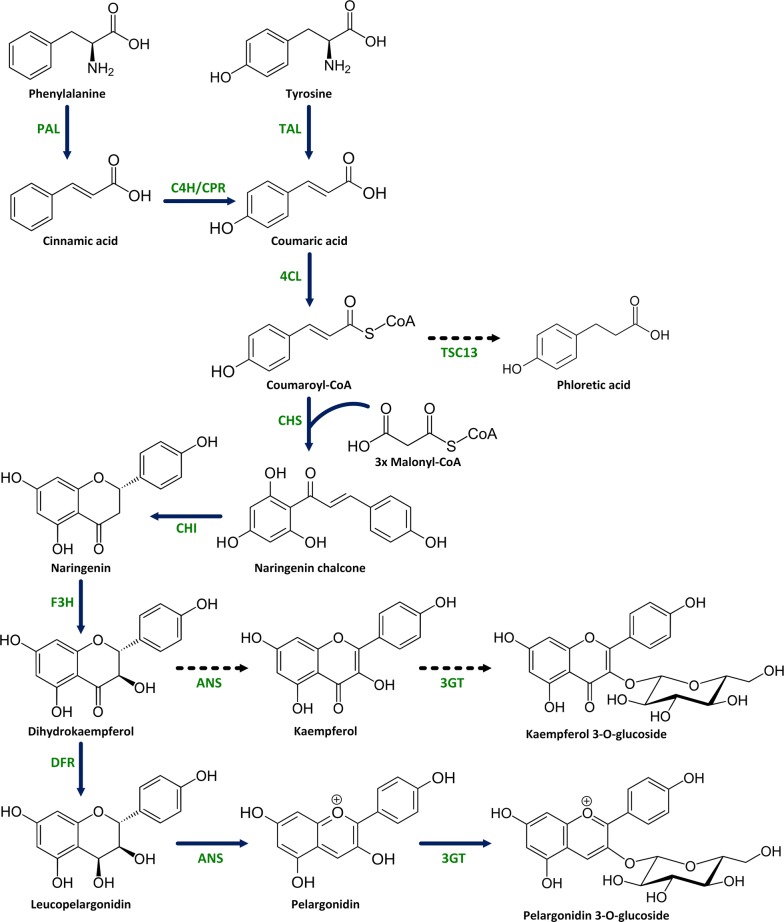
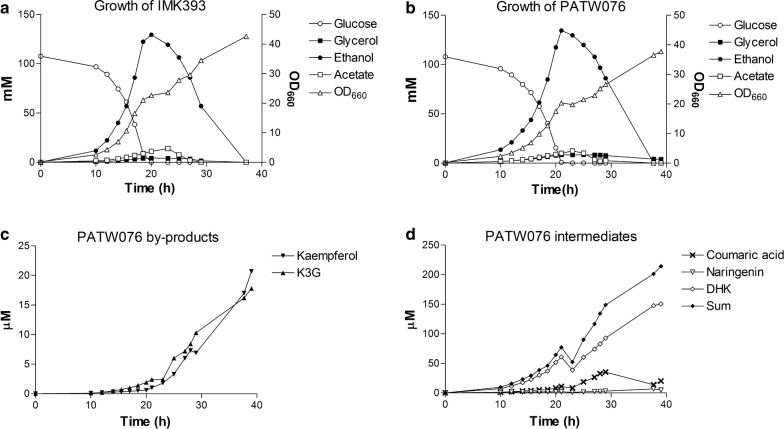
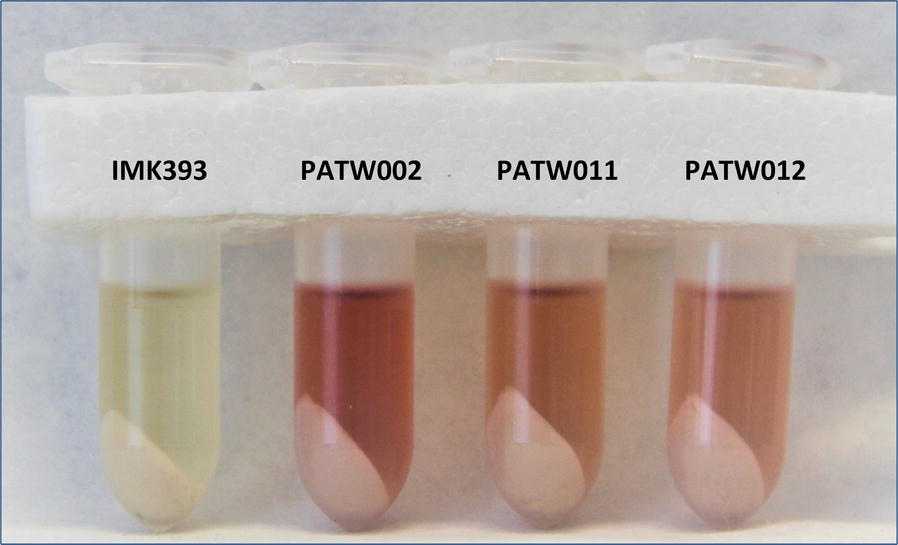
Saccharomyces cerevisiae was engineered to produce pelargonidin 3-O-glucoside starting from glucose. Specific anthocyanin biosynthetic genes from Arabidopsis thaliana and Gerbera hybrida were introduced in a S. cerevisiae strain producing naringenin, the flavonoid precursor of anthocyanins. Upon culturing, pelargonidin and its 3-O-glucoside were detected inside the yeast cells, albeit at low concentrations. A number of related intermediates and side-products were much more abundant and were secreted into the culture medium. To optimize titers of pelargonidin 3-O-glucoside further, biosynthetic genes were stably integrated into the yeast genome, and formation of a major side-product, phloretic acid, was prevented by engineering the yeast chassis. Further engineering, by removing two glucosidases which are known to degrade pelargonidin 3-O-glucoside, did not result in higher yields of glycosylated pelargonidin. In aerated, pH controlled batch reactors, intracellular pelargonidin accumulation reached 0.01 µmol/g, while kaempferol and dihydrokaempferol were effectively exported to reach extracellular concentration of 20 µM [5 mg/L] and 150 µM [44 mg/L], respectively.
The results reported in this study demonstrate the proof-of-concept that S. cerevisiae is capable of de novo production of the anthocyanin pelargonidin 3-O-glucoside. Furthermore, while current conversion efficiencies are low, a number of clear bottlenecks have already been identified which, when overcome, have huge potential to enhance anthocyanin production efficiency. These results bode very well for the development of fermentation-based production systems for specific and individual anthocyanin molecules. Such systems have both great scientific value for identifying and characterising anthocyanin decorating enzymes as well as significant commercial potential for the production of, on-demand, pure bioactive compounds to be used in the food, health and even pharma industries.
花色苷是一种多酚类色素,为水果和花朵提供粉红色到蓝色的颜色。由于花色苷作为食品着色剂和促进健康的物质的需求不断增加。植物生产花色苷往往是季节性的,由于生产力低和植物提取物复杂,往往无法满足需求。因此,按需供应系统很有用。虽然其他一些(更简单的)植物多酚已成功在酵母酿酒酵母中生产,但花色苷的生产尚未报道。
酿酒酵母被工程化以从葡萄糖开始生产天竺葵素 3-O-葡萄糖苷。来自拟南芥和大丁草的特定花色苷生物合成基因被引入到产生花色苷前体柚皮素的酿酒酵母菌株中。培养后,在酵母细胞内检测到天竺葵素及其 3-O-葡萄糖苷,但浓度较低。许多相关的中间产物和副产物更为丰富,并分泌到培养基中。为了进一步优化天竺葵素 3-O-葡萄糖苷的产量,生物合成基因被稳定整合到酵母基因组中,并通过工程改造酵母底盘来防止主要副产物 phloretic 酸的形成。进一步的工程改造,通过去除已知降解天竺葵素 3-O-葡萄糖苷的两种糖苷酶,并没有导致糖基化天竺葵素的产量更高。在充气、pH 控制的分批反应器中,细胞内天竺葵素积累达到 0.01µmol/g,同时,山柰酚和二氢山柰酚被有效输出,达到细胞外浓度 20µM[5mg/L]和 150µM[44mg/L]。
本研究报告的结果证明了酿酒酵母能够从头合成花色苷天竺葵素的概念验证。此外,尽管目前的转化率较低,但已经确定了一些明显的瓶颈,当克服这些瓶颈时,将大大提高花色苷的生产效率。这些结果为开发基于发酵的特定和单个花色苷分子生产系统提供了很好的前景。这些系统对于鉴定和表征花色苷修饰酶具有重要的科学价值,对于按需生产用于食品、健康甚至制药行业的纯生物活性化合物也具有重要的商业潜力。