Department of Health Sciences Research, Mayo Clinic, Jacksonville, FL, USA.
Department of Neuroscience, Mayo Clinic, Jacksonville, FL, USA.
Mol Neurodegener. 2018 Jul 3;13(1):35. doi: 10.1186/s13024-018-0268-2.
Single nucleotide polymorphisms (SNPs) inherited as one of two common haplotypes at the transmembrane protein 106B (TMEM106B) locus are associated with the risk of multiple neurodegenerative diseases, including frontotemporal lobar degeneration with pathological inclusions of TDP-43. Among the associated variants, rs3173615 (encoding p.T185S) is the only coding variant; however, non-coding variants may also contribute to disease risk. It has been reported that the risk haplotype is associated with higher levels of TMEM106B and increased levels of TMEM106B cause cytotoxicity; however, the precise mechanism through which TMEM106B haplotypes contribute to neurodegeneration is unclear.
We utilized RNA sequencing data derived from temporal cortex (TCX) and cerebellum (CER) from 312 North American Caucasian subjects neuropathologically diagnosed with Alzheimer's disease, progressive supranuclear palsy, pathological aging or normal controls to analyze transcriptome signatures associated with the risk (TT) and protective (SS) TMEM106B haplotypes. In cohorts matched for disease phenotype, we used Analysis of Variance (ANOVA) to identify differentially expressed genes and Weighted Gene Co-expression Network Analysis (WGCNA) to identify gene networks associated with the risk and protective TMEM106B haplotypes.
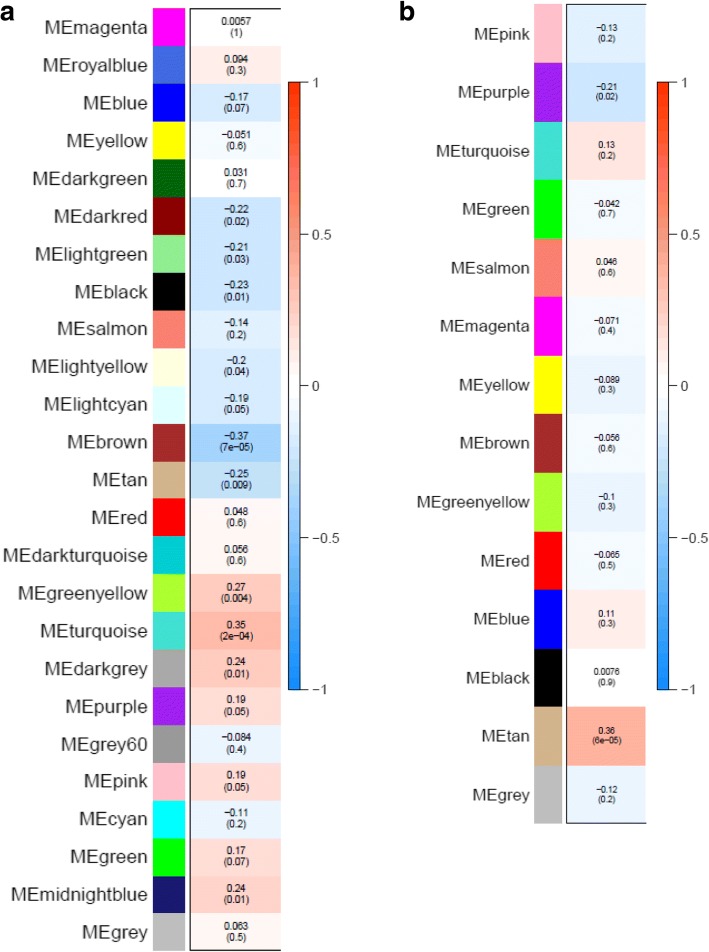
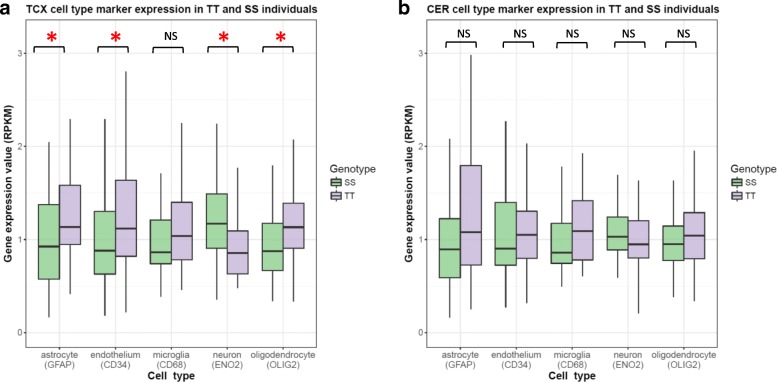
A total of 110 TCX and 116 CER samples were included in the analyses. When comparing TT to SS carriers, we detected 593 differentially expressed genes in TCX and 7 in CER. Gene co-expression network analyses further showed that in both TCX and CER the SS haplotype was positively correlated with gene networks involved in synaptic transmission, whereas the TT haplotype was positively correlated with gene networks enriched for immune response. Gene expression patterns of 5 cell-type-specific markers revealed significantly reduced expression of the neuronal marker and relative increases in all other cell markers in TT as compared to SS carriers in TCX with a similar but non-significant trend in CER.
By comparing the common TMEM106B risk and protective haplotypes we identified significant and partly conserved transcriptional differences across TCX and CER and striking changes in cell-type composition, especially in TCX. These findings illustrate the profound effect of TMEM106B haplotypes on brain health and highlight the importance to better understand TMEM106B's function and dysfunction in the context of neurodegenerative diseases.
跨膜蛋白 106B(TMEM106B)基因座上的单核苷酸多态性(SNP)作为两种常见单倍型之一遗传,与多种神经退行性疾病的风险相关,包括具有 TDP-43 病理包涵体的额颞叶变性。在相关变体中,rs3173615(编码 p.T185S)是唯一的编码变体;然而,非编码变体也可能导致疾病风险。据报道,风险单倍型与 TMEM106B 水平升高有关,而 TMEM106B 水平升高会导致细胞毒性;然而,TMEM106B 单倍型导致神经退行性变的确切机制尚不清楚。
我们利用来自 312 名北美白种人尸检时被诊断为阿尔茨海默病、进行性核上性麻痹、病理性衰老或正常对照的颞叶皮层(TCX)和小脑(CER)的 RNA 测序数据,分析与风险(TT)和保护(SS)TMEM106B 单倍型相关的转录组特征。在与疾病表型相匹配的队列中,我们使用方差分析(ANOVA)来识别差异表达基因,并使用加权基因共表达网络分析(WGCNA)来识别与风险和保护 TMEM106B 单倍型相关的基因网络。
共纳入 110 例 TCX 和 116 例 CER 样本进行分析。当比较 TT 与 SS 携带者时,我们在 TCX 中检测到 593 个差异表达基因,在 CER 中检测到 7 个。基因共表达网络分析进一步表明,在 TCX 和 CER 中,SS 单倍型与涉及突触传递的基因网络呈正相关,而 TT 单倍型与富含免疫反应的基因网络呈正相关。5 种细胞类型特异性标志物的基因表达模式显示,与 SS 携带者相比,TT 携带者的神经元标志物表达显著降低,而所有其他细胞标志物的相对表达增加,CER 中也存在类似但无统计学意义的趋势。
通过比较常见的 TMEM106B 风险和保护单倍型,我们在 TCX 和 CER 中发现了显著的、部分保守的转录差异,以及在细胞类型组成方面的显著变化,尤其是在 TCX 中。这些发现说明了 TMEM106B 单倍型对大脑健康的深远影响,并强调了更好地理解 TMEM106B 在神经退行性疾病中的功能和功能障碍的重要性。