Department of Information Technology (INTEC), Ghent University/IMEC, Technologiepark-Zwijnaarde 15, B-9052 Ghent, Belgium.
Sensors (Basel). 2018 Jul 3;18(7):2137. doi: 10.3390/s18072137.
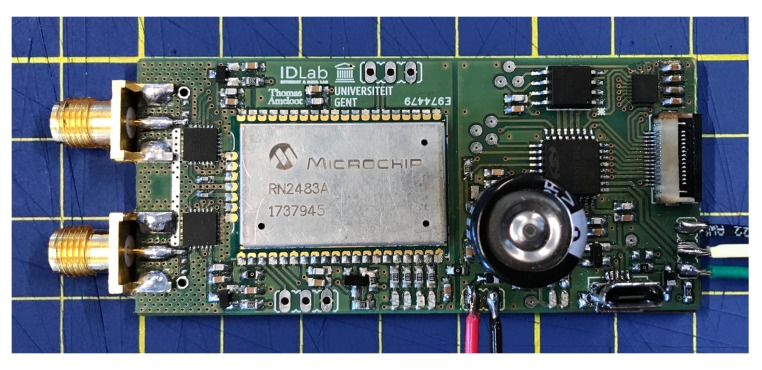
As sub-GHz wireless Internet of Things (IoT) sensor networks set the stage for long-range, low-data-rate communication, wireless technologies such as LoRa and SigFox receive a lot of attention. They aim to offer a reliable means of communication for an extensive amount of monitoring and management applications. Recently, several studies have been conducted on their performance, but none of these feature a high dynamic range in terms of channel measurement. In this contribution an autonomous, low-power, LoRa-compatible wireless sensor node is presented. The main uses for this node are situated in LoRa channel characterization and link performance analysis. By applying stepped attenuators controlled by a dynamic attenuation adjustment algorithm, this node provides a dynamic range that is significantly larger than what is provided by commercially available LoRa modules. The node was calibrated in order to obtain accurate measurements of the received signal power in dBm. In this paper, both the hardware design as well as some verification measurements are discussed, unveiling various LoRa-related research applications and opportunities.
随着亚千兆赫无线物联网 (IoT) 传感器网络为远程、低数据率通信奠定基础,LoRa 和 SigFox 等无线技术受到了广泛关注。它们旨在为大量的监测和管理应用提供可靠的通信手段。最近,已经有一些关于它们性能的研究,但这些研究都没有在信道测量方面具有高动态范围。在本贡献中,提出了一种自主的、低功耗的、兼容 LoRa 的无线传感器节点。该节点的主要用途是在 LoRa 信道特性和链路性能分析中。通过应用由动态衰减调整算法控制的步进衰减器,该节点提供了比商业可用的 LoRa 模块大得多的动态范围。该节点经过校准,以便对接收信号功率进行准确的 dBm 测量。本文讨论了硬件设计和一些验证测量,揭示了各种与 LoRa 相关的研究应用和机会。