Dipartimento di Scienze e Tecnologie Chimiche , Università di Roma "Tor Vergata" , Via della Ricerca Scientifica , 00133 Rome , Italy.
Langmuir. 2018 Dec 11;34(49):14993-14999. doi: 10.1021/acs.langmuir.8b01004. Epub 2018 Jul 18.
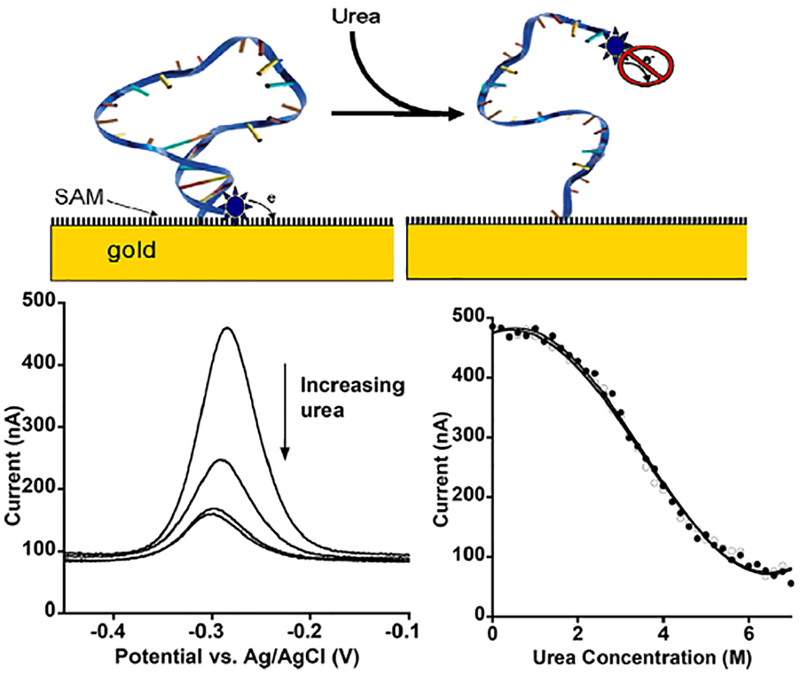
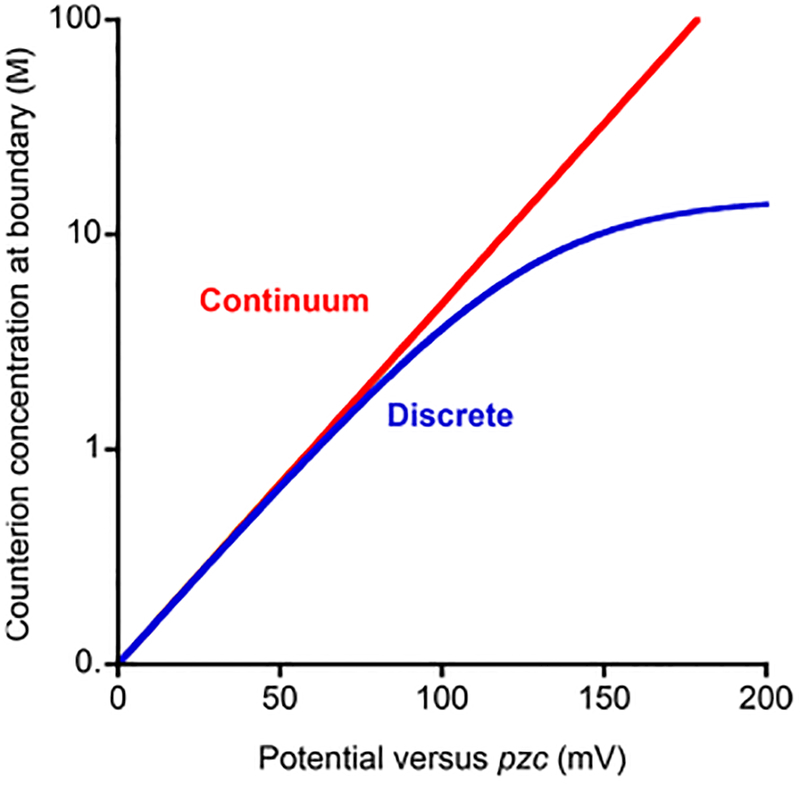
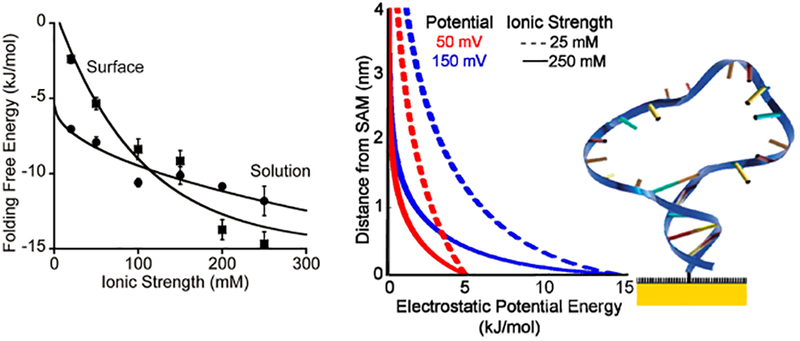
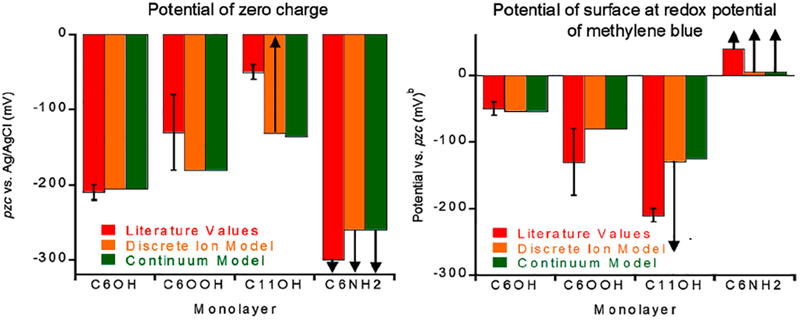
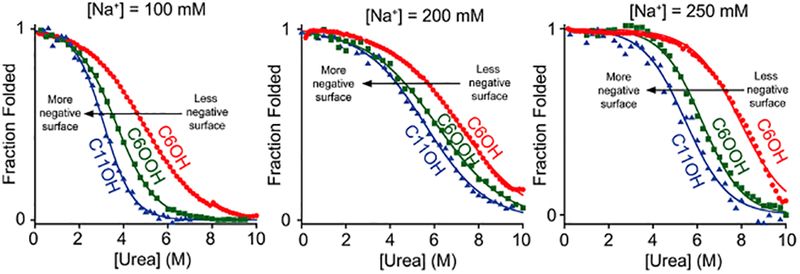
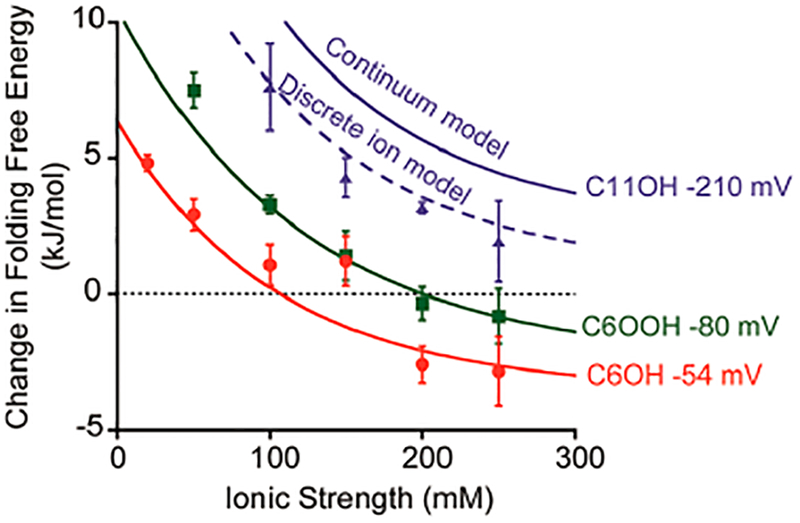
Quantitative experimental studies of the thermodynamics with which biopolymers interact with specific surfaces remain quite limited. In response, here we describe experimental and theoretical studies of the change in folding free energy that occurs when a simple biopolymer, a DNA stem-loop, is site-specifically attached to a range of chemically distinct surfaces generated via self-assembled monolayer formation on a gold electrode. Not surprisingly, the extent to which surface attachment alters the biopolymer's folding free energy depends strongly on the charge of the surface, with increasingly negatively charged surfaces leading to increased destabilization. A simple model that considers only the excluded volume and electrostatic repulsion generated by the surface and models the ionic environment above the surface as a continuum quantitatively recovers the observed free energy change associated with attachment to weakly charged negative surfaces. For more strongly charged negative surfaces a model taking into account the discrete size of the involved ions is required. Our studies thus highlight the important role that electrostatics can play in the physics of surface-biomolecule interactions.
定量实验研究表明,生物聚合物与特定表面相互作用的热力学性质仍然相当有限。有鉴于此,本文描述了对简单生物聚合物(DNA 发夹结构)在特定位置附着到一系列通过自组装单分子层在金电极上形成的具有化学差异的表面时,折叠自由能变化的实验和理论研究。毫不奇怪,表面附着改变生物聚合物折叠自由能的程度强烈依赖于表面的电荷,带更多负电荷的表面会导致更大的去稳定化。一个仅考虑表面产生的排除体积和静电排斥、并将表面上方的离子环境建模为连续体的简单模型定量地再现了与弱电荷负表面附着相关的观察到的自由能变化。对于带更多负电荷的表面,则需要考虑到涉及的离子的离散尺寸的模型。因此,我们的研究强调了静电在表面-生物分子相互作用物理学中可以发挥的重要作用。