Faculty of Veterinary & Agricultural Science, University of Melbourne, Parkville, VIC, 3010, Australia.
Agriculture Victoria, AgriBio, Centre for AgriBioscience, Bundoora, VIC, 3083, Australia.
BMC Genomics. 2018 Jul 4;19(1):521. doi: 10.1186/s12864-018-4902-8.
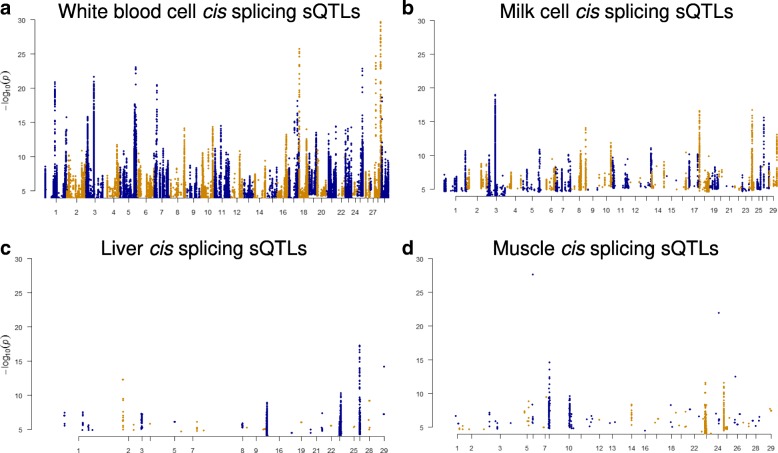
Mammalian phenotypes are shaped by numerous genome variants, many of which may regulate gene transcription or RNA splicing. To identify variants with regulatory functions in cattle, an important economic and model species, we used sequence variants to map a type of expression quantitative trait loci (expression QTLs) that are associated with variations in the RNA splicing, i.e., sQTLs. To further the understanding of regulatory variants, sQTLs were compare with other two types of expression QTLs, 1) variants associated with variations in gene expression, i.e., geQTLs and 2) variants associated with variations in exon expression, i.e., eeQTLs, in different tissues.
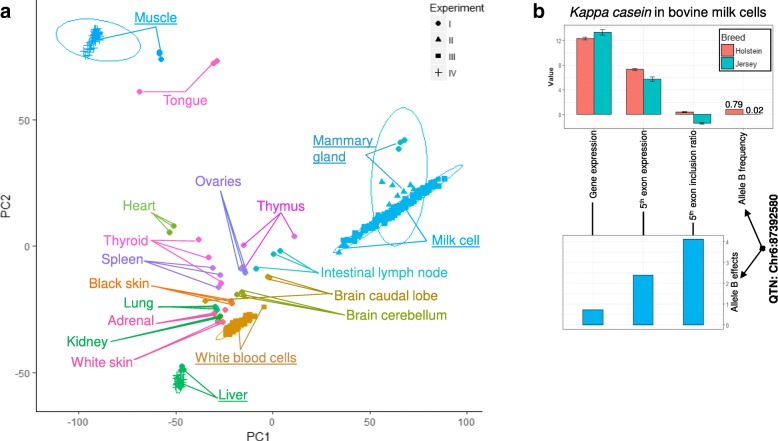
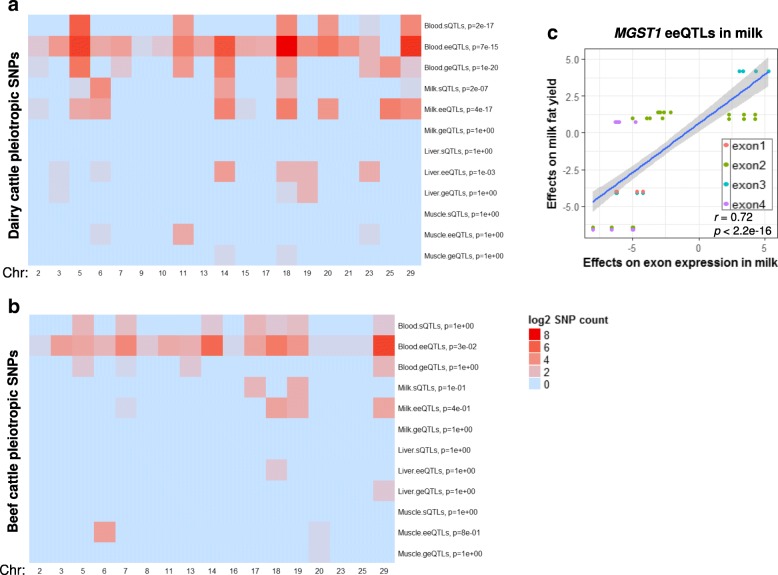
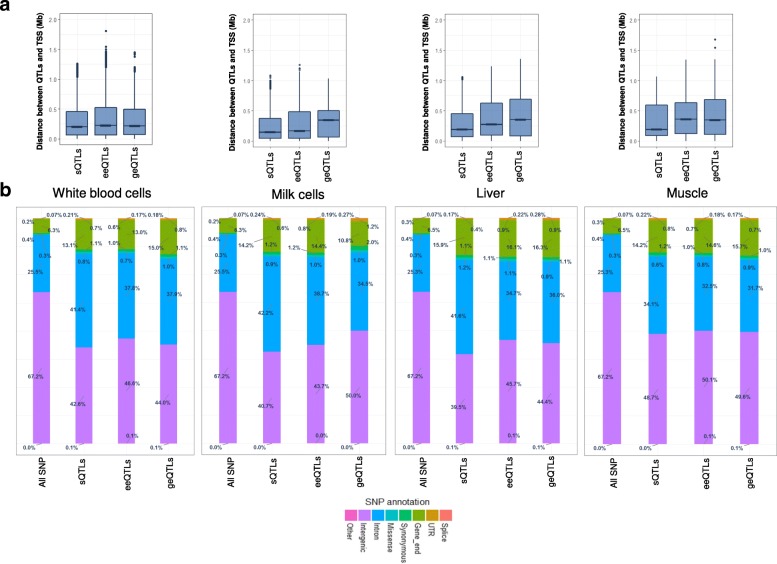
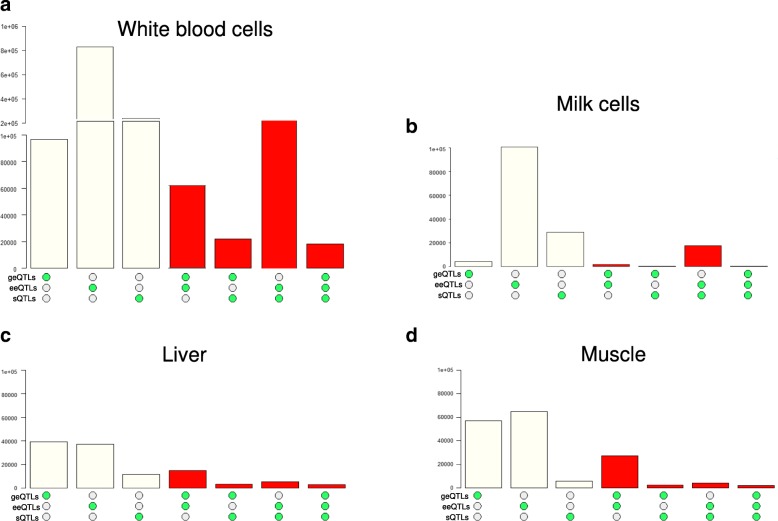
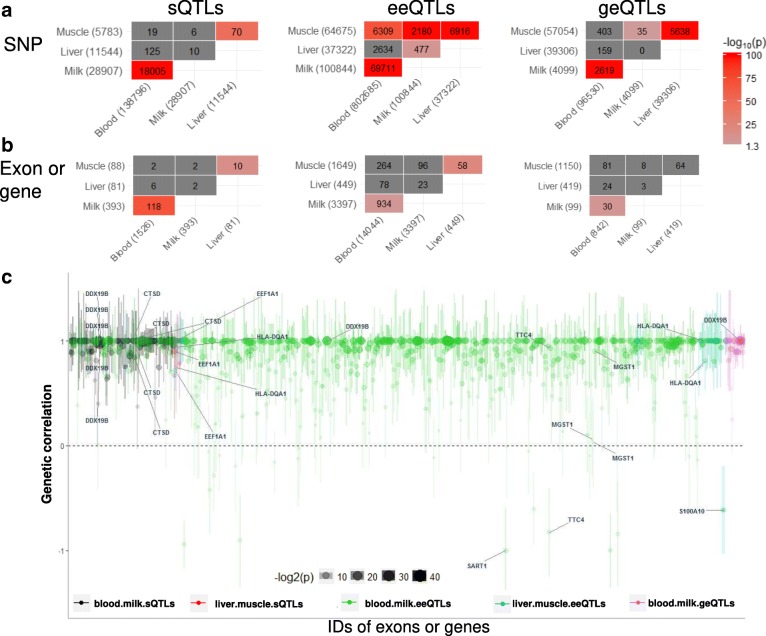
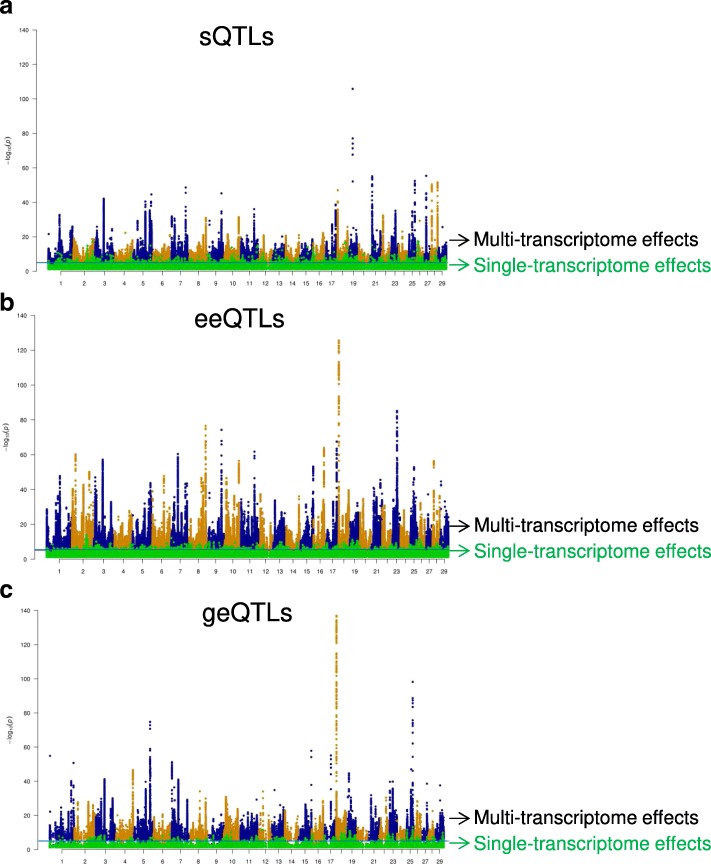
Using whole genome and RNA sequence data from four tissues of over 200 cattle, sQTLs identified using exon inclusion ratios were verified by matching their effects on adjacent intron excision ratios. sQTLs contained the highest percentage of variants that are within the intronic region of genes and contained the lowest percentage of variants that are within intergenic regions, compared to eeQTLs and geQTLs. Many geQTLs and sQTLs are also detected as eeQTLs. Many expression QTLs, including sQTLs, were significant in all four tissues and had a similar effect in each tissue. To verify such expression QTL sharing between tissues, variants surrounding (±1 Mb) the exon or gene were used to build local genomic relationship matrices (LGRM) and estimated genetic correlations between tissues. For many exons, the splicing and expression level was determined by the same cis additive genetic variance in different tissues. Thus, an effective but simple-to-implement meta-analysis combining information from three tissues is introduced to increase power to detect and validate sQTLs. sQTLs and eeQTLs together were more enriched for variants associated with cattle complex traits, compared to geQTLs. Several putative causal mutations were identified, including an sQTL at Chr6:87392580 within the 5th exon of kappa casein (CSN3) associated with milk production traits.
Using novel analytical approaches, we report the first identification of numerous bovine sQTLs which are extensively shared between multiple tissue types. The significant overlaps between bovine sQTLs and complex traits QTL highlight the contribution of regulatory mutations to phenotypic variations.
哺乳动物表型是由众多基因组变异塑造的,其中许多变异可能调节基因转录或 RNA 剪接。为了鉴定在牛(一种重要的经济和模式物种)中具有调控功能的变异,我们使用序列变异来映射与 RNA 剪接变化相关的一类表达数量性状基因座(eQTLs),即 sQTLs。为了进一步了解调控变异,我们将 sQTLs 与其他两种类型的 eQTLs 进行比较,1)与基因表达变化相关的变异,即 geQTLs,和 2)与外显子表达变化相关的变异,即 eeQTLs,在不同组织中。
使用来自 200 多头牛的四个组织的全基因组和 RNA 序列数据,通过匹配其对外显子内含子切除率的影响,验证了使用外显子包含率鉴定的 sQTLs。与 eeQTLs 和 geQTLs 相比,sQTLs 包含最高比例的位于基因内含子区域的变异,而包含最低比例的位于基因间区域的变异。许多 geQTLs 和 sQTLs 也被检测为 eeQTLs。许多 eQTLs,包括 sQTLs,在四个组织中都很显著,并且在每个组织中都有相似的作用。为了验证组织之间的这种表达 QTL 共享,使用外显子或基因周围的变异(±1 Mb)构建局部基因组关系矩阵(LGRM),并估计组织间的遗传相关性。对于许多外显子,不同组织中相同的顺式加性遗传方差决定了剪接和表达水平。因此,引入了一种有效但易于实施的元分析方法,该方法结合了来自三个组织的信息,以提高检测和验证 sQTLs 的能力。与 geQTLs 相比,sQTLs 和 eeQTLs 共同富集了与牛复杂性状相关的变异。鉴定了几个潜在的因果突变,包括 Chr6:87392580 处的 sQTL,位于κ-酪蛋白(CSN3)的第 5 个外显子内,与产奶性状相关。
使用新的分析方法,我们首次鉴定了大量牛 sQTLs,这些 sQTLs在多种组织类型之间广泛共享。牛 sQTLs 与复杂性状 QTL 之间的显著重叠突出了调控突变对表型变异的贡献。