School of Biomedical Sciences (M504), The University of Western Australia, 35 Stirling Hwy, Crawley, WA, 6009, Australia.
PathWest Laboratory Medicine, Fiona Stanley Hospital, 11 Robin Warren Dive, Murdoch, WA, 6150, Australia.
J Transl Med. 2018 Jul 4;16(1):185. doi: 10.1186/s12967-018-1564-x.
Carcinoma of unknown primary (CUP) is a metastatic epithelial malignancy in the absence of an identifiable primary tumour. Prognosis for patients with CUP is poor because treatment options are generally limited to broad spectrum chemotherapy. A shift towards personalised cancer management based on mutation profiling offers the possibility of new treatment paradigms. This study has explored whether actionable, oncogenic driver mutations are present in CUP that have potential to better inform treatment decisions.
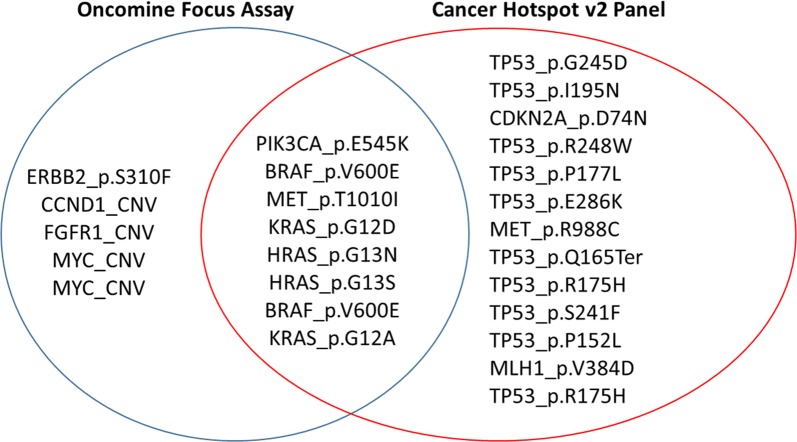
Carcinoma of unknown primary cases (n = 21) were selected and DNA was isolated from formalin-fixed paraffin embedded sections prior to amplification and sequencing. Two distinct yet complementary targeted gene panels were used to assess variants in up to 76 known cancer-related genes for the identification of biologically relevant and actionable mutations.
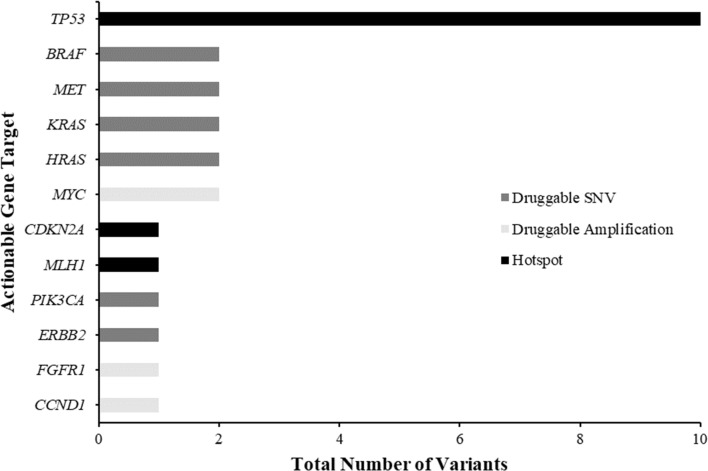
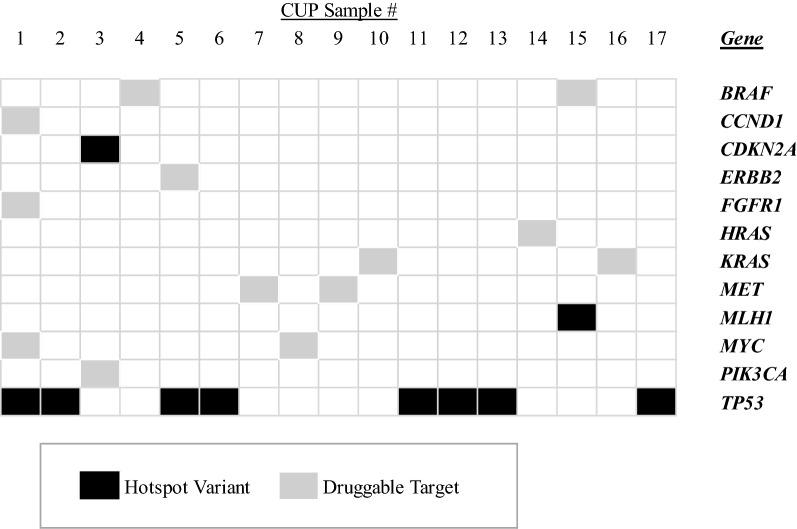
Variants were detected in 17/21 cases (81%) of which 11 (52%) were potentially actionable with drugs currently approved for use in known primary cancer types or undergoing clinical trials. The most common variants detected were in TP53 (47%), KRAS (12%), MET (12%) and MYC (12%). Differences at the molecular level were seen between common CUP histological subtypes. CUP adenocarcinomas and poorly differentiated carcinomas harboured the highest frequency of variants in genes involved in signal transduction pathways (e.g. MET, EGFR, HRAS, KRAS, and BRAF). In contrast, squamous cell carcinoma exhibited a higher frequency of variants in cell cycle control and DNA repair genes (e.g. TP53, CDKN2A and MLH1).
Taken together, mutations in biologically relevant genes were detected in the vast majority of CUP tumours, of which half provided a potentially novel treatment option not generally considered in CUP.
不明原发癌(CUP)是一种在缺乏可识别原发性肿瘤的情况下发生的转移性上皮恶性肿瘤。由于治疗选择通常仅限于广谱化疗,因此 CUP 患者的预后较差。基于突变分析的个性化癌症管理方法为新的治疗模式提供了可能。本研究探讨了 CUP 中是否存在潜在的治疗相关的致癌驱动突变,这些突变有可能更好地指导治疗决策。
选择了 21 例不明原发癌病例,并在扩增和测序前从福尔马林固定石蜡包埋切片中分离出 DNA。使用两种不同但互补的靶向基因panel 来评估多达 76 个已知与癌症相关的基因中的变体,以确定具有生物学意义和可操作性的突变。
在 21 例病例中有 17 例(81%)检测到了变体,其中 11 例(52%)可能具有可操作性,这些药物目前已批准用于已知的原发性癌症类型或正在临床试验中。检测到的最常见变体是 TP53(47%)、KRAS(12%)、MET(12%)和 MYC(12%)。在常见的 CUP 组织学亚型之间观察到了分子水平上的差异。CUP 腺癌和低分化癌中涉及信号转导途径的基因(如 MET、EGFR、HRAS、KRAS 和 BRAF)中的变体频率最高。相比之下,鳞状细胞癌中细胞周期控制和 DNA 修复基因(如 TP53、CDKN2A 和 MLH1)中的变体频率更高。
总之,在绝大多数 CUP 肿瘤中检测到了具有生物学意义的基因突变,其中一半提供了一种通常不考虑用于 CUP 的潜在新的治疗选择。