Rau Asta, Wouters Edwin, Engelbrecht Michelle, Masquillier Caroline, Uebel Kerry, Kigozi Gladys, Sommerland Nina, Janse van Rensburg André
University of the Free State (UFS), Centre for Health Systems Research & Development (CHSR&D), Faculty of the Humanities, PO Box 339, Bloemfontein, 9300, South Africa.
Department of Sociology, University of Antwerp (AU), Research Centre for Longitudinal & Life Course Studies (CELLO), Faculty of Political and Social Sciences, Sint-Jacobstraat 2, BE-2000, Antwerp, Belgium.
Trials. 2018 Jul 4;19(1):351. doi: 10.1186/s13063-018-2713-5.
Occupational exposure to tuberculosis (TB) constitutes a major health risk for healthcare workers (HCWs). The HIV epidemic equally affects the workforce because of the mutually reinforcing epidemiology of HIV and TB. Stigmas associated with HIV and TB have become so intricately entangled that they stop some HCWs from seeking care in a context where serious shortages in human resources for health besiege public health facilities. It is thus imperative to research, as well as attempt to tackle, HIV and TB stigma among HCWs. But little has been done internationally-and nationally, only our own exploratory studies. Our project aims to address this by (1) scientifically assessing the extent and sources of HIV and TB-related stigma among HCWs and (2) developing and testing evidence-based, stigma-reduction interventions in public hospitals in the Free State Province of South Africa.
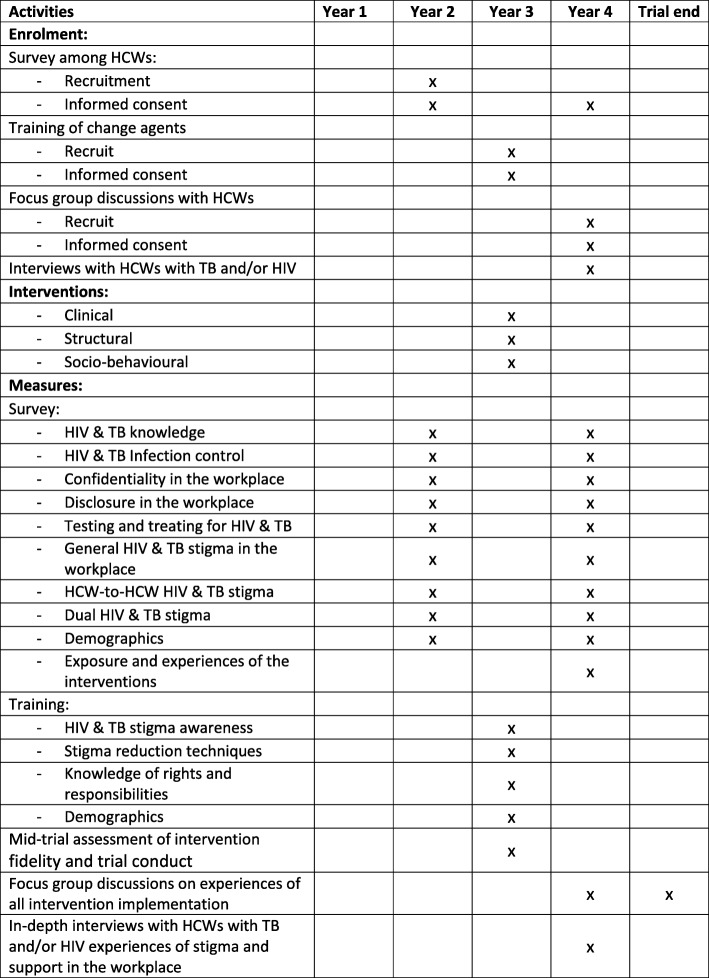
METHODS/DESIGN: The research follows a stratified cluster randomised controlled trial (RCT) design. Pre intervention, a self-administered questionnaire with the pilot study's validated stigma scales is used to measure stigma and other key variables among randomly selected HCWs in eight hospitals-stratified by size and district and then randomly allocated to four intervention and four control sites. Interventions comprise HIV- and TB-stigma reduction activities-mainly Social and Behavioural Change Communication (SBCC) interventions-at three social-ecology levels (individual, community, and socio-structural). An outside assessor will appraise the trial mid-way through implementation. Post intervention, all baseline respondents will be followed up to complete the baseline questionnaire with additional items on interventions. Qualitative data will be collected to better understand HIV and TB stigma and explore if, and how, interventions impact stigma levels in the workplace.
The study regards as HCWs all staff, working in all different types of jobs, at all levels in the hospitals. Thus, the research addresses HIV and TB stigma across the whole workforce and the entire workplace. In doing so it will (1) generate essential information on stigma among HCWs and (2) implement stigma-reduction interventions that are innovative yet replicable, and potentially beneficial in addressing a pernicious human-rights-based issue.
South African National Clinical Trials Register, registration ID: DOH-27-1115-5204 . Prospectively registered on 26 August 2015.
医护人员职业暴露于结核病构成重大健康风险。由于艾滋病病毒和结核病的相互强化流行,艾滋病疫情同样影响着医护人员队伍。与艾滋病病毒和结核病相关的耻辱感已错综复杂地交织在一起,在公共卫生设施面临严重卫生人力资源短缺的情况下,导致一些医护人员不愿寻求治疗。因此,研究并试图解决医护人员中的艾滋病病毒和结核病耻辱感问题势在必行。但国际上对此研究甚少,在国内,也只有我们自己的探索性研究。我们的项目旨在通过以下方式解决这一问题:(1)科学评估医护人员中与艾滋病病毒和结核病相关耻辱感的程度及来源;(2)在南非自由邦省的公立医院开发并测试基于证据的减少耻辱感干预措施。
方法/设计:本研究采用分层整群随机对照试验(RCT)设计。干预前,使用一份带有试点研究验证过的耻辱感量表的自填式问卷,对八家医院中随机抽取的医护人员进行耻辱感及其他关键变量的测量,这些医院按规模和地区分层,然后随机分配到四个干预组和四个对照组。干预措施包括在三个社会生态层面(个人、社区和社会结构层面)开展减少艾滋病病毒和结核病耻辱感的活动,主要是社会和行为改变沟通(SBCC)干预措施。一名外部评估员将在试验实施过程中进行中期评估。干预后,将对所有基线受访者进行随访,以完成包含干预措施附加项目的基线问卷。将收集定性数据,以更好地了解艾滋病病毒和结核病耻辱感,并探讨干预措施是否以及如何影响工作场所的耻辱感水平。
本研究将医院各级各类工作岗位的所有工作人员视为医护人员。因此,该研究关注整个医护人员队伍和整个工作场所中的艾滋病病毒和结核病耻辱感问题。这样做将(1)生成关于医护人员耻辱感的重要信息;(2)实施创新且可复制的减少耻辱感干预措施,这些措施可能有助于解决一个基于人权的有害问题。
南非国家临床试验注册中心,注册号:DOH - 27 - 1115 - 5204。于2015年8月26日前瞻性注册。