Department of Medicine, Division of Hematology, Stanford University School of Medicine, Stanford, CA, 94305, USA.
Veterans Affairs Palo Alto Health Care System, Room A4-131, Building 101, 3801 Miranda Avenue, Palo Alto, CA, 94304, USA.
Arthritis Res Ther. 2018 Jul 4;20(1):132. doi: 10.1186/s13075-018-1615-y.
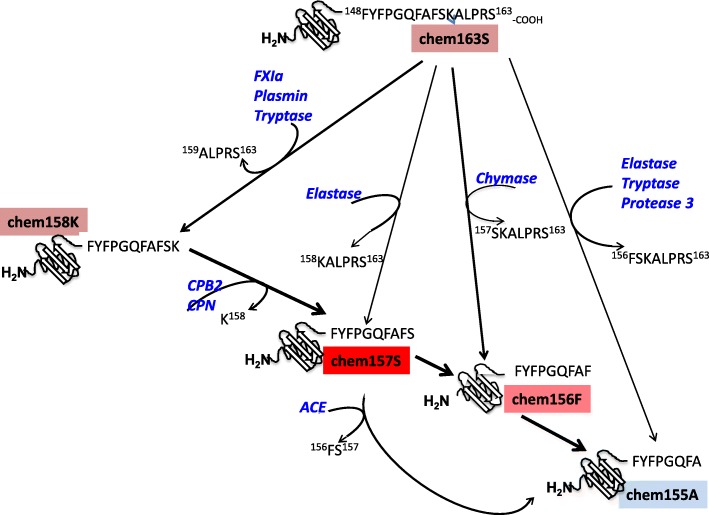
Chemerin is a chemoattractant involved in immunity that also functions as an adipokine. Chemerin is secreted as an inactive precursor (chem163S), and its activation requires proteolytic cleavages at its C-terminus, involving proteases in coagulation, fibrinolysis, and inflammation. Previously, we found chem158K was the dominant chemerin form in synovial fluids from patients with arthritis. In this study, we aimed to characterize a distinct cleaved chemerin form, chem156F, in osteoarthritis (OA) and rheumatoid arthritis (RA).
Purified chem156F was produced in transfected CHO cells. To quantify chem156F in OA and RA samples, we developed a specific ELISA for chem156F using antibody raised against a peptide representing the C-terminus of chem156F.
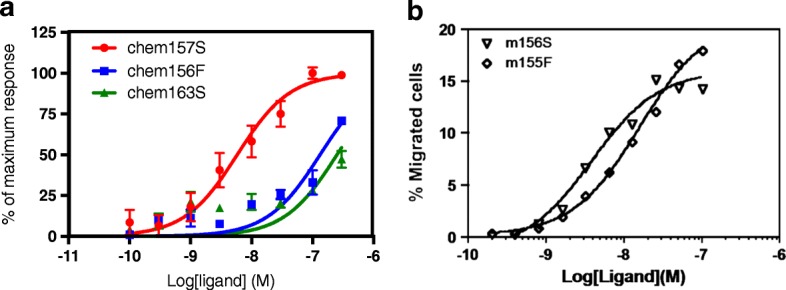
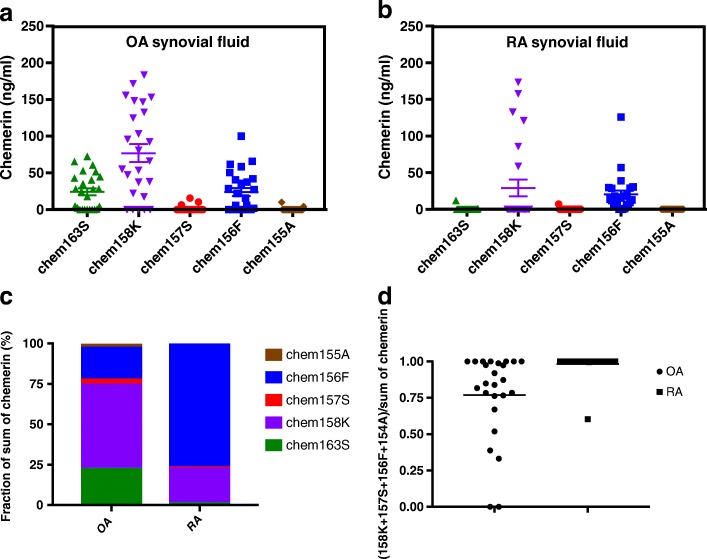
Ca mobilization assays showed that the EC values for chem163S, chem156F, and chem157S were 252 ± 141 nM, 133 ± 41.5 nM, and 5.83 ± 2.48 nM, respectively. chem156F was more active than its precursor, chem163S, but very much less potent than chem157S, the most active chemerin form. Chymase was shown to be capable of cleaving chem163S at a relevant rate. Using the chem156F ELISA we found a substantial amount of chem156F present in synovial fluids from patients with OA and RA, 24.06 ± 5.51 ng/ml and 20.35 ± 5.19 ng/ml (mean ± SEM, n = 25) respectively, representing 20% of total chemerin in OA and 76.7% of chemerin in RA synovial fluids.
Our data show that chymase cleavage of chem163S to partially active chem156F can be found in synovial fluids where it can play a role in modulation of the inflammation in joints.
趋化素是一种参与免疫反应的趋化因子,同时也作为脂肪因子发挥作用。趋化素以无活性前体(chem163S)的形式分泌,其激活需要 C 末端的蛋白水解切割,涉及凝血、纤溶和炎症中的蛋白酶。此前,我们发现 chem158K 是关节炎患者滑液中主要的趋化素形式。在这项研究中,我们旨在研究一种在骨关节炎(OA)和类风湿关节炎(RA)中独特的切割趋化素形式 chem156F。
在转染的 CHO 细胞中产生纯化的 chem156F。为了定量 OA 和 RA 样本中的 chem156F,我们使用针对 chem156F C 末端肽的抗体开发了针对 chem156F 的特异性 ELISA。
钙动员测定表明,chem163S、chem156F 和 chem157S 的 EC 值分别为 252±141nM、133±41.5nM 和 5.83±2.48nM。chem156F 比其前体 chem163S 更活跃,但比最活跃的趋化素形式 chem157S 差得多。糜蛋白酶被证明能够以相关速率切割 chem163S。使用 chem156F ELISA,我们发现大量 chem156F 存在于 OA 和 RA 患者的滑液中,分别为 24.06±5.51ng/ml 和 20.35±5.19ng/ml(平均值±SEM,n=25),分别占 OA 总趋化素的 20%和 RA 滑液中趋化素的 76.7%。
我们的数据表明,糜蛋白酶切割 chem163S 形成部分活性的 chem156F 可在滑液中发现,它可在关节炎症的调节中发挥作用。