Ophthalmic Genetics and Visual Function Branch, National Eye Institute, National Institutes of Health, Bethesda, MD, 20892, USA.
State Key Laboratory of Ophthalmology, Zhongshan Ophthalmic Center, Sun Yat-Sen University, Guangzhou, Guangdong, China.
Hum Genomics. 2018 Jul 4;12(1):35. doi: 10.1186/s40246-018-0165-3.
Retinitis pigmentosa is an important cause of severe visual dysfunction. This study reports a novel splicing mutation in the lecithin retinol acyltransferase (LRAT) gene associated with early onset retinitis pigmentosa and characterizes the effects of this mutation on mRNA splicing and structure.
Genome-wide linkage analysis followed by dideoxy sequencing of the linked candidate gene LRAT was performed in a consanguineous Pakistani family with autosomal recessive retinitis pigmentosa. In silico prediction and minigene assays were used to investigate the effects of the presumptive splicing mutation.
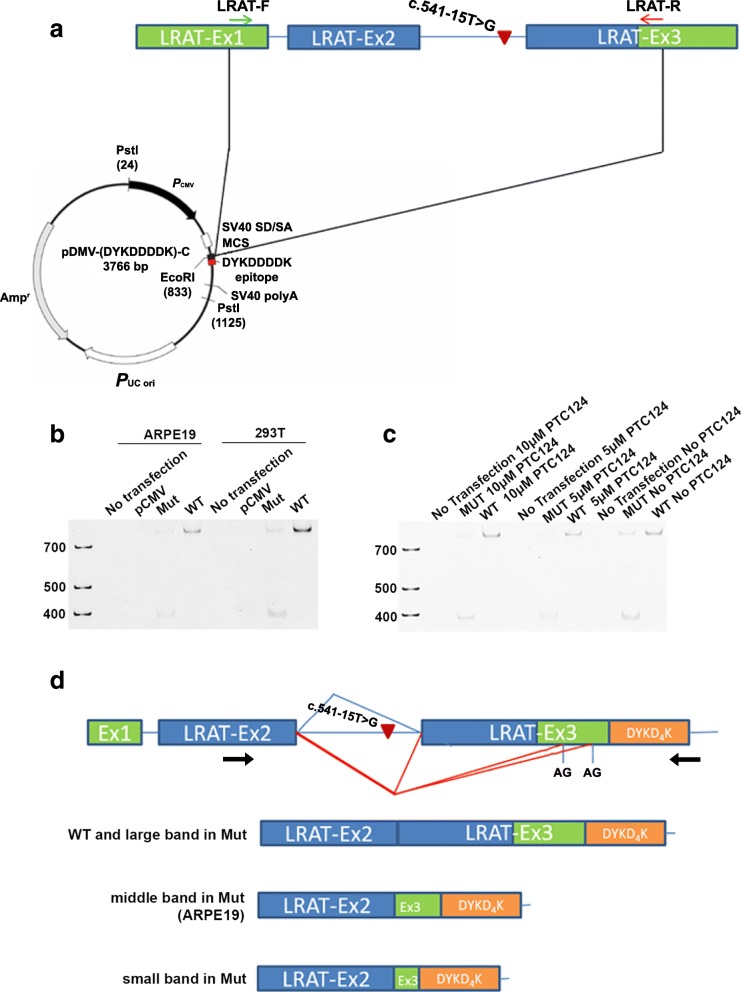
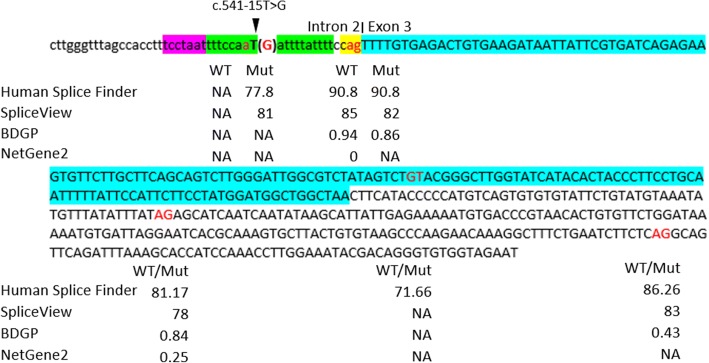
ARRP in this family was linked to chromosome 4q31.21-q32.1 with a maximum LOD score of 5.40. A novel homozygous intronic mutation (NM_004744.4: c.541-15T>G) was detected in LRAT. In silico tools predicted that the AG-creating mutation would activate an intronic cryptic acceptor site, but cloning fragments of wild-type and mutant sequences of LRAT into Exontrap Cloning Vector pET01 and Expression Cloning Vector pCMV-(DYKDK)-C showed that the primary effect of the sequence change was to weaken the nearby authentic acceptor site and cause exon skipping, with only a small fraction of transcripts utilizing the acceptor site producing the reference transcript.
The c.541-15T>G mutation in LRAT results in aberrant splicing and is therefore predicted to be causal for the early onset retinitis pigmentosa in this family. In addition, this work suggests that minigenes adapted to the specific gene and exon may need to be designed for variants in the first and last exon and intron to mimic the authentic splicing mechanism in vivo.
色素性视网膜炎是严重视力障碍的一个重要原因。本研究报道了一种新的卵磷脂视黄醇酰基转移酶(LRAT)基因剪接突变,与早发性色素性视网膜炎有关,并对该突变对 mRNA 剪接和结构的影响进行了特征描述。
对一个常染色体隐性遗传色素性视网膜炎的巴基斯坦近亲家庭进行全基因组连锁分析,然后对连锁的候选基因 LRAT 进行双脱氧测序。使用计算机预测和迷你基因试验来研究推定剪接突变的影响。
该家系的 ARRP 与染色体 4q31.21-q32.1 连锁,最大 LOD 得分为 5.40。在 LRAT 中检测到一个新的纯合内含子突变(NM_004744.4:c.541-15T>G)。计算机工具预测,AG 生成突变将激活内含子的隐蔽接受位点,但将野生型和突变型 LRAT 序列的克隆片段插入 Exontrap 克隆载体 pET01 和 Expression Cloning Vector pCMV-(DYKDK)-C 表明,序列变化的主要影响是削弱附近的真实接受位点并导致外显子跳跃,只有一小部分转录本利用接受位点产生参考转录本。
LRAT 中的 c.541-15T>G 突变导致异常剪接,因此预计该突变是该家系早发性色素性视网膜炎的致病原因。此外,这项工作表明,需要针对第一个和最后一个外显子和内含子中的变体设计适应特定基因和外显子的迷你基因,以模拟体内真实的剪接机制。