Department of Prosthodontics, Peking University School and Hospital of Stomatology, 22 Zhongguancun South Avenue, Haidian District, Beijing, 100081, China.
Department of Oral and Maxillofacial Surgery, Peking University School and Hospital of Stomatology, 22 Zhongguancun South Avenue, Haidian District, Beijing, 100081, China.
Stem Cell Res Ther. 2018 Jul 4;9(1):185. doi: 10.1186/s13287-018-0935-9.
The mammalian target of rapamycin (mTOR) pathway plays a significant role in osteogenic differentiation and bone maintenance. As the only known endogenous inhibitor of mTOR function, DEP domain containing mTOR interacting protein (DEPTOR) is potentially involved in stem cell differentiation, although the pathophysiological significance and its molecular mechanisms remain unclear. The present study aimed to elucidate the effects of DEPTOR on the progress of osteoporosis and investigate the underlying molecular mechanisms of osteogenic regulation.
An ovariectomy mouse model with decreased bone formation and osteogenic induction with bone marrow mesenchymal stem cells (BMSCs) were used to investigate the relationship between DEPTOR and osteogenic events. A loss-of-function investigation was then performed to explore the role of DEPTOR in the osteogenic differentiation of BMSCs both in vitro and in vivo. Finally, long noncoding RNA (lncRNA) and mRNA sequences were investigated to reveal the underlying mechanisms of DEPTOR in osteogenic regulation. RNA interference, western blotting, and chromatin immunoprecipitation assays were performed for further mechanistic determination.
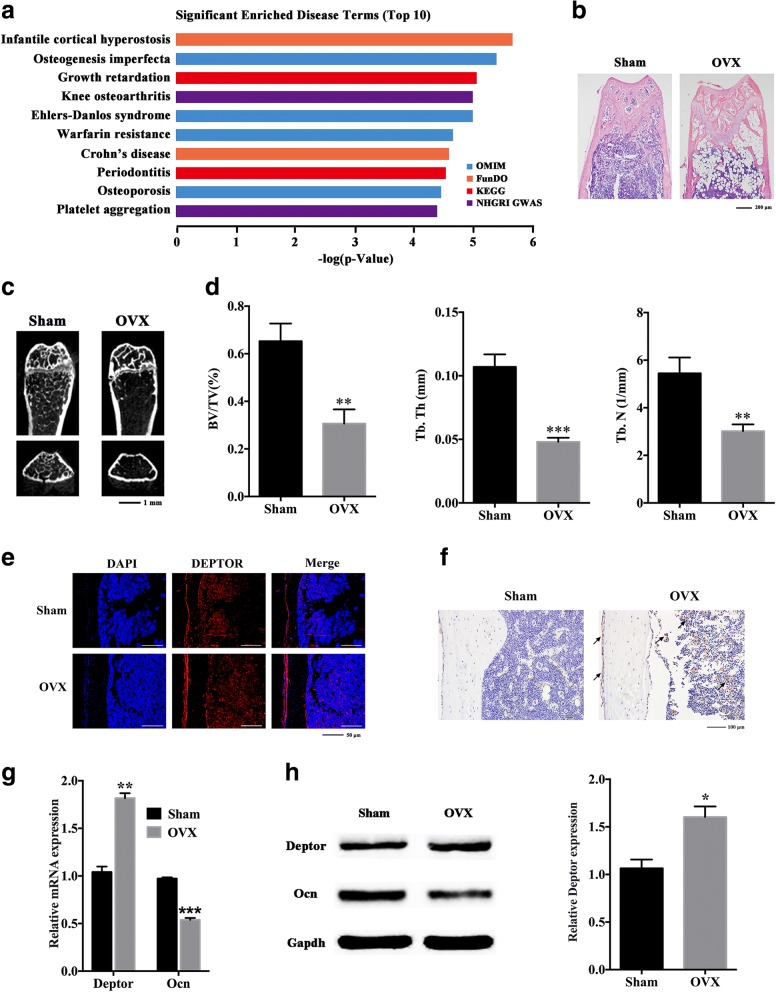
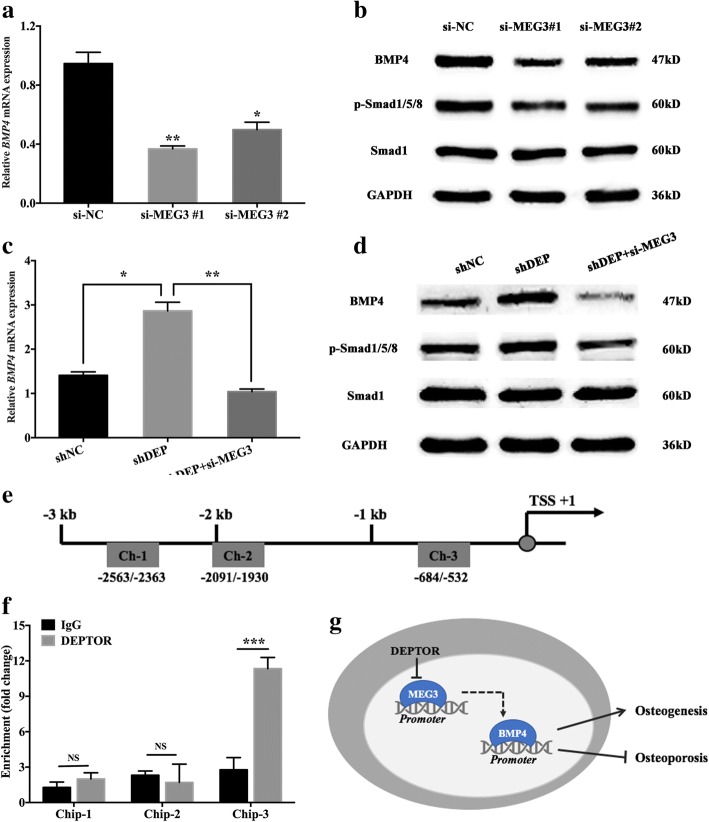
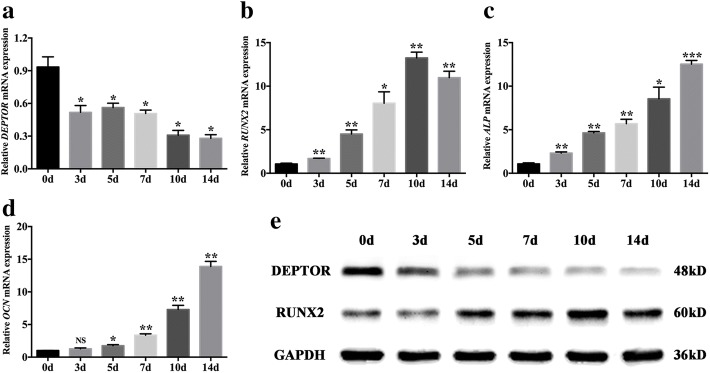
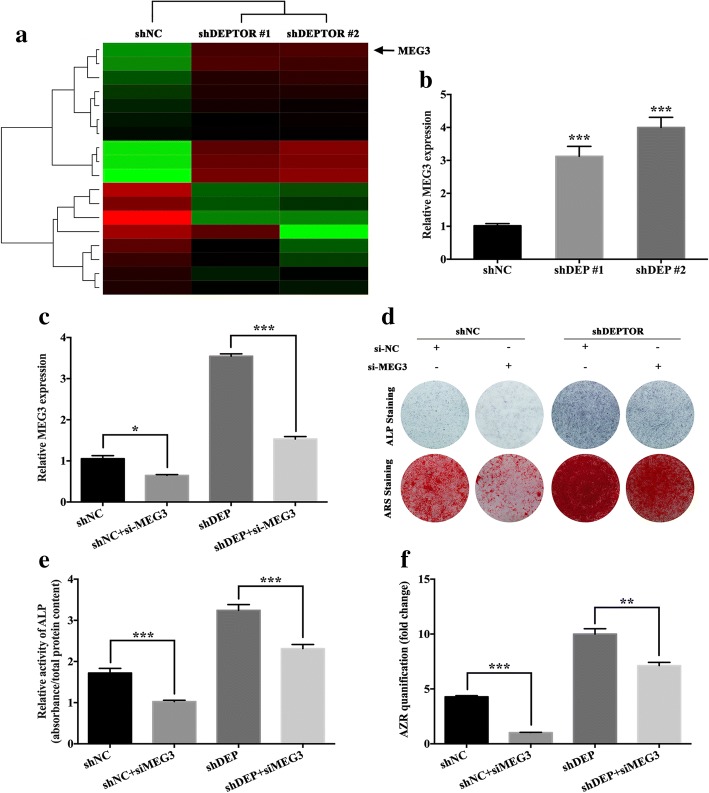
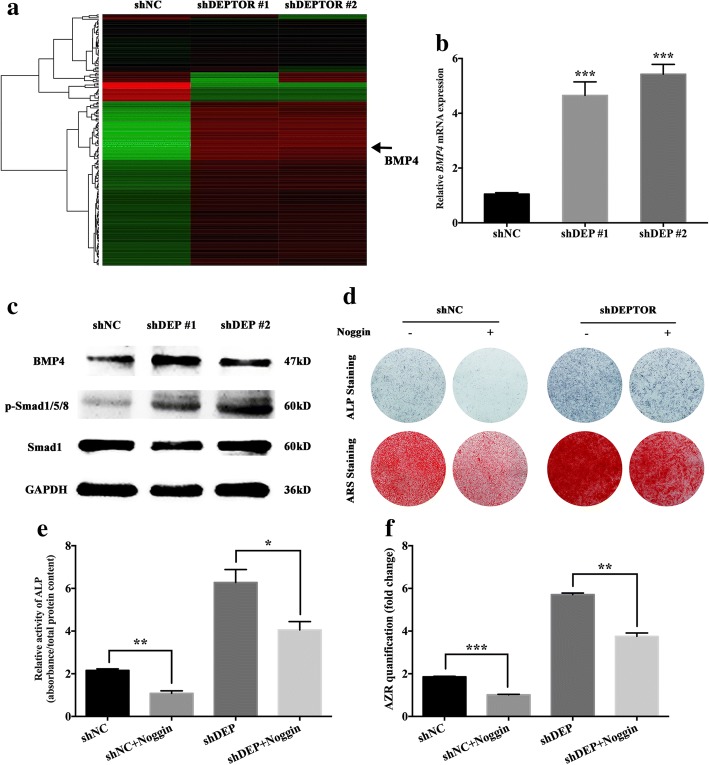
The results indicated that DEPTOR contributes to the progress of osteoporosis, and higher expression of Deptor was observed in osteoporotic bones. The expression of DEPTOR was reduced during the osteogenic differentiation of BMSCs, and knockdown of DEPTOR promoted BMSC osteogenesis in vitro and in vivo. lncRNA and mRNA sequences indicated that knockdown of DEPTOR upregulated the expression of maternally expressed 3 (nonprotein coding) (MEG3), which subsequently activated bone morphogenetic protein 4 (BMP4) signaling. Furthermore, DEPTOR could bind to a specific region (- 1000 bp ~ 0) of the MEG3 promoter to regulate its transcription, and inhibition of MEG3 reduced BMP4 activation triggered by DEPTOR knockdown.
Taken together, our study revealed a novel function of DEPTOR in osteogenic differentiation by inhibiting MEG3-mediated activation of BMP4 signaling, which suggested that DEPTOR could be a therapeutic target for bone loss diseases and skeletal tissue regeneration.
哺乳动物雷帕霉素靶蛋白(mTOR)途径在成骨分化和骨维持中起着重要作用。DEP 结构域包含 mTOR 相互作用蛋白(DEPTOR)作为唯一已知的 mTOR 功能的内源性抑制剂,可能参与干细胞分化,尽管其病理生理意义及其分子机制尚不清楚。本研究旨在阐明 DEPTOR 对骨质疏松症进展的影响,并研究成骨调节的潜在分子机制。
使用骨形成减少的去卵巢小鼠模型和骨髓间充质干细胞(BMSC)的成骨诱导来研究 DEPTOR 与成骨事件之间的关系。然后进行功能丧失研究,以探讨 DEPTOR 在 BMSC 的成骨分化中的作用,包括体外和体内。最后,研究长链非编码 RNA(lncRNA)和 mRNA 序列,以揭示 DEPTOR 在成骨调节中的潜在机制。进行 RNA 干扰、western blot 和染色质免疫沉淀测定以进一步确定机制。
结果表明,DEPTOR 促进骨质疏松症的进展,骨质疏松症骨中观察到更高的 Deptor 表达。在 BMSC 的成骨分化过程中,DEPTOR 的表达减少,而 DEPTOR 的敲低促进了 BMSC 的体外和体内成骨作用。lncRNA 和 mRNA 序列表明,DEPTOR 的敲低上调了母系表达 3(非蛋白编码)(MEG3)的表达,随后激活了骨形态发生蛋白 4(BMP4)信号。此外,DEPTOR 可以与 MEG3 启动子的特定区域(-1000 bp~0)结合,调节其转录,抑制 MEG3 减少了由 DEPTOR 敲低触发的 BMP4 激活。
综上所述,我们的研究揭示了 DEPTOR 通过抑制 MEG3 介导的 BMP4 信号激活在成骨分化中的新功能,这表明 DEPTOR 可能成为治疗骨丢失疾病和骨骼组织再生的靶点。