Department of Polymeric Materials, School of Materials Science and Engineering, Tongji University, Shanghai, 201804, China.
Institute for Advanced Study, Tongji University, Shanghai, 200092, China.
Nat Commun. 2018 Jul 4;9(1):2605. doi: 10.1038/s41467-018-04763-y.
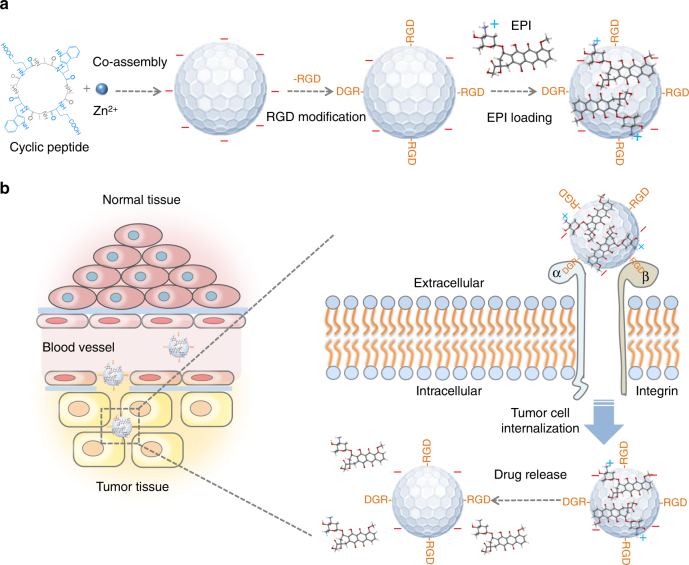
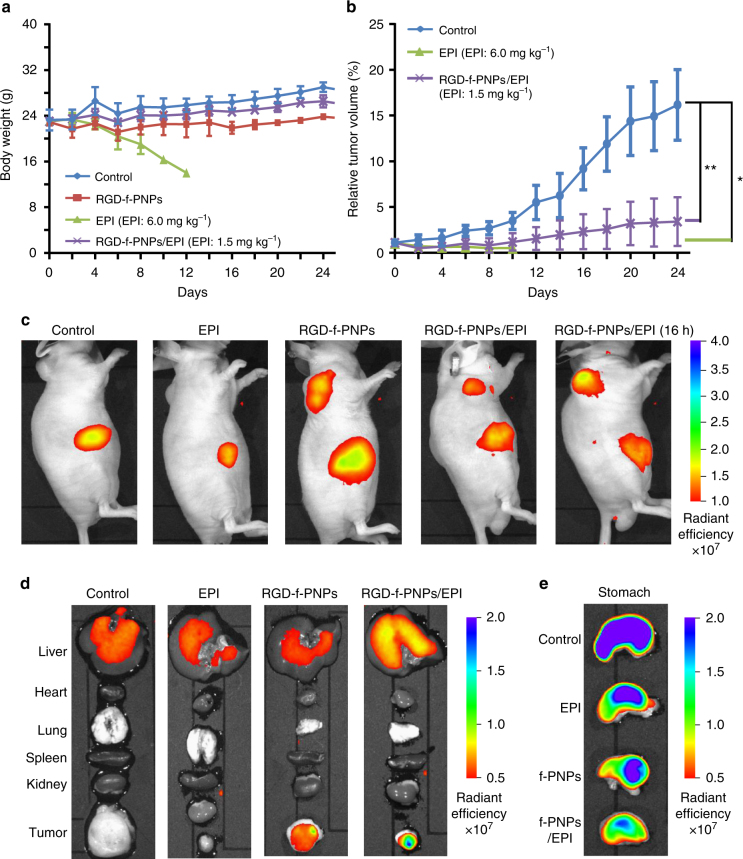
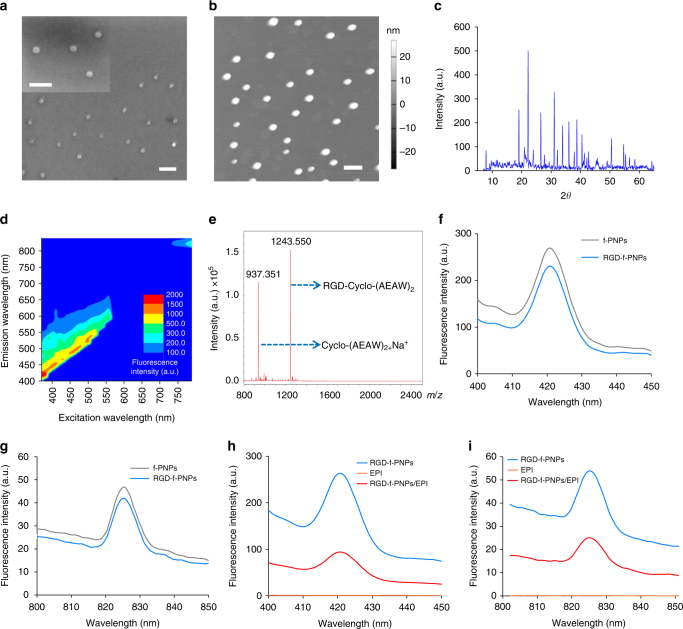
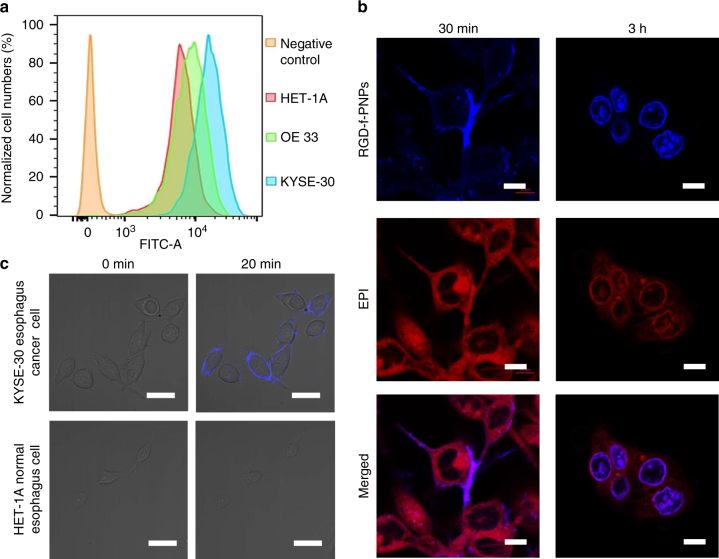
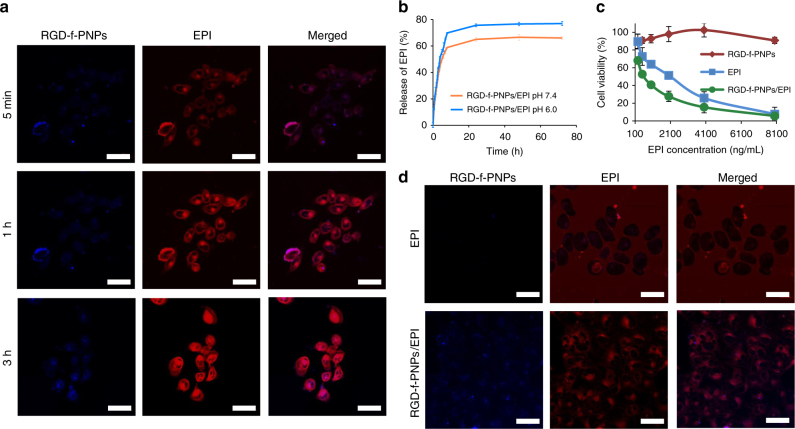
Various types of nanoparticles have been proposed for targeted drug delivering, imaging, and tracking of therapeutic agents. However, highly biocompatible nanoparticles with structure-induced fluorescence and capability to conjugate with biomarkers and drugs remain lacking. This research proposes and synthesizes fluorescent nanoparticles (f-PNPs) assembled by cyclic peptides to combine imaging and drug delivering for esophageal cancer (EC). To achieve tumor targeting, f-PNPs are first conjugated with RGD moieties to selectively target EC cells via αβ integrin; the nanoparticles are then embedded with epirubicin (EPI). Cell viability assays and analysis of tissue histology reveal that EPI-loaded RGD-f-PNPs (RGD-f-PNPs/EPI) led to significantly reduced cardiotoxicity and improved anti-tumor activity compared to EPI alone. Moreover, the drug delivery to tumor sites and therapeutic responses could be monitored with near-infrared fluorescence using RGD-f-PNPs/EPI. This unique nanoparticle system may lead to potential approaches for bioorganic fluorescence-based delivering, imaging, and drug release tracking.
各种类型的纳米颗粒已被提议用于靶向药物输送、成像和治疗剂的跟踪。然而,具有结构诱导荧光且能够与生物标志物和药物结合的高度生物相容的纳米颗粒仍然缺乏。本研究提出并合成了由环肽组装的荧光纳米颗粒(f-PNPs),用于结合成像和食管癌(EC)的药物输送。为了实现肿瘤靶向,f-PNPs 首先与 RGD 部分缀合,通过 αβ 整合素选择性靶向 EC 细胞;然后将纳米颗粒嵌入表阿霉素(EPI)。细胞活力测定和组织学分析表明,与单独使用 EPI 相比,载有 EPI 的 RGD-f-PNPs(RGD-f-PNPs/EPI)导致心脏毒性显著降低,抗肿瘤活性提高。此外,使用 RGD-f-PNPs/EPI 可以通过近红外荧光监测药物向肿瘤部位的输送和治疗反应。这种独特的纳米颗粒系统可能为基于生物有机荧光的药物输送、成像和药物释放跟踪提供潜在方法。