Lin Sue-Jin, Baumeister Tobias R, Garg Saurabh, McKeown Martin J
Graduate Program in Neuroscience, University of British Columbia, Vancouver, BC, Canada.
Pacific Parkinson's Research Centre, University of British Columbia, Vancouver, BC, Canada.
Front Neurol. 2018 Jun 20;9:482. doi: 10.3389/fneur.2018.00482. eCollection 2018.
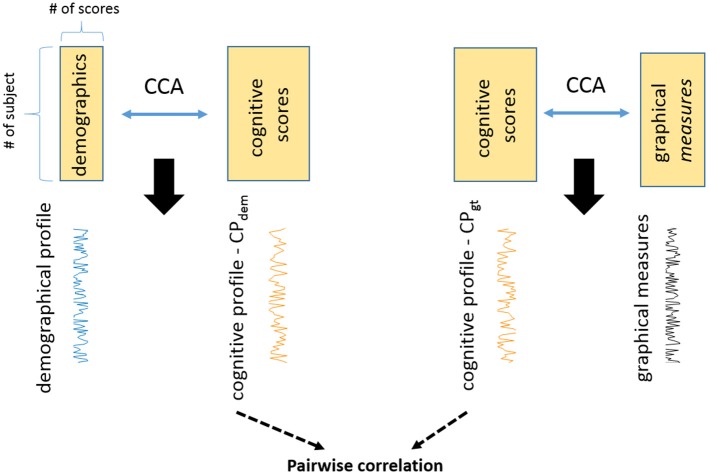
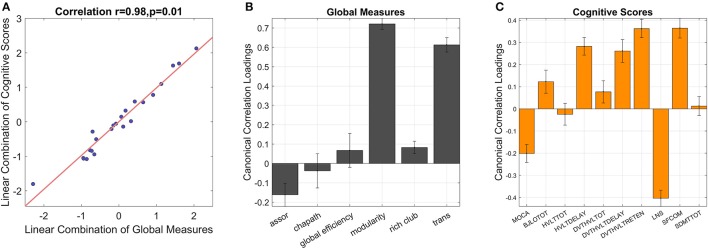
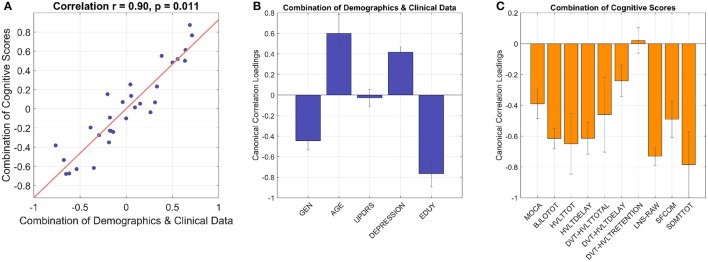
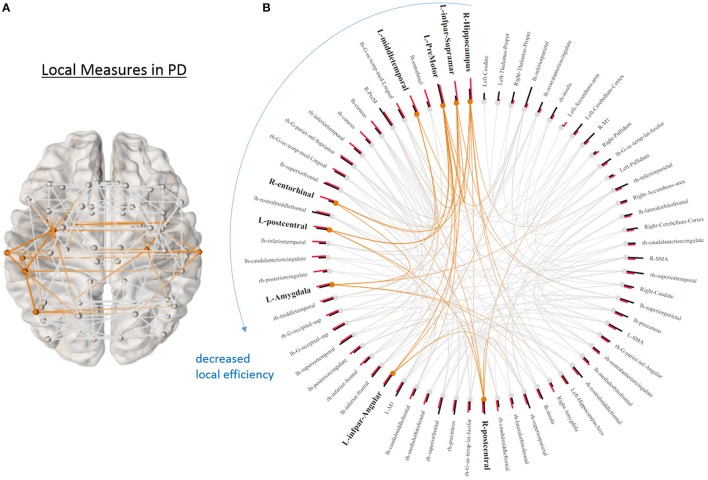
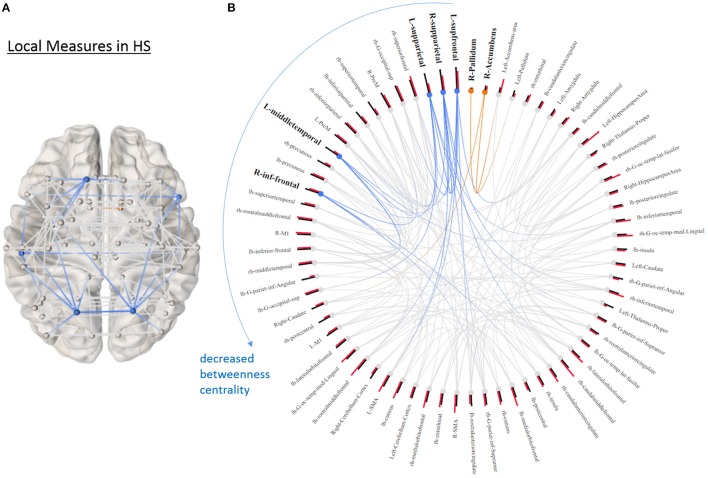
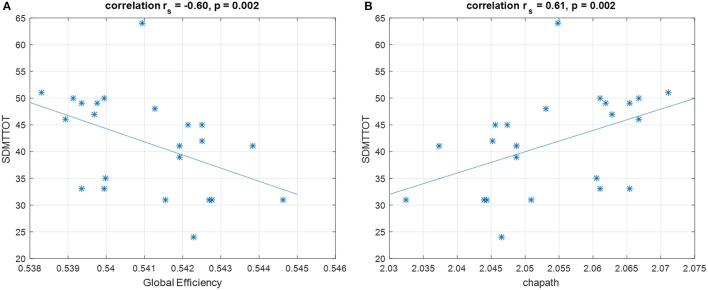
The clinicopathological correlations between aspects of cognition, disease severity and imaging in Parkinson's Disease (PD) have been unclear. We studied cognitive profiles, demographics, and functional connectivity patterns derived from resting-state fMRI data (rsFC) in 31 PD subjects from the Parkinson's Progression Markers Initiative (PPMI) database. We also examined rsFC from 19 healthy subjects (HS) from the Pacific Parkinson's Research Centre. Graph theoretical measures were used to summarize the rsFC patterns. Canonical correlation analysis (CCA) was used to relate separate cognitive profiles in PD that were associated with disease severity and demographic measures as well as rsFC network measures. The CCA model relating cognition to demographics suggested female gender and education supported cognitive function in PD, age and depression scores were anti-correlated with overall cognition, and UPDRS had little influence on cognition. Alone, rsFC global network measures did not significantly differ between PD and controls, yet some nodal network measures, such as network segregation, were distinguishable between PD and HS in cortical "hub" regions. The CCA model relating cognition to rsFC global network values, which was not related to the other CCA model relating cognition to demographic information, suggested modularity, rich club coefficient, and transitivity was also broadly related to cognition in PD. Our results suggest that education, aging, comorbidity, and gender impact cognition more than overall disease severity in PD. Cortical "hub" regions are vulnerable in PD, and impairments of processing speed, attention, scanning abilities, and executive skills are related to enhanced functional segregation seen in PD.
帕金森病(PD)中认知、疾病严重程度和影像学各方面之间的临床病理相关性一直不明确。我们研究了帕金森病进展标志物倡议(PPMI)数据库中31名PD受试者的认知概况、人口统计学特征以及静息态功能磁共振成像数据(rsFC)得出的功能连接模式。我们还检查了太平洋帕金森病研究中心19名健康受试者(HS)的rsFC。采用图论方法总结rsFC模式。使用典型相关分析(CCA)来关联PD中与疾病严重程度、人口统计学指标以及rsFC网络指标相关的不同认知概况。将认知与人口统计学关联的CCA模型表明,女性性别和教育程度对PD的认知功能有支持作用,年龄和抑郁评分与整体认知呈负相关,而统一帕金森病评定量表(UPDRS)对认知影响不大。单独来看,PD组和对照组之间rsFC全局网络指标无显著差异,但一些节点网络指标,如网络分离,在皮质“枢纽”区域的PD组和HS组之间是可区分的。将认知与rsFC全局网络值关联的CCA模型(与将认知与人口统计学信息关联的其他CCA模型无关)表明,模块化、富俱乐部系数和传递性在PD中也与认知广泛相关。我们的结果表明,在PD中,教育、衰老、合并症和性别对认知的影响大于整体疾病严重程度。皮质“枢纽”区域在PD中易受影响,处理速度、注意力、扫描能力和执行技能的损害与PD中增强的功能分离有关。