Naven Lynn, Inglis Greig, Harris Rachel, Fergie Gillian, Teal Gemma, Phipps Rebecca, Stewart Sally, Kelly Lorna, Hilton Shona, Smith Madeline, McCartney Gerry, Walsh David, Tolan Matthew, Egan James
Glasgow Centre for Population Health, UK.
University of Edinburgh, UK.
Evid Policy. 2018 May 31;14(2):301-321. doi: 10.1332/174426417X14987303892451.
Informing policy and practice with up-to-date evidence on the social determinants of health is an ongoing challenge. One limitation of traditional approaches is the time-lag between identification of a policy or practice need and availability of results. The Right Here Right Now (RHRN) study piloted a near-real-time data-collection process to investigate whether this gap could be bridged.
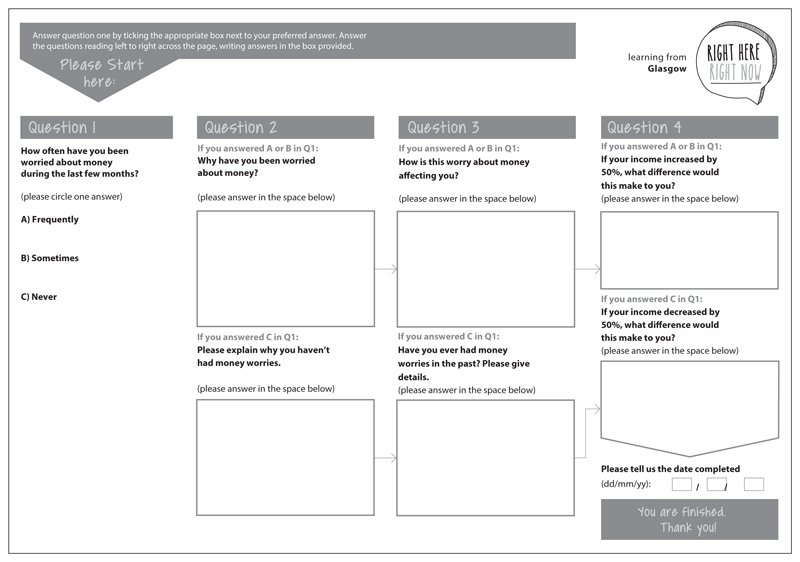
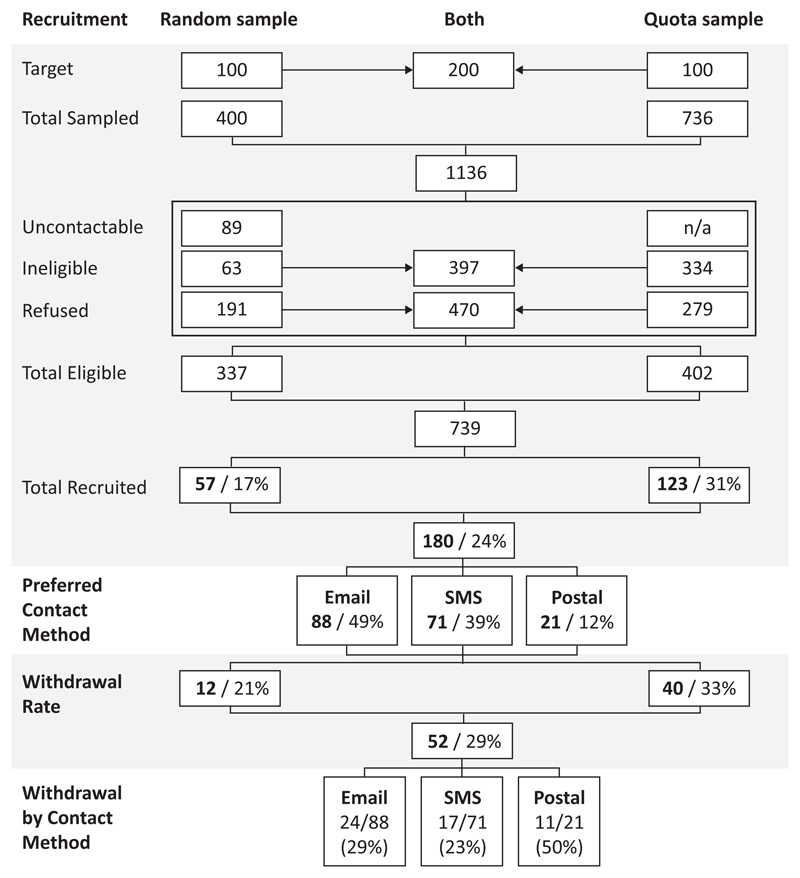
A website was developed to facilitate the issue of questions, data capture and presentation of findings. Respondents were recruited using two distinct methods - a clustered random probability sample, and a quota sample from street stalls. Weekly four-part questions were issued by email, Short Messaging Service (SMS or text) or post. Quantitative data were descriptively summarised, qualitative data thematically analysed, and a summary report circulated two weeks after each question was issued. The pilot spanned 26 weeks.
It proved possible to recruit and retain a panel of respondents providing quantitative and qualitative data on a range of issues. The samples were subject to similar recruitment and response biases as more traditional data-collection approaches. Participants valued the potential to influence change, and stakeholders were enthusiastic about the findings generated, despite reservations about the lack of sample representativeness. Stakeholders acknowledged that decision-making processes are not flexible enough to respond to weekly evidence.
RHRN produced a process for collecting near-real-time data for policy-relevant topics, although obtaining and maintaining representative samples was problematic. Adaptations were identified to inform a more sustainable model of near-real-time data collection and dissemination in the future.
利用最新的健康社会决定因素证据为政策和实践提供信息是一项持续的挑战。传统方法的一个局限性是在确定政策或实践需求与结果可用之间存在时间滞后。“此时此刻”(RHRN)研究试点了一种近实时数据收集过程,以调查这种差距是否可以弥合。
开发了一个网站,以促进问题的提出、数据收集和结果呈现。通过两种不同的方法招募受访者——聚类随机概率样本和街头摊位的配额样本。每周通过电子邮件、短消息服务(SMS或文本)或邮寄方式发布四部分问题。对定量数据进行描述性总结,对定性数据进行主题分析,并在每个问题发布两周后分发一份总结报告。试点为期26周。
事实证明,可以招募并保留一组受访者,他们就一系列问题提供定量和定性数据。这些样本与更传统的数据收集方法存在类似的招募和回应偏差。参与者重视影响变革的潜力,利益相关者对所产生的结果充满热情,尽管对样本缺乏代表性有所保留。利益相关者承认,决策过程不够灵活,无法对每周的证据做出回应。
RHRN产生了一个为与政策相关的主题收集近实时数据的过程,尽管获取和维持具有代表性的样本存在问题。确定了一些调整措施,以便为未来更可持续的近实时数据收集和传播模式提供信息。