Nitecka-Buchta Aleksandra, Walczynska-Dragon Karolina, Batko-Kapustecka Jolanta, Wieckiewicz Mieszko
Department of Temporomandibular Disorders, Unit SMDZ in Zabrze, Medical University of Silesia in Katowice, Traugutta Sq. 2, 41-800 Zabrze, Poland.
Department of Experimental Dentistry, Faculty of Dentistry, Wroclaw Medical University, 26 Krakowska St., 50-425 Wroclaw, Poland.
Pain Res Manag. 2018 Jun 3;2018:8261090. doi: 10.1155/2018/8261090. eCollection 2018.
A novel option for myofascial pain (MFP) management and muscle regeneration is intramuscular collagen injections. The aim of the study was to evaluate the efficiency of intramuscular injections of collagen and lidocaine in decreasing MFP within masseter muscles.
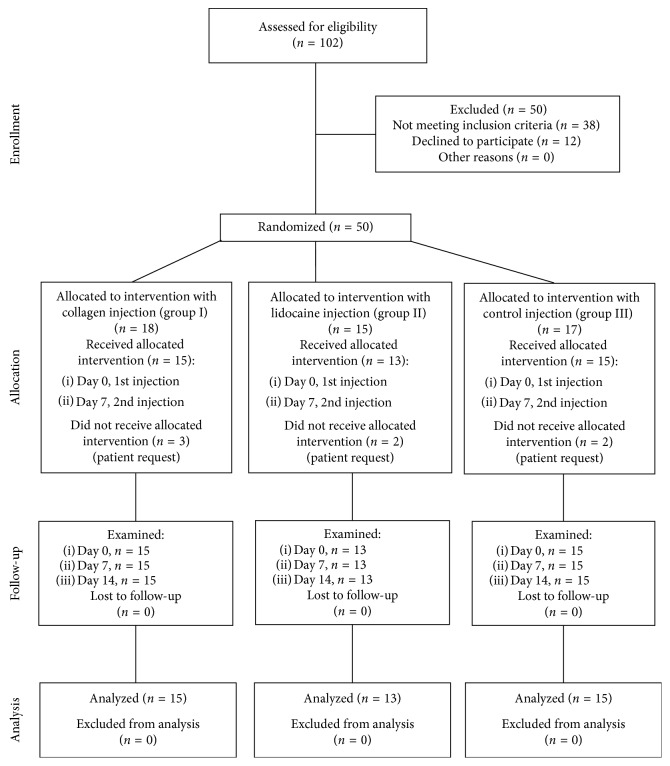
Myofascial pain within masseter muscles was diagnosed on the basis of the Diagnostic Criteria for Temporomandibular Disorders (II.1.A. 2 and 3). A total of 43 patients with diagnosed MFP within masseter muscles were enrolled to the study (17 male and 26 female, 40 ± 3.8 years old) and randomly divided into three groups. The first group received injections using 2 ml of collagen MD Muscle (Guna), the second group received 2 ml of 2% lidocaine without a vasoconstrictor, and the third group 2 ml of saline as a control (0.9% NaCl). All patients received repeated injections at one-week intervals (days 0 and 7). The visual analogue scale was used to determine pain intensity changes during each follow-up visit (days 0, 7, and 14) in each group. The masseter muscle activity was measured on each visit (days 0, 7, and 14) with surface electromyography (sEMG) (Neurobit Optima 4, Neurobit Systems).
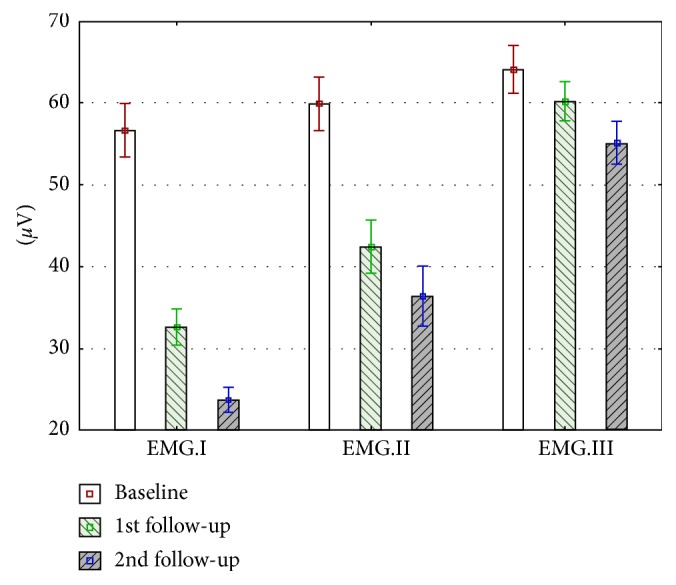
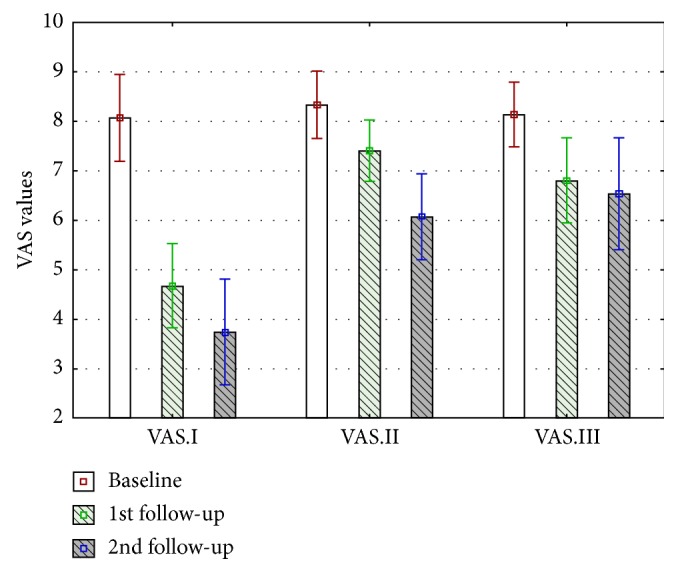
We found that sEMG masseter muscle activity was significantly decreased in Group I (59.2%), less in Group II (39.3%), and least in Group III (14%). Pain intensity reduction was 53.75% in Group I, 25% in Group II, and 20.1% in Group III.
The study confirmed that intramuscular injection of collagen is a more efficient method for reducing myofascial pain within masseter muscles than intramuscular injection of lidocaine.
肌内注射胶原蛋白是一种治疗肌筋膜疼痛(MFP)和促进肌肉再生的新方法。本研究旨在评估肌内注射胶原蛋白和利多卡因减轻咬肌肌筋膜疼痛的效果。
根据颞下颌关节紊乱病诊断标准(II.1.A.2和3)诊断咬肌肌筋膜疼痛。本研究共纳入43例诊断为咬肌肌筋膜疼痛的患者(男17例,女26例,年龄40±3.8岁),随机分为三组。第一组注射2ml胶原蛋白MD Muscle(古纳公司),第二组注射2ml不含血管收缩剂的2%利多卡因,第三组注射2ml生理盐水作为对照(0.9%氯化钠)。所有患者均在第0天和第7天每隔一周重复注射一次。采用视觉模拟评分法确定每组每次随访(第0、7和14天)时疼痛强度的变化。每次随访(第0、7和14天)时,用表面肌电图(sEMG)(Neurobit Optima 4,Neurobit Systems公司)测量咬肌活动。
我们发现,第一组sEMG咬肌活动显著降低(59.2%),第二组降低较少(39.3%),第三组降低最少(14%)。第一组疼痛强度降低53.75%,第二组降低25%,第三组降低20.1%。
该研究证实,肌内注射胶原蛋白比肌内注射利多卡因更有效地减轻咬肌肌筋膜疼痛。