Sundlöv Anna, Gustafsson Johan, Brolin Gustav, Mortensen Nadja, Hermann Rebecca, Bernhardt Peter, Svensson Johanna, Ljungberg Michael, Tennvall Jan, Sjögreen Gleisner Katarina
Oncology and Pathology, Department of Clinical Sciences Lund, Skåne University Hospital, Lund University, Lund, Sweden.
Department of Oncology, Skåne University Hospital, SE-221 85, Lund, Sweden.
EJNMMI Phys. 2018 Jul 5;5(1):12. doi: 10.1186/s40658-018-0210-2.
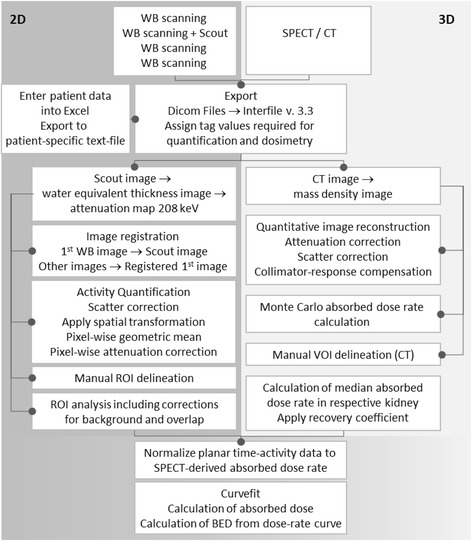
Recently, Lu-dotatate therapy for neuroendocrine tumours has received regulatory approval. Dosimetry can be used to optimize treatment on an individual basis, but there is no international consensus as to how it should be done. The aim of this study is to determine a feasible and accurate dosimetry method to guide individualized peptide receptor radionuclide therapy (PRRT) for patients with neuroendocrine tumours. As part of a clinical trial on Lu-dotatate therapy, renal dosimetry was performed for all patients in each treatment cycle, using a hybrid planar-SPECT/CT method. In the present study, we use the image data acquired from 22 patients and 119 cycles and define a set of alternative treatment planning strategies, each representing a simplification in terms of image acquisition and dosimetric calculations. The results from the simplified strategies are compared to the results from the protocol-prescribed hybrid planar-SPECT/CT-based method by analysing differences both in per-cycle and total cumulative absorbed dose (AD) analyses.
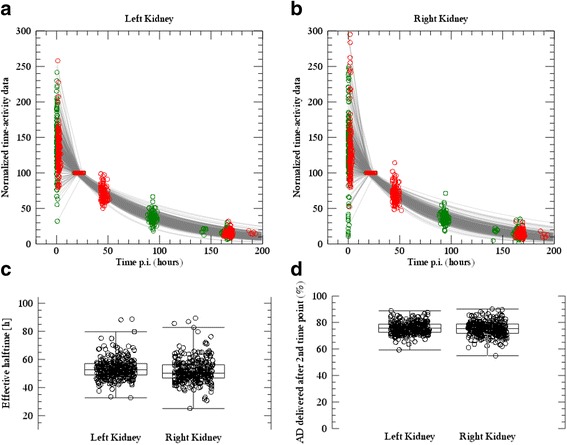
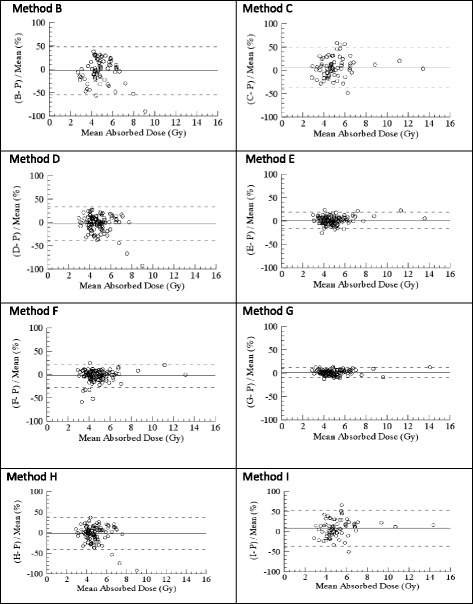
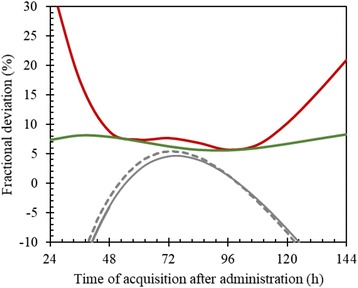
In general, the SPECT-based methods gave results that were largely consistent with the protocol-specified hybrid method, both in the per-cycle and cumulative AD analyses. Notably, performing one SPECT/CT per cycle at 96 h yielded ADs that were very similar to the protocol method. The methods using planar dosimetry resulted in larger variations, as expected, while giving 4 cycles to all patients resulted in the largest inter-individual differences in cumulative AD.
Performing one SPECT/CT at 96 h in every treatment cycle gives sufficiently reliable dosimetric results to base individualized treatment planning on, with a reasonable demand on resources.
最近,镥-奥曲肽治疗神经内分泌肿瘤已获得监管批准。剂量测定可用于根据个体情况优化治疗,但对于应如何进行剂量测定尚无国际共识。本研究的目的是确定一种可行且准确的剂量测定方法,以指导神经内分泌肿瘤患者的个体化肽受体放射性核素治疗(PRRT)。作为镥-奥曲肽治疗临床试验的一部分,在每个治疗周期对所有患者进行肾脏剂量测定,采用平面-SPECT/CT混合方法。在本研究中,我们使用从22例患者和119个周期获取的图像数据,定义了一组替代治疗计划策略,每个策略在图像采集和剂量计算方面都代表了一种简化。通过分析每个周期和总累积吸收剂量(AD)分析中的差异,将简化策略的结果与基于方案规定的平面-SPECT/CT方法的结果进行比较。
总体而言,基于SPECT的方法在每个周期和累积AD分析中得出的结果与方案规定的混合方法基本一致。值得注意的是,在96小时时每个周期进行一次SPECT/CT所得到的AD与方案方法非常相似。正如预期的那样,使用平面剂量测定的方法产生了更大的差异,而对所有患者给予4个周期的治疗导致累积AD的个体间差异最大。
在每个治疗周期的96小时进行一次SPECT/CT可提供足够可靠的剂量测定结果,以便基于此进行个体化治疗计划,且对资源的需求合理。