Health and Wellbeing, Sheffield Hallam University, Sheffield United Kingdom.
School of Social and Community Medicine, University of Bristol, Bristol United Kingdom.
PLoS One. 2018 Jul 5;13(7):e0197606. doi: 10.1371/journal.pone.0197606. eCollection 2018.
National guidelines (NICE-CG175) recommended 12 weeks of supervised exercise training for men treated with androgen deprivation therapy (ADT) for prostate cancer to counter debilitating adverse effects of castration. As with other chronic conditions where exercise is indicated, it is uncertain if these services are being delivered in the health services. The aim of this multi-centre investigation was to examine what exercise referral is currently available for men on ADT as provided by the NHS and if a supervised, individually-tailored exercise training package (as per the national NICE guidelines CG175) is embedded within prostate cancer care.
A multi-centre investigation of current National Health Service (NHS) care involving a web-based survey of NHS prostate cancer care, five focus groups involving 26 men on ADT and 37 semi-structured interviews with healthcare professionals (HCPs) involved in the management of prostate cancer. Descriptive statistics and thematic analysis evaluated quantitative and qualitative data, respectively. Qualitative methods followed COREQ standards.
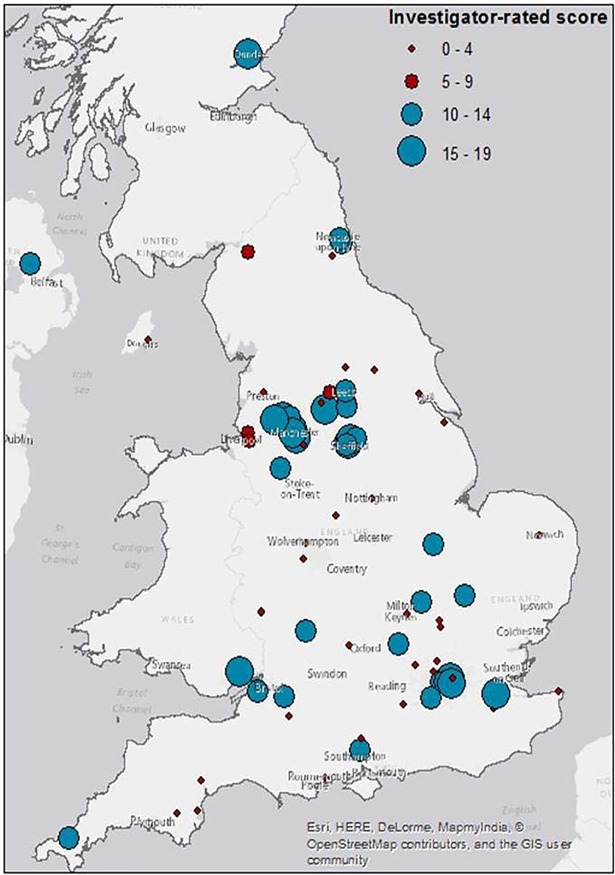
HCPs and men on ADT asserted that medical castration has a serious and debilitating impact on many features of men's quality of life. There is support for exercise training programmes as part of cancer care and patients would support their initiation soon after diagnosis. Involving the Multidisciplinary Team (MDT) is proposed as key to this. Critically, traditional values in oncology would need to be overcome for widespread acceptance. Specialist further training for HCPs around behaviour change support could encourage this. Given that these schemes are seen as a fundamental part of cancer care, it is felt the NHS should commission and support provision. 79 representatives of 154 NHS trusts (51%) provided survey data on current delivery: only 17% could provide supervised exercise as per CG175.
Evidence-based national exercise guidelines are not being delivered to men on ADT as intended. Traditional values in oncology and the need for NHS financial support are seen as major barriers to provision of current best practice guidelines. Despite this both HCPs and men on ADT are in favour of such programmes being a fundamental part of their cancer care.
国家指南(NICE-CG175)建议对接受雄激素剥夺疗法(ADT)治疗前列腺癌的男性进行 12 周的监督运动训练,以对抗去势的衰弱性不良反应。与其他需要运动的慢性疾病一样,尚不确定卫生服务是否提供了这些服务。本多中心研究的目的是检查 NHS 目前为接受 ADT 的男性提供的运动转介服务,以及是否在前列腺癌护理中嵌入了经过监督的、个体化定制的运动训练方案(如 NICE 指南 CG175 所述)。
这是一项涉及 NHS 前列腺癌护理的基于网络的调查的多中心研究,调查了 NHS 目前的护理情况,包括对接受 ADT 的 26 名男性进行了 5 个焦点小组访谈和对参与前列腺癌管理的 37 名医疗保健专业人员(HCP)进行了 37 次半结构访谈。描述性统计和主题分析分别评估了定量和定性数据。定性方法遵循 COREQ 标准。
HCP 和接受 ADT 的男性都认为医学去势对男性生活质量的许多方面都有严重的、衰弱的影响。人们支持将运动训练计划作为癌症护理的一部分,并且患者会支持在诊断后不久开始进行运动训练。有人提议让多学科团队(MDT)参与其中是关键。至关重要的是,需要克服肿瘤学中的传统价值观才能被广泛接受。为 HCP 提供有关行为改变支持的专业进一步培训可能会鼓励这种做法。鉴于这些方案被视为癌症护理的基本组成部分,人们认为 NHS 应该委托并支持这些方案的提供。154 个 NHS 信托的 79 名代表(51%)提供了关于当前服务提供情况的调查数据:只有 17%的信托能够按照 CG175 提供监督运动。
依据循证的国家运动指南并没有按照预期提供给接受 ADT 的男性。肿瘤学中的传统价值观和 NHS 资金支持的需求被认为是提供当前最佳实践指南的主要障碍。尽管如此,HCP 和接受 ADT 的男性都赞成将这些方案作为其癌症护理的基本组成部分。