Institute of Multiphase Processes, Leibniz Universität Hannover, Hannover, Germany.
Unit for Reproductive Medicine, Clinic for Horses, University of Veterinary Medicine Hannover, Hannover, Germany.
PLoS One. 2018 Jul 5;13(7):e0199867. doi: 10.1371/journal.pone.0199867. eCollection 2018.
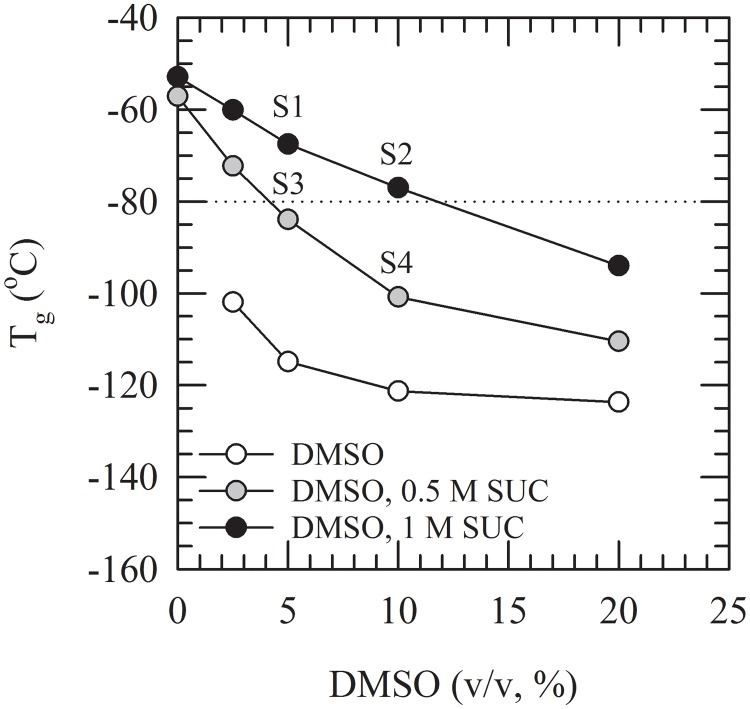
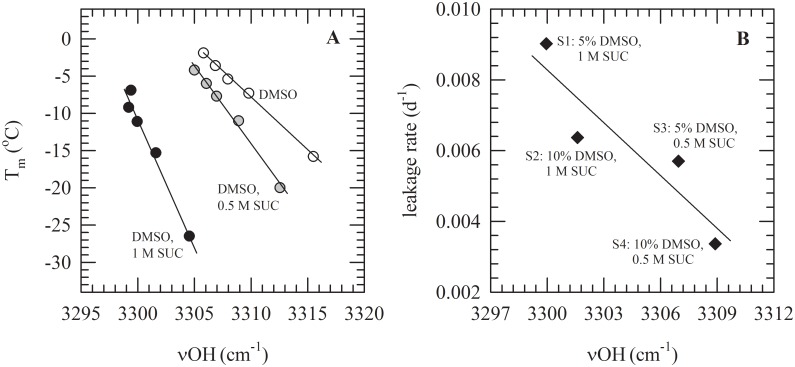
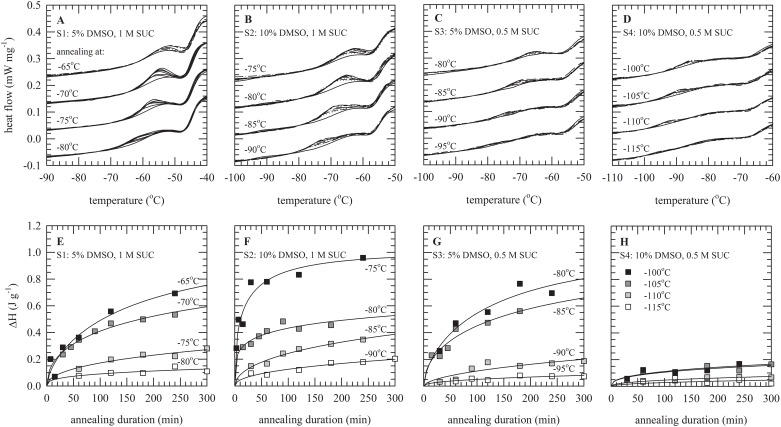
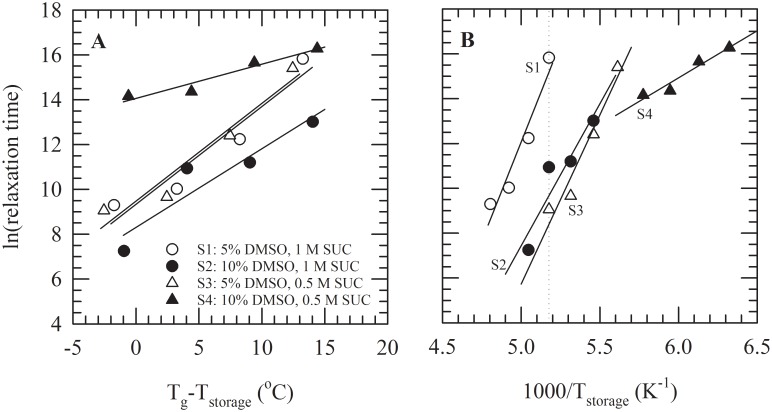
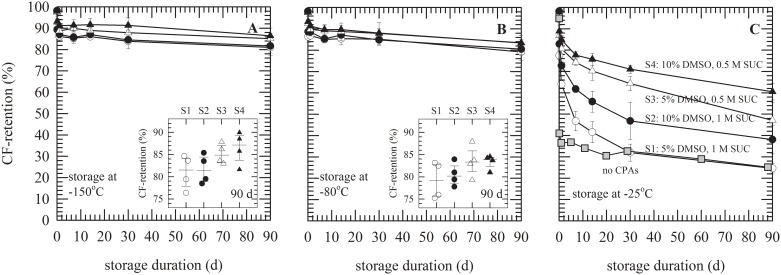
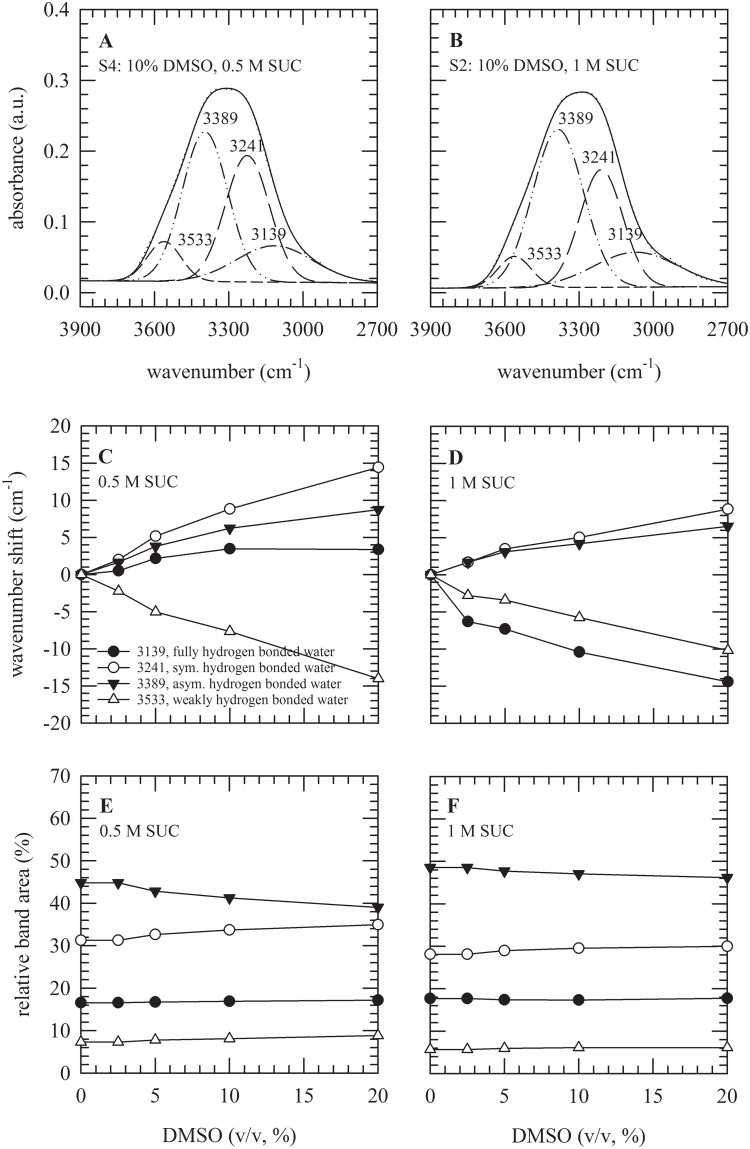
Cryopreservation of biological materials is predominantly done using liquid nitrogen, and its application involves high maintenance costs and the need for periodical refilling of liquid nitrogen. Stable storage in mechanical freezers at -80°C would eliminate these issues and allow for shipment of frozen specimens using dry ice. In this work, the possibility of increasing the storage temperature of cryopreserved samples to -80°C by using combinations of DMSO and sucrose has been studied. Preservation efficacy was studied by measuring stability of liposomes encapsulated with carboxyfluorescein during storage at -150, -80 and -25°C for up to three months. Thermal and molecular mobility properties of the different DMSO-sucrose formulations were measured using differential scanning calorimetry, whereas hydrogen bonding interactions of the formulations were probed by Fourier transform infrared spectroscopy. It was found that addition of sucrose to DMSO solutions increases the Tg, and decreases molecular mobility in the glassy state at a particular temperature. Although it was expected that storage above or close to Tg at -80°C would affect liposome stability, stability was found to be similar compared to that of samples stored at -150°C. Higher molecular mobility in the glassy state could not be associated with faster CF-leakage rates. Distinct differences in storage stability at -25°C, far above Tg, were found among the sucrose/DMSO formulations, which were explained by the differences in permeability of sucrose and DMSO resulting in different levels of osmotic stress in the formulations.
生物材料的冷冻保存主要使用液氮进行,其应用涉及高维护成本和定期补充液氮的需求。在-80°C 的机械冷冻器中稳定储存可以解决这些问题,并允许使用干冰运输冷冻标本。在这项工作中,通过使用 DMSO 和蔗糖的组合,研究了将冷冻保存样品的储存温度提高到-80°C 的可能性。通过测量在-150、-80 和-25°C 下储存长达三个月的包封有羧基荧光素的脂质体的稳定性来研究保存效果。使用差示扫描量热法测量了不同 DMSO-蔗糖配方的热和分子迁移特性,而通过傅里叶变换红外光谱探测了配方的氢键相互作用。结果发现,在 DMSO 溶液中添加蔗糖会增加 Tg,并在特定温度下降低玻璃态中的分子迁移率。虽然预计在高于或接近-80°C 的 Tg 下储存会影响脂质体的稳定性,但发现其稳定性与在-150°C 下储存的样品相似。在玻璃态中较高的分子迁移率不能与更快的 CF 泄漏率相关联。在-25°C 下(远高于 Tg),蔗糖/DMSO 配方之间发现了明显的储存稳定性差异,这可以通过蔗糖和 DMSO 的渗透率差异来解释,这导致配方中存在不同水平的渗透压力。