a Department of Molecular Biosciences , Northwestern University , Evanston , IL , USA.
Cell Cycle. 2018;17(11):1345-1357. doi: 10.1080/15384101.2018.1480226. Epub 2018 Jul 25.
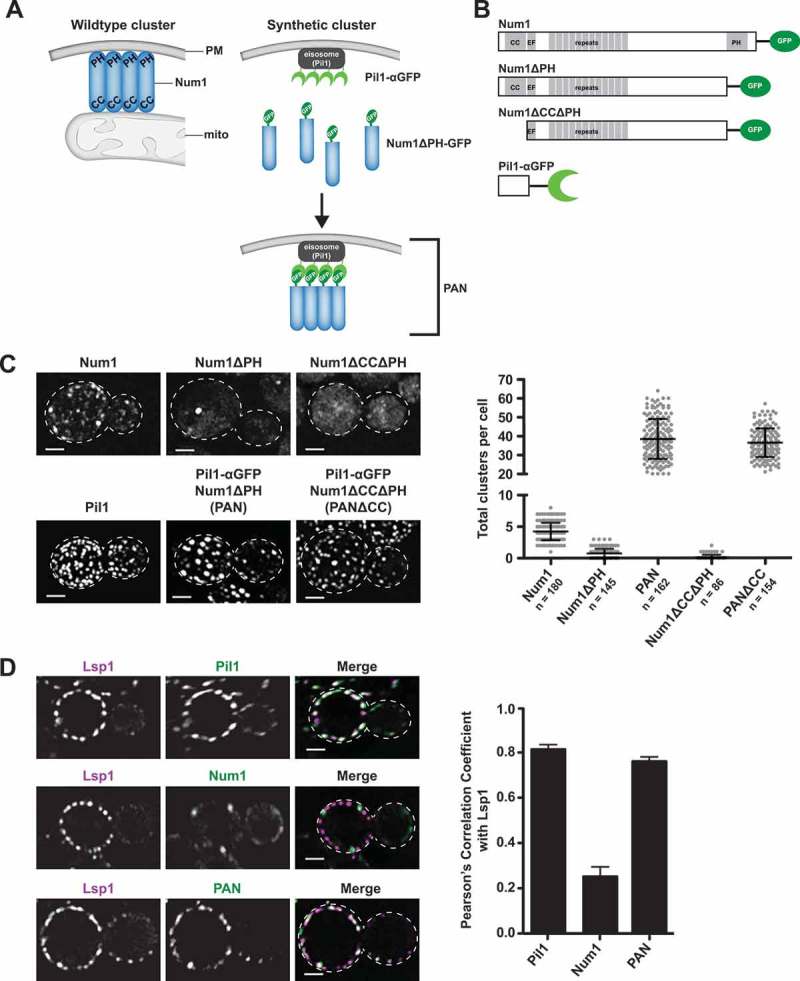
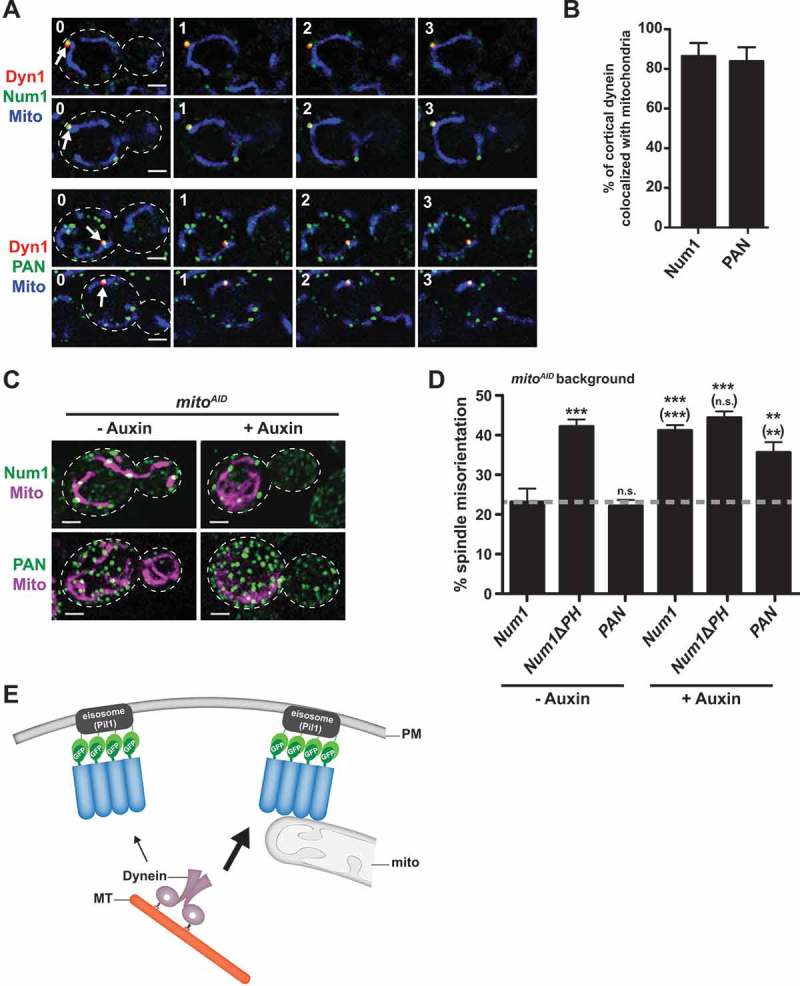
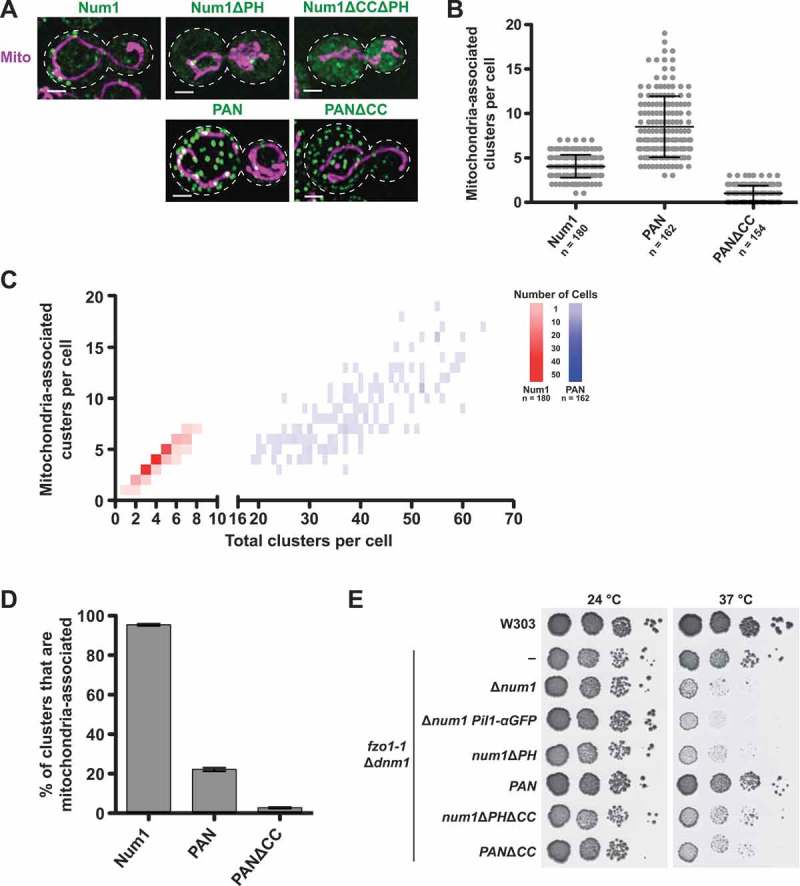
Organelle distribution is regulated over the course of the cell cycle to ensure that each of the cells produced at the completion of division inherits a full complement of organelles. In yeast, the protein Num1 functions in the positioning and inheritance of two essential organelles, mitochondria and the nucleus. Specifically, Num1 anchors mitochondria as well as dynein to the cell cortex, and this anchoring activity is required for proper mitochondrial distribution and dynein-mediated nuclear inheritance. The assembly of Num1 into clusters at the plasma membrane is critical for both of its anchoring functions. We have previously shown that mitochondria drive the assembly of Num1 clusters and that these mitochondria-assembled Num1 clusters serve as cortical attachment sites for dynein. Here we further examine the role for mitochondria in dynein anchoring. Using a GFP-αGFP nanobody targeting system, we synthetically clustered Num1 on eisosomes to bypass the requirement for mitochondria in Num1 cluster formation. Utilizing this system, we found that mitochondria positively impact the ability of synthetically clustered Num1 to anchor dynein and support dynein function even when mitochondria are no longer required for cluster formation. Thus, the role of mitochondria in regulating dynein function extends beyond simply concentrating Num1; mitochondria likely promote an arrangement of Num1 within a cluster that is competent for dynein anchoring. This functional dependency between mitochondrial and nuclear positioning pathways likely serves as a mechanism to order and integrate major cellular organization systems over the course of the cell cycle.
细胞器的分布在细胞周期中受到调控,以确保细胞分裂完成后产生的每个细胞都继承了完整的细胞器。在酵母中,蛋白质 Num1 在线粒体和细胞核这两个必需细胞器的定位和遗传中发挥作用。具体来说,Num1 将线粒体和动力蛋白锚定在细胞膜皮层上,这种锚定活性对于线粒体的正确分布和动力蛋白介导的核遗传是必需的。Num1 在质膜上组装成簇对于其两种锚定功能都至关重要。我们之前已经表明,线粒体驱动 Num1 簇的组装,并且这些线粒体组装的 Num1 簇作为动力蛋白的皮层附着位点。在这里,我们进一步研究了线粒体在动力蛋白锚定中的作用。使用针对 GFP-αGFP 纳米体的靶向系统,我们在端位体上合成地聚集 Num1,以绕过线粒体在 Num1 簇形成中的作用。利用这个系统,我们发现线粒体可以积极影响合成的聚集 Num1 锚定动力蛋白的能力,并支持动力蛋白的功能,即使线粒体不再需要形成簇。因此,线粒体在调节动力蛋白功能方面的作用不仅局限于集中 Num1;线粒体可能促进了 Num1 簇内的一种排列方式,使其能够与动力蛋白锚定。线粒体和核定位途径之间的这种功能依赖性可能是在细胞周期中对主要细胞组织系统进行排序和整合的一种机制。