Aga Khan University Hospital (AKUH), Karachi, Pakistan.
French Medical Institute for Mothers and Children (FMIC), Kabul, Afghanistan.
World J Surg Oncol. 2018 Jul 5;16(1):129. doi: 10.1186/s12957-018-1429-z.
Pakistan's population is ethnically diverse with distinct ethnic groups inhabiting various parts of the country. Cancer statistics obtained from specific regions populated by distinct ethnic groups may vary considerably. There is no national cancer registry. To determine whether there are indeed significant statistical differences in cancer incidence and prevalence, data was recorded from different parts of Pakistan based on the ethnic composition of the population in those parts.
Ten papers (original articles) on cancer incidence and prevalence in Pakistan published in the last two decades were selected from PubMed and Google Scholar. Meta-analysis of findings of these studies was performed using Meta-analysis of Observational Studies in Epidemiology (MOOSE) checklist. χ-based I test was used for evaluating heterogeneity and Forest plots were generated for calculating unadjusted prevalence estimates. Oral, gastric, prostate, breast, and colorectal cancers were selected for meta-analysis. I values of 75% or greater indicated high heterogeneity.
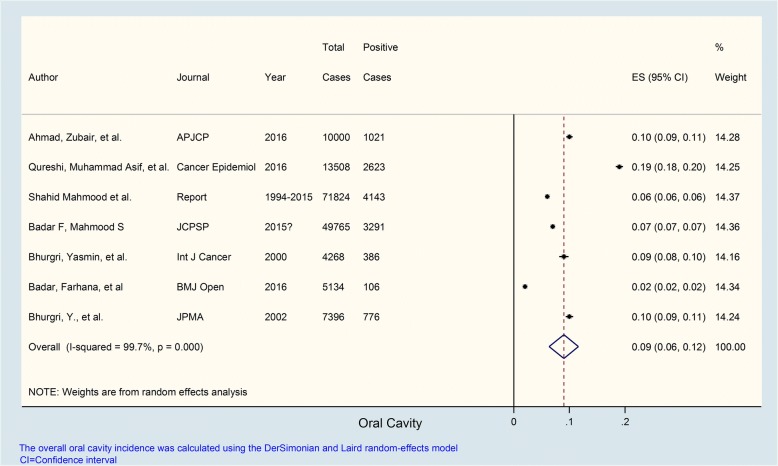
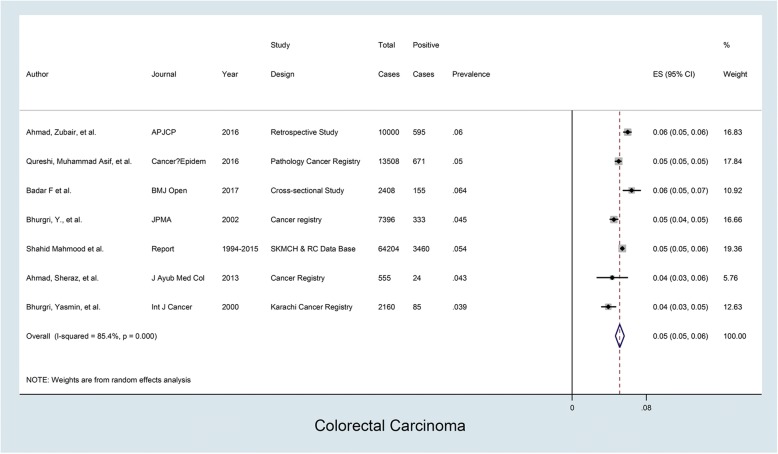
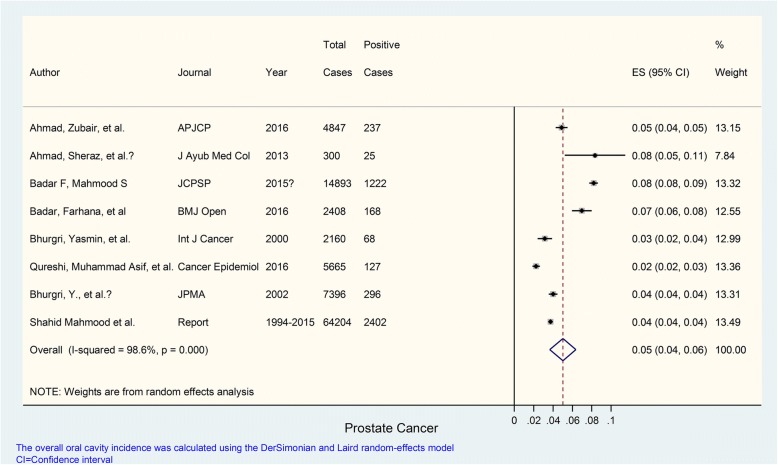
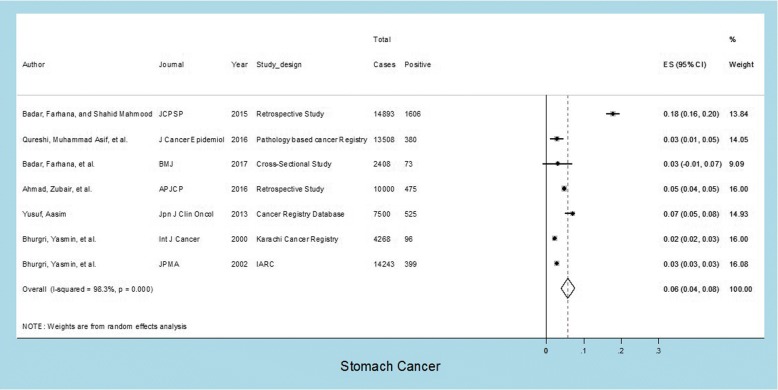
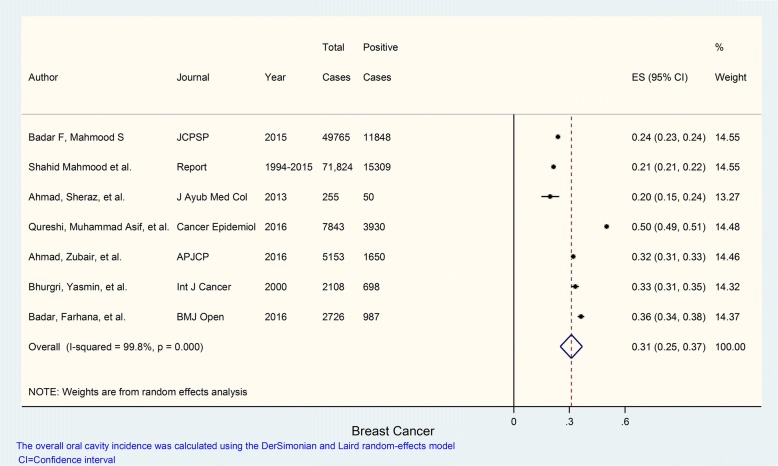
All five types of cancer selected for meta-analysis (performed on studies carrying similar statistical weights) showed extremely high heterogeneity with I values of 99.7% for oral cancer, 98.6% for prostate cancer, 98.3% for gastric cancer, 99.8% for breast cancer, and 85.4% for colorectal cancer. p values for all cancers were highly statistically significant.
Our findings show that the prevalence rates of different cancer types demonstrate marked variation in different studies depending on the place of origin of the study and dominant ethnic group in that region, and these variations are highly statistically significant. A national cancer registry needs to be established as soon as possible.
巴基斯坦人口种族多样,不同的种族群体居住在该国的不同地区。来自特定地区(由不同种族群体居住)的癌症统计数据可能存在较大差异。巴基斯坦没有国家癌症登记处。为了确定癌症发病率和患病率是否确实存在显著的统计差异,我们根据这些地区的人口种族构成,从巴基斯坦的不同地区记录数据。
从 PubMed 和 Google Scholar 中选择了过去二十年发表的十篇关于巴基斯坦癌症发病率和患病率的论文(原始文章)。使用观察性研究的荟萃分析(MOOSE)清单对这些研究的结果进行荟萃分析。使用 χ 基于检验评估异质性,并生成森林图以计算未经调整的患病率估计值。选择口腔癌、胃癌、前列腺癌、乳腺癌和结直肠癌进行荟萃分析。I 值为 75%或更高表示高度异质性。
我们选择进行荟萃分析的所有五种癌症(对具有相似统计权重的研究进行分析)都表现出极高的异质性,口腔癌的 I 值为 99.7%,前列腺癌的 I 值为 98.6%,胃癌的 I 值为 98.3%,乳腺癌的 I 值为 99.8%,结直肠癌的 I 值为 85.4%。所有癌症的 p 值均具有统计学意义。
我们的研究结果表明,不同癌症类型的患病率在不同研究中存在显著差异,具体取决于研究的来源地和该地区的主要种族群体,这些差异具有统计学意义。需要尽快建立国家癌症登记处。