Shaffer Ashton A, Durand Christine M
Department of Surgery, Johns Hopkins University School of Medicine, Baltimore, MD.
Department of Epidemiology, Johns Hopkins School of Public Health, Baltimore, MD.
Curr Treat Options Infect Dis. 2018 Mar;10(1):107-120. doi: 10.1007/s40506-018-0144-1. Epub 2018 Mar 5.
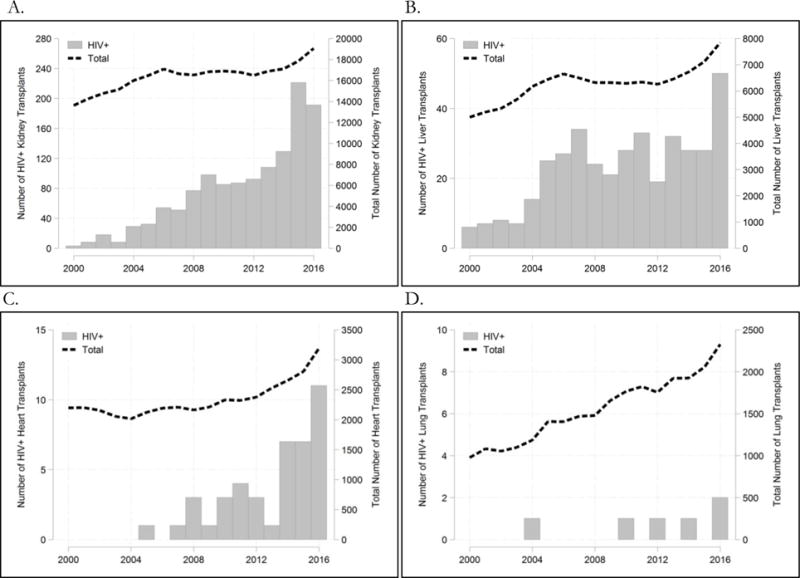
The prevalence of end-stage organ disease is increasing among HIV-infected (HIV+) individuals. Individuals with well-controlled HIV on antiretroviral therapy (ART), without active opportunistic infections or cancer, and with specified minimum CD4 cell counts are appropriate transplant candidates. Infectious disease clinicians can improve access to transplantation for these patients and optimize management pre- and post-transplant.
Clinical trials and registry-based studies demonstrate excellent outcomes for select HIV+ kidney and liver transplant recipients with similar patient and graft survival as HIV-uninfected patients. Elevated allograft rejection rates have been observed in HIV+ individuals; this may be related to a dysregulated immune system or drug interactions. Lymphocyte-depleting immunosuppression has been associated with lower rejection rates without increased infections using national registry data. Hepatitis C virus (HCV) coinfection has been associated with worse outcomes, however improvements are expected with direct-acting antivirals.
Solid organ transplantation should be considered for HIV+ individuals with end-stage organ disease. Infectious disease clinicians can optimize ART to avoid pharmacoenhancers, which interact with immunosuppression. The timing of HCV treatment (pre- or post-transplant) should be discussed with the transplant team. Finally, organs from HIV+ donors can now be considered for HIV+ transplant candidates, within research protocols.
在感染人类免疫缺陷病毒(HIV)的个体中,终末期器官疾病的患病率正在上升。接受抗逆转录病毒治疗(ART)且HIV得到良好控制、无活动性机会性感染或癌症且CD4细胞计数达到特定最低水平的个体是合适的移植候选人。传染病临床医生可以改善这些患者获得移植的机会,并优化移植前后的管理。
临床试验和基于登记处的研究表明,部分HIV阳性的肾移植和肝移植受者的预后良好,其患者和移植物存活率与未感染HIV的患者相似。在HIV阳性个体中观察到移植排斥率升高;这可能与免疫系统失调或药物相互作用有关。使用国家登记数据显示,淋巴细胞清除免疫抑制与较低的排斥率相关,且感染率未增加。丙型肝炎病毒(HCV)合并感染与较差的预后相关,不过预计直接作用抗病毒药物会带来改善。
对于患有终末期器官疾病的HIV阳性个体,应考虑进行实体器官移植。传染病临床医生可以优化ART,以避免使用与免疫抑制相互作用的药物增强剂。应与移植团队讨论HCV治疗的时机(移植前或移植后)。最后,在研究方案范围内,现在可以考虑将来自HIV阳性供体的器官用于HIV阳性移植候选人。