Lindenschot Marieke, de Groot Imelda J M, Koene Saskia, Satink Ton, Steultjens Esther M J, Nijhuis-van der Sanden Maria W G
Department IQ Healthcare, Research Institute for Health Sciences, Radboud University Medical Center Nijmegen, Postbus 9101, 6500 HB Nijmegen, Netherlands.
Department of Occupational Therapy, HAN University of Applied Sciences, Postbus 6960, 6503 GL Nijmegen, Netherlands.
Occup Ther Int. 2018 Jun 6;2018:5716947. doi: 10.1155/2018/5716947. eCollection 2018.
Engagement in everyday activities is important for the health and wellbeing of children. Children with mitochondrial disorders have impaired energy production leading to limitations in activity. It is unknown which activities these children perform and if the nature of activities of low-functioning children differs from average-functioning children. Therefore, this pilot study explored the activities reported in patient records of a heterogeneous group of children with genetically confirmed mitochondrial disorders.
A retrospective qualitative directed content analysis by health care professionals reported activities (as part of their professional reasoning obligations) in hospital patient records of children with mitochondrial disorder.
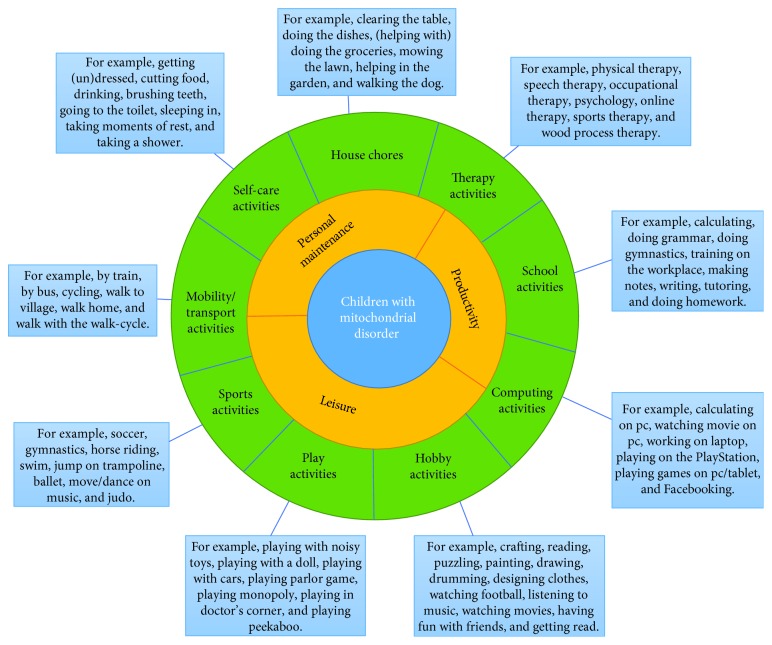
Seventeen patient records, presenting notes on capacities and performed activities, showed an overview of everyday activities that covered the categories: self-care, house chores, therapy, school, computing, hobby, play, sports, and mobility/transport. The activity categories of low-functioning children did not differ from average-functioning children, although descriptions of specific activities differed between groups.
This pilot exploration indicates that the types of activities that children with mitochondrial disorders perform are not necessarily linked to the child's impairments. However, differences in levels of independence, assistive device usage, and energy costs seem to exist. Future research should address the child's perspective on, and meaning of, activity performances.
参与日常活动对儿童的健康和幸福至关重要。线粒体疾病患儿的能量产生受损,导致活动受限。目前尚不清楚这些儿童进行哪些活动,以及功能低下儿童的活动性质是否与功能正常儿童不同。因此,这项试点研究探讨了一组经基因确诊的线粒体疾病患儿的病历中所报告的活动。
医疗保健专业人员对线粒体疾病患儿的医院病历进行回顾性定性定向内容分析,报告活动情况(作为其专业推理义务的一部分)。
17份病历记录了能力和所进行的活动,展示了日常活动的概况,涵盖以下类别:自我护理、家务、治疗、学校活动、计算机操作、爱好、玩耍、运动以及移动/交通。功能低下儿童的活动类别与功能正常儿童并无差异,尽管两组之间具体活动的描述有所不同。
这项试点探索表明,线粒体疾病患儿所进行的活动类型不一定与患儿的损伤相关。然而,在独立程度、辅助设备使用和能量消耗方面似乎存在差异。未来的研究应关注儿童对活动表现的看法及其意义。