Alavi Sara, Stewart Ashleigh Jacqueline, Kefford Richard F, Lim Su Yin, Shklovskaya Elena, Rizos Helen
Department of Biomedical Sciences, Faculty of Medicine and Health Sciences, Macquarie University, Sydney, NSW, Australia.
Melanoma Institute Australia, Sydney, NSW, Australia.
Front Immunol. 2018 Jun 21;9:1414. doi: 10.3389/fimmu.2018.01414. eCollection 2018.
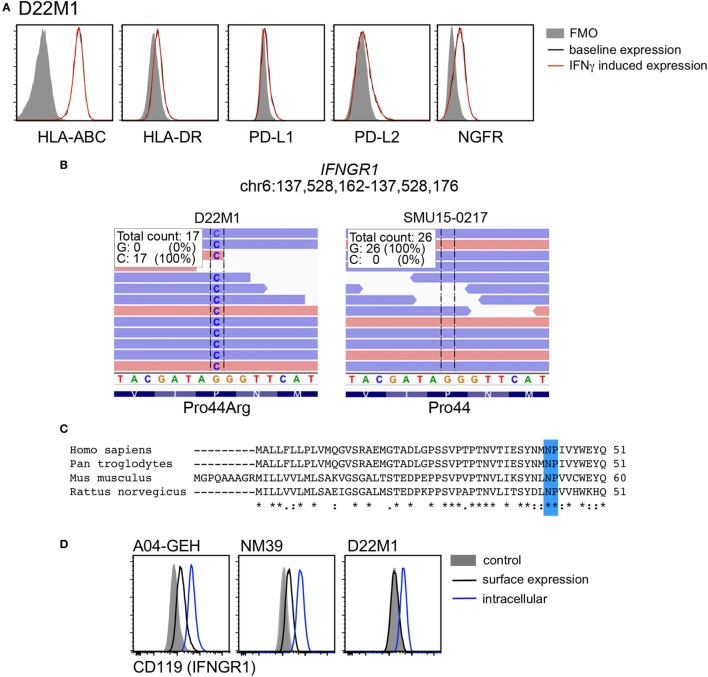
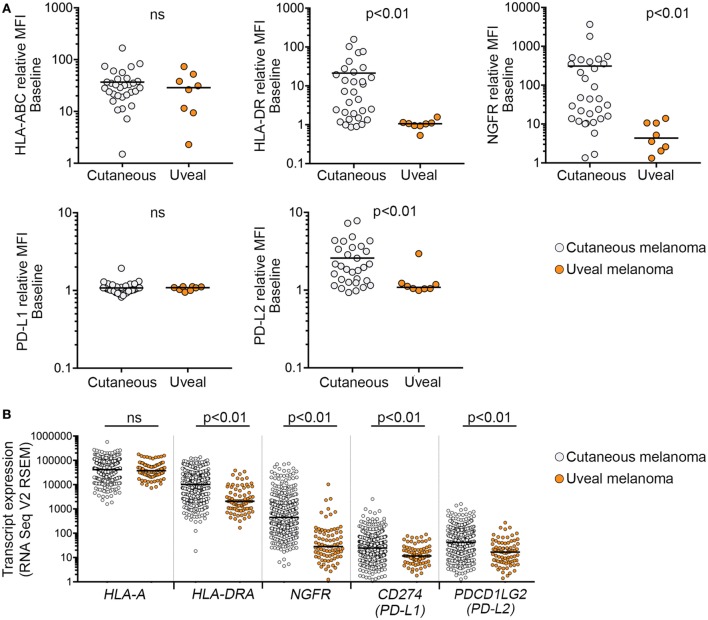
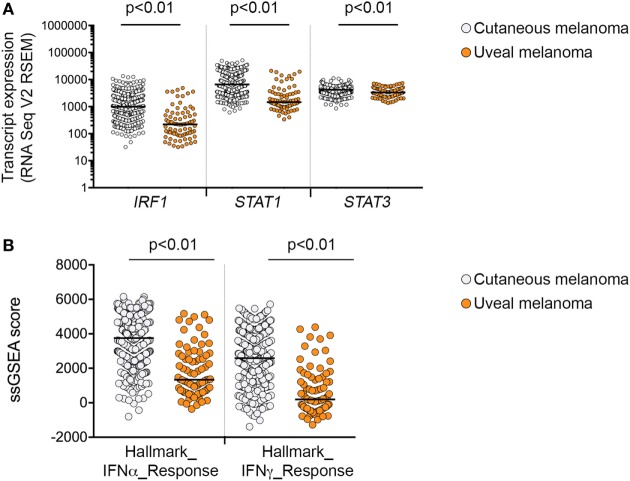
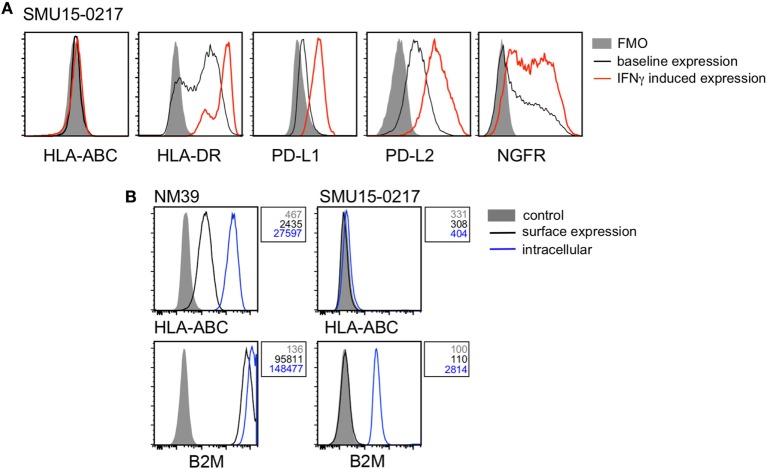
Immune checkpoint inhibitors that block the programmed cell death protein 1/PD-L1 pathway have significantly improved the survival of patients with advanced melanoma. Immunotherapies are only effective in 15-40% of melanoma patients and resistance is associated with defects in antigen presentation and interferon signaling pathways. In this study, we examined interferon-γ (IFNγ) responses in a large panel of immune checkpoint inhibitor-naïve melanoma cells with defined genetic drivers; -mutant ( = 11), -mutant ( = 10), wild type ( = 10), and -mutant uveal melanomas (UVMs) ( = 8). Cell surface expression of established IFNγ downstream targets PD-L1, PD-L2, HLA-A, -B, and -C, HLA-DR, and nerve growth factor receptor (NGFR) were analyzed by flow cytometry. Basal cellular expression levels of HLA-A, -B, -C, HLA-DR, NGFR, and PD-L2 predicted the levels of IFNγ-stimulation, whereas PD-L1 induction was independent of basal expression levels. Only 13/39 (33%) of the melanoma cell lines tested responded to IFNγ with potent induction of all targets, indicating that downregulation of IFNγ signaling is common in melanoma. In addition, we identified two well-recognized mechanisms of immunotherapy resistance, the loss of β-2-microglobulin and interferon gamma receptor 1 expression. We also examined the influence of melanoma driver oncogenes on IFNγ signaling and our data suggest that UVM have diminished capacity to respond to IFNγ, with lower induced expression of several targets, consistent with the disappointing response of UVM to immunotherapies. Our results demonstrate that melanoma responses to IFNγ are heterogeneous, frequently downregulated in immune checkpoint inhibitor-naïve melanoma and potentially predictive of response to immunotherapy.
阻断程序性细胞死亡蛋白1/PD-L1通路的免疫检查点抑制剂显著提高了晚期黑色素瘤患者的生存率。免疫疗法仅对15%-40%的黑色素瘤患者有效,而耐药性与抗原呈递和干扰素信号通路缺陷有关。在本研究中,我们检测了一大组未接受过免疫检查点抑制剂治疗、具有明确基因驱动因素的黑色素瘤细胞中的干扰素-γ(IFNγ)反应;BRAF突变(n = 11)、NRAS突变(n = 10)、野生型(n = 10)和GNAQ突变葡萄膜黑色素瘤(UVM)(n = 8)。通过流式细胞术分析了已确定的IFNγ下游靶点PD-L1、PD-L2、HLA-A、-B和-C、HLA-DR以及神经生长因子受体(NGFR)的细胞表面表达。HLA-A、-B、-C、HLA-DR、NGFR和PD-L2的基础细胞表达水平可预测IFNγ刺激水平,而PD-L1的诱导与基础表达水平无关。在测试的39个黑色素瘤细胞系中,只有13个(33%)对IFNγ有反应,所有靶点均有强力诱导,这表明IFNγ信号下调在黑色素瘤中很常见。此外,我们确定了两种公认的免疫疗法耐药机制——β-2-微球蛋白和干扰素γ受体1表达缺失。我们还研究了黑色素瘤驱动癌基因对IFNγ信号的影响,我们的数据表明UVM对IFNγ的反应能力减弱,几个靶点的诱导表达较低,这与UVM对免疫疗法的令人失望的反应一致。我们的结果表明,黑色素瘤对IFNγ的反应是异质性的,在未接受过免疫检查点抑制剂治疗的黑色素瘤中经常下调,并且可能预测对免疫疗法的反应。