Abdelgadir Elamin, Rashid Fauzia, Bashier Alaaeldin, Ali Razan
Dubai Hospital, Dubai, UAE.
J Clin Med Res. 2018 Aug;10(8):615-625. doi: 10.14740/jocmr3467w. Epub 2018 Jun 27.
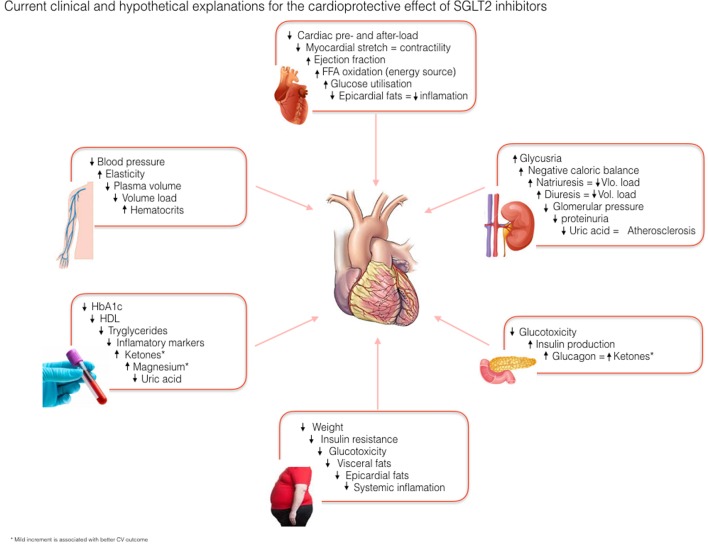
Landmark trials on diabetes control have shown variable results in terms of cardiovascular benefits, with the majority showing a favorable effect of glycemic control on microvascular and, more recently, macrovascular complications. However, some trials pointed out a CV hazard with tight diabetes mellitus (DM) control. Most of those trials were assessing the impact of glycemic control, more than evaluating the effect of a certain medication. In the last decade, food and drugs administration (FDA) has mandated that all new hypoglycemic agents run a CV outcome trial (CVOT) for safety in order to grant and sustain approval. The most stunning results came from relatively new agents in the field of diabetes management, sodium-glucose cotransporter-2 inhibitors (SGLT2i) and the glucagon-like peptide-1 agonists (GLP-1 agonists), details of these CVOTs will be addressed later in this document. SGLT2i effect on the cardiovascular system remains an area of extensive research. We aimed in this review to summarize what is the current evidence of cardiovascular protection upon using SGLT2i. Moreover, we wanted to raise a point that may be strongly adopted in the future, combining SGLT2i plus GLP-1 agonists, having a cardiovascular privilege in both molecules.
关于糖尿病控制的里程碑式试验在心血管益处方面显示出不同的结果,大多数试验表明血糖控制对微血管并发症有积极影响,最近对大血管并发症也有积极影响。然而,一些试验指出严格控制糖尿病(DM)存在心血管风险。这些试验大多评估的是血糖控制的影响,而不是某种药物的效果。在过去十年中,美国食品药品监督管理局(FDA)要求所有新型降糖药物进行心血管结局试验(CVOT)以确保安全性,从而获得并维持批准。最令人震惊的结果来自糖尿病管理领域相对较新的药物,即钠-葡萄糖协同转运蛋白2抑制剂(SGLT2i)和胰高血糖素样肽-1激动剂(GLP-1激动剂),这些CVOT的详细情况将在本文后面阐述。SGLT2i对心血管系统的影响仍是一个广泛研究的领域。在本综述中,我们旨在总结使用SGLT2i时心血管保护的现有证据。此外,我们想提出一个未来可能会被大力采用的观点,即联合使用SGLT2i和GLP-1激动剂,这两种药物在心血管方面都有优势。